Medical Assistant vs. Esthetician: Which Career Fits You?
If you’re weighing a medical assistant vs esthetics career, both are legitimate paths — but they lead to very different daily realities, earning timelines, and long-term opportunities. This guide breaks down what each role actually looks like, what training costs in Virginia, and how to figure out which path fits your goals — including a faster, more affordable option most people never consider.
Key Takeaways
- Virginia requires no state license for medical assistants — certification is voluntary but employer-preferred
- Virginia esthetics licensure requires 600 clock hours of accredited training
- Medical assistant programs typically run 9–12 months and cost $10,000–$20,000
- AVI Career Training’s esthetics and laser programs offer faster timelines with competitive tuition in Northern Virginia
- Medical estheticians in the DC metro area work in med spas, dermatology offices, and plastic surgery clinics — earning well above traditional spa rates
Choosing the wrong path costs you time and money. Choosing the right one can launch a career you genuinely love. Let’s get into it.
Explore AVI’s Esthetics & Laser Programs →
—
What Does a Medical Assistant Actually Do Day-to-Day?
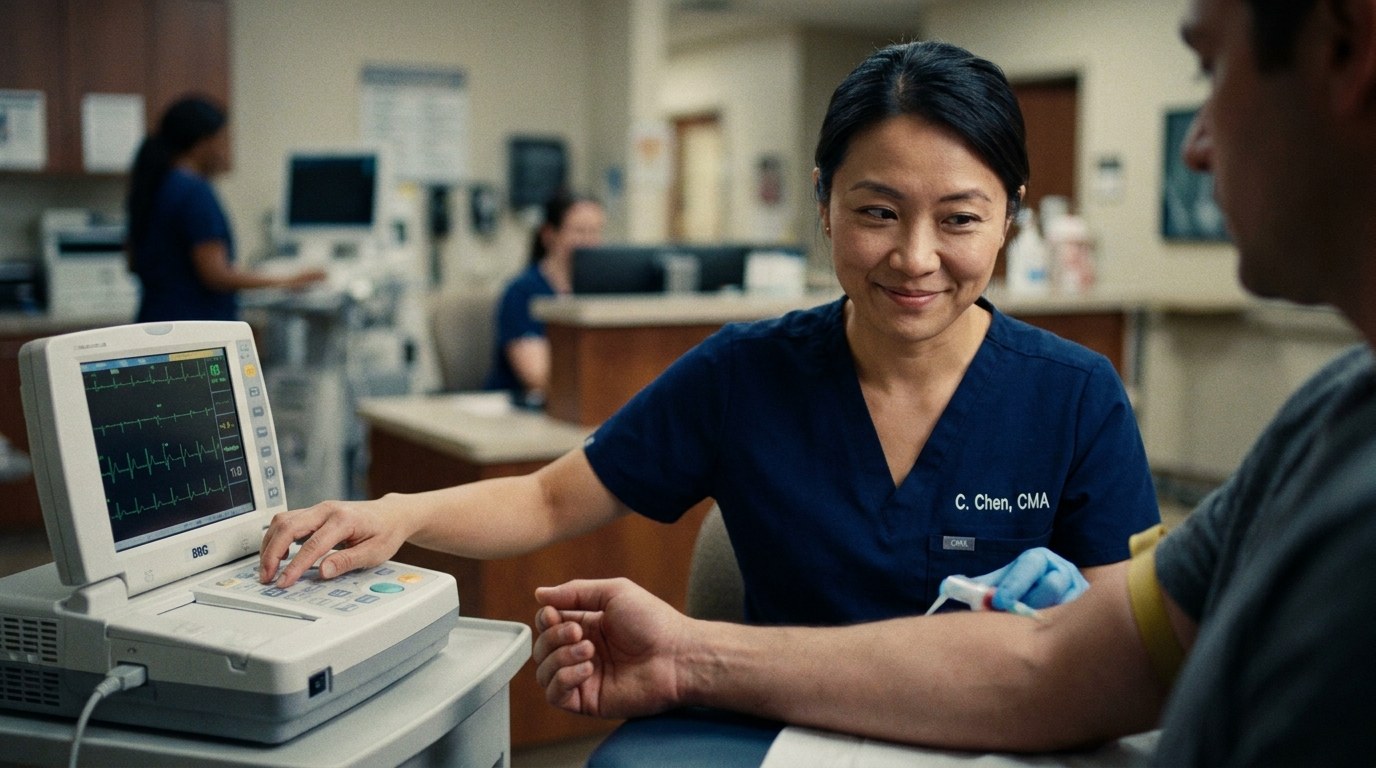
A medical assistant (MA) works in clinical and administrative support roles inside physician offices, urgent care centers, hospitals, and specialty practices. They are not nurses, and they are not physicians — but they are the backbone of most outpatient medical offices.
On the clinical side, MAs take patient vital signs, prepare exam rooms, draw blood, administer injections, assist with minor procedures, and process lab specimens. On the administrative side, they schedule appointments, manage patient records, verify insurance, and handle billing codes. Most MAs do both — often on the same shift.
What the Work Environment Feels Like
Medical assistant work is fast-paced and structured. You’ll follow strict clinical protocols, work under physician supervision, and spend most of your day inside a medical office — fluorescent lights, scrubs, and a packed schedule. If you love the energy of a healthcare environment and find satisfaction in helping patients navigate medical appointments, this can be deeply rewarding work.
If you crave creativity, client relationships, and a more aesthetic environment, that instinct is worth paying attention to.
Licensing in Virginia: What You Actually Need to Know
Here’s a fact that surprises most people researching this path: Virginia does not require medical assistants to hold a state license. Unlike nurses or dental hygienists, MAs in Virginia can be hired without any mandatory certification. That said, most employers strongly prefer — and many require — a nationally recognized credential like the Certified Medical Assistant (CMA) through the American Association of Medical Assistants (AAMA) or the Registered Medical Assistant (RMA) through the American Medical Technologists (AMT).
Earning those credentials typically means completing an accredited program and passing a national exam. So while the state doesn’t mandate it, the job market effectively does.
—
What Is a Medical Esthetician — and How Is It Different?
A medical esthetician is a licensed esthetician who works in clinical or medical settings — performing advanced skin treatments that go well beyond what you’d find in a day spa. Think chemical peels, microdermabrasion, laser hair removal, photofacials, and post-surgical skin care in dermatology offices, plastic surgery practices, and medical spas.
This is not the same as a traditional esthetician doing facials at a neighborhood spa. And it’s definitely not the same as a medical assistant handling clinical intake and paperwork in a physician’s office.
Where Does Cosmetic Laser Technology Fit In?
This is where it gets interesting — especially if you’re in Northern Virginia.
Cosmetic Laser Technician is a specialized role focused on operating laser and light-based equipment for aesthetic treatments: laser hair removal, skin resurfacing, IPL photofacials, and body contouring. In the DC metro area, med spas and dermatology practices actively recruit trained laser technicians. It’s one of the fastest-growing roles in aesthetic medicine, and it requires specialized training — not a medical assistant credential.
AVI Career Training in Vienna, Virginia offers both esthetics and Cosmetic Laser Technician programs — designed specifically to prepare graduates for clinical aesthetic environments in the Northern Virginia and DC metro market.
The Key Distinction Between These Three Roles
| Role | Primary Setting | License Required? | Touches Patients’ Skin? |
|—|—|—|—|
| Medical Assistant | Physician offices, clinics | No (VA) | Limited — vitals, injections |
| Esthetician | Spas, salons, med spas | Yes — VA license (600 hours) | Yes — skin treatments |
| Cosmetic Laser Tech | Med spas, dermatology | Specialized training required | Yes — laser/light devices |
The medical esthetician and cosmetic laser technician paths share something important: you’re building a client-centered, hands-on aesthetic practice — not processing paperwork or navigating insurance codes.
—
Comparing the Numbers — Training Time, Cost, and Earning Potential
Numbers matter when you’re making a career investment. Here’s an honest side-by-side look at what each path requires in Virginia.
Training Time
Medical Assistant programs in Virginia typically run 9–12 months at community colleges or private vocational schools. Some accelerated programs compress the timeline, but most students spend close to a year in training before sitting for a national certification exam.
Virginia esthetics licensure requires 600 clock hours of training at an accredited school — approved by the Virginia Department of Professional and Occupational Regulation (DPOR). Depending on your schedule, full-time students can complete this in a matter of months.
Cosmetic Laser Technician programs vary by school. AVI’s program is designed with working adults in mind — a focused, skills-forward curriculum that gets you job-ready faster than a traditional medical assistant program .
Program Costs
Medical assistant programs in Virginia range from approximately $10,000 to $20,000 depending on the school type — community colleges on the lower end, private career schools on the higher end. Financial aid is typically available for accredited programs that meet federal eligibility thresholds.
AVI Career Training offers competitive tuition for its esthetics and laser programs. Financial aid and the GI Bill® are available for qualifying programs — speak with AVI’s admissions team directly to understand which programs qualify and what payment options are available for shorter-track programs.
> ? Call AVI at (703) 943-9841 to get current tuition figures and discuss your financing options.
Medical Assistant Salary in Virginia vs. Esthetician Earnings
According to the U.S. Bureau of Labor Statistics (BLS), the median annual wage for medical assistants in the United States is approximately $42,000, with Virginia figures slightly higher given the DC metro cost of living. Entry-level MAs in Northern Virginia often start in the $36,000–$44,000 range.
Licensed estheticians show wider earnings variance — traditional spa estheticians may earn in that same range, but medical estheticians and cosmetic laser technicians in the DC metro area can earn significantly more, particularly with tips, commission structures, or self-employment. Med spa positions in Tysons Corner, McLean, and Bethesda routinely list salaries of $45,000–$65,000+ for experienced laser and medical aesthetics professionals.
The earning ceiling in medical aesthetics is meaningfully higher — especially for those who build a client base or move into a self-employed or suite-rental model.
—
Career Paths and Where Each Role Can Take You in Northern Virginia
Northern Virginia and the broader DMV area offer strong demand for both paths — but the trajectory looks very different.
Where Medical Assistants Work in the DC Metro Area
Medical assistants in Northern Virginia are hired by primary care practices, urgent care centers, specialty clinics (dermatology, OB/GYN, orthopedics), and hospital systems like Inova and Kaiser Permanente. The region’s dense healthcare infrastructure means steady demand for MAs — but advancement typically requires additional education (nursing school, healthcare management degrees) to move into higher-paying clinical roles.
Most medical assistant positions are salaried, W-2 employment with set hours. There is limited room for entrepreneurship or self-direction within the MA role itself.
Where Estheticians and Laser Technicians Work in Northern Virginia
This is where the DC metro region’s affluence becomes a real advantage. Northern Virginia — Tysons Corner, McLean, Reston, Arlington, Fairfax — has one of the highest concentrations of medical spas and aesthetic clinics on the East Coast. Clients here have disposable income and high expectations for skin care and aesthetic services.
Licensed estheticians and cosmetic laser technicians in this market work in:
The esthetics path offers something the medical assistant track generally does not: a realistic route to self-employment and income that scales with your client base.
—
Can You Go From Esthetics to Medical Aesthetics?
Yes — and this career bridge is one of the most powerful things about the esthetics path.
A Virginia esthetics license is your entry point. Once licensed, you can pursue advanced training in laser technology, chemical peels, microneedling, and other clinical modalities. Many medical spas and dermatology practices in Northern Virginia specifically hire licensed estheticians with laser training — because you bring both the skin science foundation and the technical laser skills they need.
This is exactly the combination that AVI Career Training’s programs are built to deliver. Start with esthetics, add laser training, and you’re positioned for the most in-demand aesthetic roles in the DC metro market.
—
How to Decide — Questions to Ask Yourself Before You Enroll
The best career path is the one that fits your life — not just the one that sounds most impressive at a dinner party. Work through these questions honestly.
1. What does your ideal workday look like?
If you picture yourself in scrubs, moving quickly between exam rooms, drawing blood and updating patient charts — medical assisting may be a genuine fit. If you picture yourself performing skin consultations, operating laser equipment, and building relationships with clients who return to see you specifically — esthetics and laser technology is the closer match.
2. Do you want a path to self-employment?
Medical assistants work for employers. Full stop. Estheticians and laser technicians can build independent practices, rent suites, and own their client relationships. If entrepreneurship is part of your long-term vision, the esthetics path offers that runway — and the DC metro area is one of the best markets in the country to build it.
3. How quickly do you need to start earning?
Virginia esthetics licensure requires 600 clock hours. AVI’s programs are built to get you through that training efficiently, so you can sit for your Virginia State Board exam and start working. Medical assistant programs typically run 9–12 months before you’re eligible for national certification. If speed-to-income matters to you, that difference is worth taking seriously.
4. Do you want to work on people’s appearance and confidence — or their clinical health needs?
Neither answer is wrong. But they’re different callings. Estheticians help people feel confident, address skin concerns, and achieve aesthetic goals. Medical assistants support clinical diagnosis and treatment. If beauty, skin, and confidence transformation is what excites you, stop trying to talk yourself into the clinical paperwork version of healthcare.
5. Are you drawn to the Northern Virginia med spa market specifically?
If the answer is yes, the fastest and most direct route into that market is an esthetics license paired with laser technician training — not a medical assistant credential. Med spas are not physician offices. They are aesthetic businesses that hire licensed beauty and laser professionals, not clinical support staff.
—
Frequently Asked Questions
Q: How long does it take to become a medical assistant in Virginia?
A: Most medical assistant programs in Virginia run 9–12 months. After completing the program, graduates can pursue voluntary national certification (CMA or RMA) through national credentialing bodies. Virginia does not require state licensure for medical assistants.
Q: Is medical assistant a good career in 2025?
A: Medical assisting remains a stable career with steady demand in Virginia’s healthcare market. However, it offers limited upward mobility without additional education, and median salaries in the $36,000–$44,000 entry-level range are similar to what estheticians and laser technicians earn in the Northern Virginia med spa market — often with more flexibility and earning upside on the aesthetics side.
Q: What’s the difference between a medical esthetician and a medical assistant ?
A: A medical esthetician is a licensed esthetician (requiring 600 clock hours and a Virginia state license) who performs advanced skin and laser treatments in clinical settings like med spas and dermatology offices. A medical assistant is a clinical and administrative support role in physician offices — handling vital signs, injections, and patient records. They are entirely different careers with different training, licensing, and day-to-day responsibilities.
Q: Can you go from esthetics to medical aesthetics?
A: Yes. A Virginia esthetics license is the foundation for a medical aesthetics career. Many estheticians in the DC metro area add specialized training — such as AVI Career Training’s Cosmetic Laser Technician program — to qualify for positions at medical spas, dermatology practices, and plastic surgery clinics in Northern Virginia.
Q: What careers in Virginia don’t require a 4-year degree?
A: Several high-demand careers in Virginia require only vocational training and a state license — including esthetician, cosmetologist, nail technician, massage therapist, cosmetic laser technician, and electrologist. AVI Career Training in Vienna, Virginia offers accredited programs in all of these fields, with most programs completable in under a year.
Q: Does AVI Career Training offer medical assistant training?
A: AVI Career Training does not offer a medical assistant program . AVI specializes in COE-accredited beauty and wellness career training — including esthetics, Cosmetic Laser Technician, cosmetology, massage therapy, nail technology, and electrolysis. For students drawn to clinical aesthetics, AVI’s esthetics and laser programs offer a direct path into Northern Virginia’s med spa and dermatology market.
Q: What is the medical assistant salary in Virginia?
A: According to BLS data, medical assistants in Virginia earn a median annual wage in the range of $38,000–$45,000, with Northern Virginia figures on the higher end due to the DC metro cost of living. Experienced medical estheticians and cosmetic laser technicians in the same market regularly earn at or above that range — with greater income upside through tips, commission, and self-employment.