Medical Assistant vs Esthetician Careers in Northern Virginia |
A medical assistant vs. esthetics career comparison comes down to this: both offer real job stability, short training timelines, and strong demand in Northern Virginia and the DC metro area — but they lead to very different daily lives, income structures, and long-term possibilities.
This guide breaks down both careers honestly so you can decide which one actually fits your goals, your lifestyle, and the kind of work that will keep you motivated five years from now. If esthetics turns out to be your path, AVI Career Training in Vienna, Virginia is one of the most direct routes to getting licensed and working in the DMV area.
Apply to AVI Career Training →
—
⚡ Key Takeaways
- Virginia requires 600 clock hours to become a licensed esthetician — a timeline comparable to many MA certificate programs.
- BLS data shows estheticians in the DC metro area frequently exceed the Virginia statewide median, with tips, commission, and self-employment upside that MA roles typically do not offer.
- Esthetics can branch directly into medical esthetics, cosmetic laser, and electrolysis — merging beauty skills with clinical settings without a nursing or MA credential.
- AVI Career Training is COE Accredited and SCHEV Certified, with GI Bill® acceptance and financial aid available for qualifying programs.
- Northern Virginia’s Tysons/DC corridor is one of the highest-demand markets in the country for skilled estheticians and medical spa professionals.
—
What Does Each Career Actually Look Like Day-to-Day?
The most important question isn’t which career pays more on paper — it’s which one you’d actually want to show up for every morning.
Working as a Medical Assistant
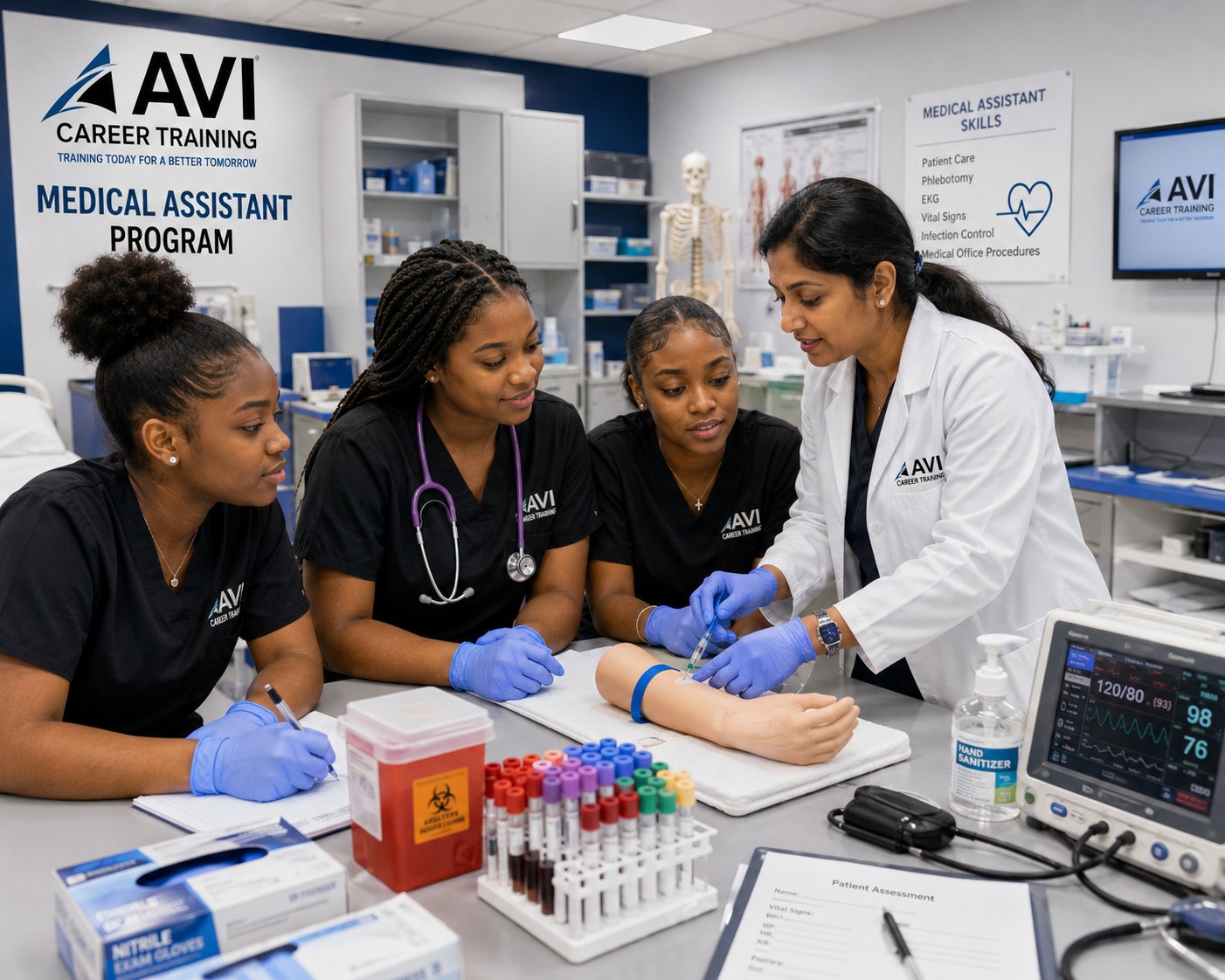
Medical assistants work in clinical settings: physician offices, urgent care clinics, outpatient surgery centers, and specialty practices. A typical day involves taking patient vitals, updating electronic health records, scheduling appointments, preparing exam rooms, drawing blood, administering injections, and handling billing or insurance documentation.
It’s a role that demands precision and patience. You’re supporting medical professionals in a structured, protocol-driven environment where accuracy is critical. If you genuinely want to work in healthcare and find the clinical setting energizing, that’s a real draw. But the environment is also fast-paced, emotionally demanding, and often involves difficult patient situations — illness, anxiety, and urgent care scenarios are daily realities.
Working as an Esthetician
Estheticians work in a fundamentally different environment: spas, salons, medical spas, wellness centers, and private studios. Your day is built around one-on-one client relationships — performing facials, chemical peels, waxing, brow and lash services, and advanced skincare treatments.
The pace is client-driven rather than crisis-driven. You’re helping people look and feel their best, managing your own appointment book, and building a loyal clientele who return for you specifically. In high-end Northern Virginia spas and medical spas near Tysons Corner, estheticians are delivering premium treatments to a well-educated, higher-income client base — which translates directly into stronger tips and consistent return business.
If you want a career where you use your hands, build real relationships, express creativity, and work in a positive, beauty-focused environment, esthetics is a genuinely different daily experience from clinical healthcare work.
The honest bottom line: Medical assisting is healthcare support work in a clinical setting. Esthetics is skilled, hands-on wellness work in a client-centered setting. Neither is “easier” — they’re just designed for different people.
—
Training Timeline and Licensing Requirements in Virginia
Both careers are accessible without a four-year degree — and both can be completed in roughly the same window of time.
Medical Assistant Training in Virginia
Medical assistant programs in Virginia are typically offered through community colleges and vocational schools. A certificate program runs approximately 9 to 12 months of full-time study. An associate degree takes closer to two years. Most programs include coursework in anatomy, medical terminology, clinical procedures, and administrative systems.
Virginia does not currently require MAs to hold a state license, though national certification (such as the CMA through AAMA or RMA through AMT) is strongly preferred by employers and increasingly expected in the Northern Virginia job market.
Esthetics Licensing in Virginia
To become a licensed esthetician in Virginia, you must complete a minimum of 600 clock hours of esthetics training at a state-approved school, then pass both the written and practical portions of the National-Interstate Council (NIC) exam. Licensing is administered by the Virginia Department of Professional and Occupational Regulation (DPOR).
At an accredited school like AVI Career Training in Vienna, Virginia, those 600 hours are structured as hands-on, real-client training — not just classroom instruction. Graduates leave with the skills, the state license, and the professional foundation to work immediately.
The timeline is genuinely comparable to an MA certificate. If speed-to-employment is a priority, esthetics licensing doesn’t require you to wait years.
Clock hours required for Virginia esthetician license (DPOR)
Months typical for an MA certificate program in Virginia
Exams required for Virginia esthetics license (written + practical, NIC)
AVI Career Training’s accreditation — Council on Occupational Education
—
Salary and Earning Potential — Virginia and Northern Virginia Specifically
Direct answer: On paper, Virginia median salaries for estheticians and medical assistants are in a similar range — but the earning ceiling and income structure are meaningfully different, especially in the Northern Virginia market.
What Medical Assistants Earn in Virginia
According to the U.S. Bureau of Labor Statistics Occupational Employment and Wage Statistics (OEWS) data, medical assistants in Virginia earn a median annual wage in the range of approximately $38,000–$44,000. In the Washington-Arlington-Alexandria metro area, wages trend toward the higher end of that range given the cost of living and healthcare employer density. Advancement typically requires additional credentials, and salary increases are largely tied to employer pay scales and years of experience.
MA compensation is generally wage-based with standard benefits — predictable, but with a more defined ceiling without further credentialing into nursing or other allied health roles.
What Estheticians Earn in Virginia
BLS OEWS data places Virginia esthetician median wages in the range of approximately $38,000–$52,000 annually — with the DC metro area, including Northern Virginia and the Tysons Corner corridor, skewing toward or above the higher end of that range.
But the more important point is this: esthetics income doesn’t stop at the base wage.
Estheticians in high-end Northern Virginia spas and medical spas routinely earn additional income through:
- Tips — often 15–25% added to each service
- Commission on retail product sales
- Service bonuses from employers in commission-based structures
- Self-employment as a suite or studio owner — with income potential limited only by your clientele and schedule
A skilled, licensed esthetician with a loyal client base in the DC metro market can meaningfully exceed median wage figures. That upside simply doesn’t exist in the same way for a salaried MA role.
Meet Danielle — a 29-year-old originally from Fairfax, Virginia who spent three years working front-desk admin at a dental office. She liked helping people but felt disconnected from the work. She researched both medical assisting and esthetics programs for months, running the numbers on tuition, timeline, and earning potential.
What tipped her toward esthetics wasn’t the salary data — it was a conversation with an esthetician at a medical spa in Tysons who described her average Tuesday: four clients, two of them regulars she’d been seeing for over a year, a facial, two peels, and a brow wax. “She said she was home by 6 p.m. and had made $300 in tips alone that week,” Danielle recalled.
She enrolled in an esthetics program, completed her 600 hours, passed her Virginia State Board exams, and landed her first position at a Northern Virginia medical spa within six weeks of graduating.
—
Where Can Each Career Take You? Growth Paths and Long-Term Options
Career paths are not static. Where you start isn’t necessarily where you’ll spend the next 30 years — and that’s especially true in esthetics.
Medical Assistant Career Trajectory
MAs can advance into roles like medical office manager, healthcare administrator, or specialty MA (cardiology, dermatology, etc.). Moving into clinical nursing or physician assistant roles requires significant additional education — typically a two-to-four-year nursing program or a master’s degree. Advancement is credential-gated, which means more school and more tuition at each step.
Esthetics Career Trajectory — and the Medical Spa Bridge
Here’s where the medical assistant vs. esthetics career comparison gets genuinely interesting for people drawn to the clinical or healthcare-adjacent angle.
Esthetics doesn’t have to mean the spa counter at a hotel. The field has expanded dramatically into medical settings:
- Medical Spa Esthetician: Work alongside physicians and nurse practitioners performing clinical-grade facials, peels, and pre/post-procedure skin care
- Cosmetic Laser Technician: Perform laser hair removal, skin rejuvenation, and body contouring treatments — a distinct credential path that AVI Career Training offers
- Electrolysis: Permanent hair removal — a licensed, regulated specialty that AVI also trains students in
- Spa Owner / Suite Rental: Entrepreneurs can lease their own treatment room and build an independent practice
- Educator or Platform Artist: Train others, work with product brands, or teach at accredited schools
If your interest in “medical” is really about clinical precision, skincare science, and working with technology — not necessarily nursing — then the esthetics-to-medical-spa path may be a better fit than a traditional MA role. You can get there without an MA credential at all.
Meet Marcus — a 34-year-old Army veteran from the DMV area who separated from service and was researching the fastest healthcare careers in Northern Virginia. He almost enrolled in an MA program before a career counselor at his transition assistance program mentioned cosmetic laser technology.
“I didn’t know that was a thing,” he said. “I thought esthetics was just facials.” After learning that laser technicians in Northern Virginia medical spas can earn well above the median with tips and commission — and that training was available locally at a COE-accredited school that accepted his GI Bill® — the decision became straightforward.
Marcus enrolled at AVI Career Training, completed his Cosmetic Laser Technician program, and now works at a medical aesthetics clinic in the Tysons Corner area.
—
How to Choose — and Where to Start in Northern Virginia
The real question isn’t “which career pays more” — it’s “which career will you actually build a life around?” Use these three filters to get clear.
Filter 1: Environment
Do you want to work in a clinical, hospital-adjacent setting where the stakes are medical and the pace is driven by patient volume? That’s the MA world. Or do you want a client-centered, creativity-positive environment where you set the tone of each appointment and build relationships over years? That’s esthetics.
Filter 2: Income Structure
Are you comfortable with a predictable hourly wage with standard benefits? MA may suit you. Do you want income that scales with your skill, your client relationships, and your hustle — with real upside from tips, retail commission, and eventual self-employment? Esthetics offers that.
Filter 3: Where You Want to Go, Not Just Where You’re Starting
If your long-term vision involves working in a clinical or medical environment, a licensed esthetician working in a medical spa, laser clinic, or dermatologist’s office can absolutely do that — often without the full clinical credential stack of an MA. AVI’s Cosmetic Laser Technician and Electrolysis programs extend that path further.
Starting Your Esthetics Career at AVI Career Training in Vienna, Virginia
AVI Career Training is a COE-accredited, SCHEV-certified beauty and wellness school located at 1595 Spring Hill Rd #720, Vienna, VA 22182 — in the heart of Northern Virginia, minutes from the Tysons Corner market where demand for skilled estheticians and medical spa professionals is among the highest in the region.
AVI’s Basic Esthetics program meets Virginia DPOR’s 600-hour requirement with hands-on training on real clients, covering skincare science, waxing, facials, chemical exfoliation, and the inclusive techniques needed to serve every skin tone confidently.
What AVI offers that matters to career-changers and first-time students:
- COE Accreditation — Council on Occupational Education, a nationally recognized accrediting body
- SCHEV Certified — State Council of Higher Education for Virginia
- GI Bill® Accepted — Active duty, veterans, and eligible dependents can apply military education benefits
- Financial Aid Available — For qualifying programs (contact admissions to confirm eligibility for your specific program)
- Inclusive Curriculum — Training that covers all skin tones and hair textures, not