
Medical Assistant Training: Vocational vs. 4-Year Degree
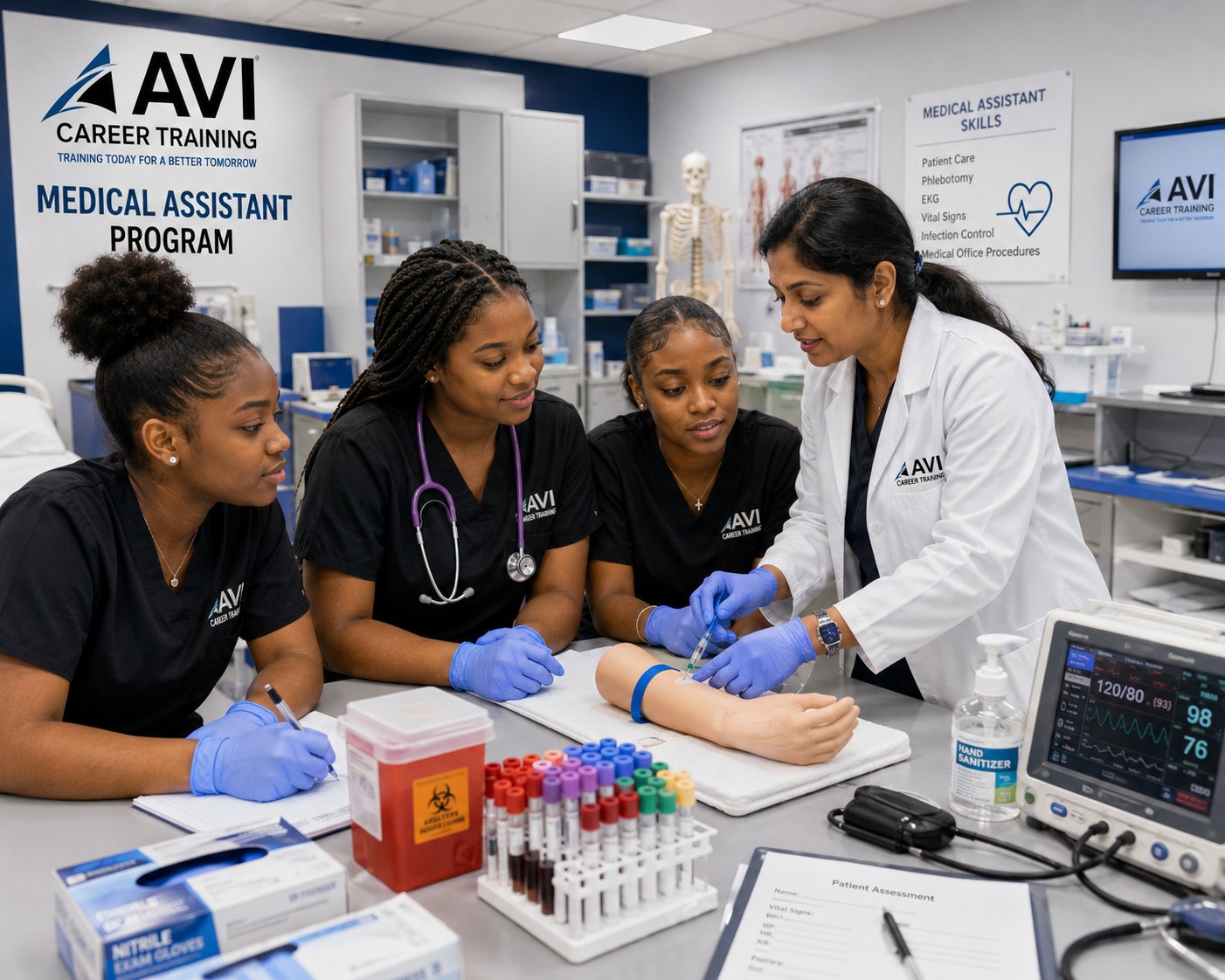
A vocational certificate in medical assisting takes 9–12 months and costs a fraction of a 4-year degree — and in most cases, it’s the only credential employers actually require. If you’re weighing speed, cost, and career outcomes, the numbers strongly favor the vocational path for entry-level medical assistant roles.
Ready to explore a hands-on career path in the Northern Virginia area? See AVI Career Training’s programs and find the right fit for your goals.
- MA certificate programs run 9–12 months; a 4-year bachelor’s degree takes 4 years — a difference of 3+ years out of the workforce
- Average MA certificate program cost: $3,000–$15,000 vs. $40,000–$120,000+ for a bachelor’s degree
- BLS median annual wage for Medical Assistants in the U.S.: approximately $42,000, and the DC metro area typically pays above the national median
- Most MA certification exams — CMA (AAMA) and RMA (AMT) — require an accredited program diploma, not a 4-year degree
- Fast healthcare-adjacent careers like Massage Therapy, Esthetics, and Cosmetic Laser Technology follow the same short-program, licensure-based model — and AVI Career Training in Vienna, Virginia offers all three
This guide breaks down the real tradeoffs — time, money, hiring outcomes, and career ceilings — so you can make a decision based on facts, not assumptions. And if you discover that medical assisting isn’t quite the right fit, we’ll walk you through some compelling alternatives in the healthcare-adjacent space that you can launch in under a year right here in Northern Virginia.
—
What Does Medical Assistant Training Actually Cover?
Medical assisting combines clinical and administrative work into one versatile role — and what a training program covers depends far more on its accreditation and curriculum depth than on whether it’s a certificate or a degree.
On the clinical side, medical assistants are trained to:
On the administrative side, the role includes:
Here’s the critical distinction: a vocational certificate program teaches these skills through direct hands-on application. You practice clinical techniques in a lab setting before completing an externship in a real medical office. A 4-year bachelor’s degree, by contrast, surrounds that same hands-on core with two additional years of general education requirements — English composition, social science electives, lab sciences — that have little bearing on day-one job performance as a medical assistant.
Both paths can lead to the same entry-level MA role. The question is whether those extra years and extra dollars change your outcome in a meaningful way.
> Transparency note: AVI Career Training is a COE-accredited beauty and wellness school in Vienna, Virginia. AVI does not offer a Medical Assistant program. This guide is designed to give you accurate, unbiased information about MA training pathways — and to introduce you to related hands-on healthcare careers where AVI does provide expert training.
—
Time to Launch — Vocational Certificate vs. 4-Year Degree
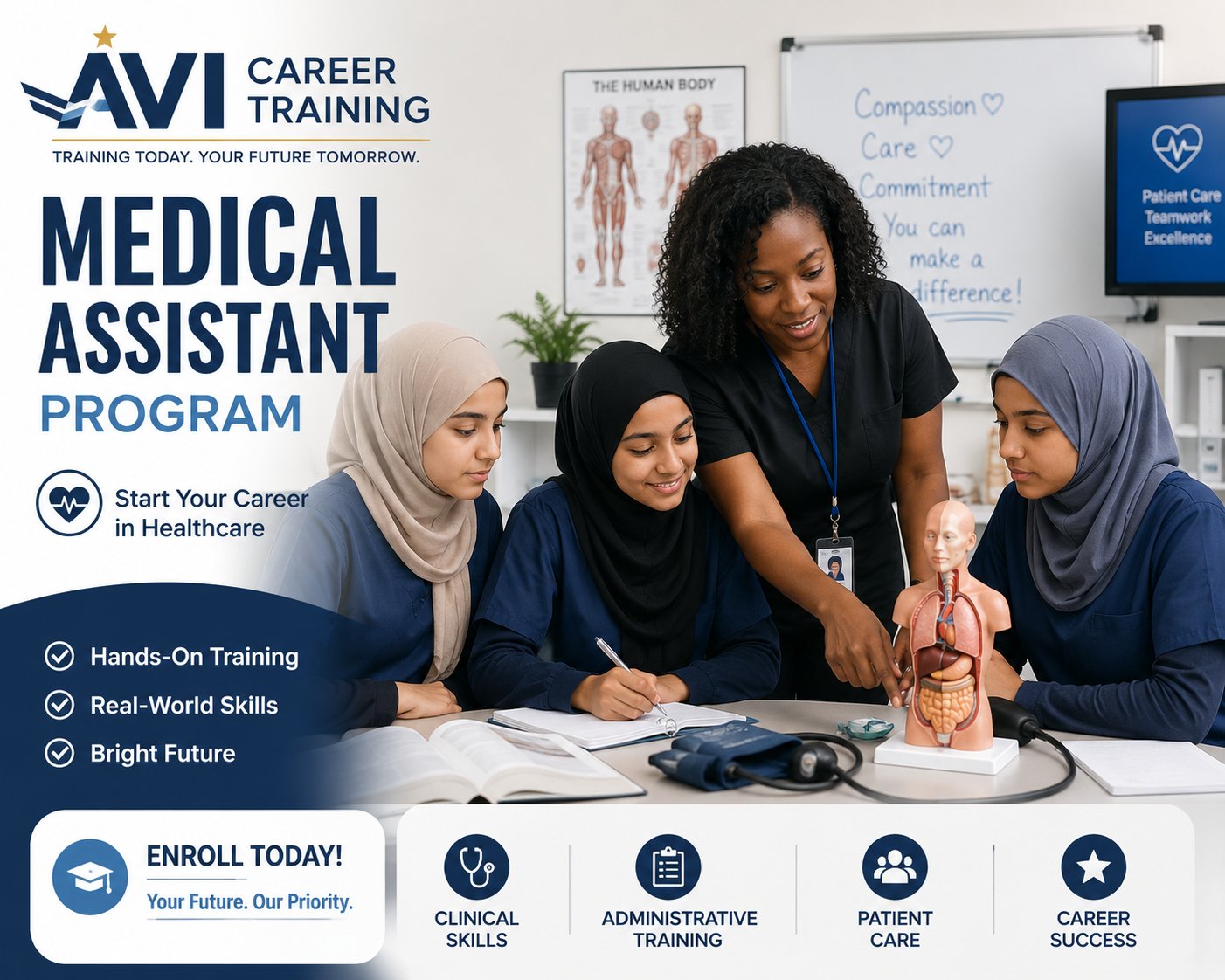
The most straightforward answer to “how long does it take to become a medical assistant?” is this: a vocational certificate takes 9–12 months; a 4-year degree takes four years.
That three-year gap has compounding consequences that most prospective students underestimate.
The Opportunity Cost Calculation
Consider two people who both want to become medical assistants:
That’s the opportunity cost of the degree: not just what you pay in, but what you don’t earn while you’re waiting to enter the workforce.
Where Does the Associate Degree Fit?
An associate degree — typically a 2-year program offered at community colleges — sits between a certificate and a bachelor’s. It costs less than a 4-year degree and takes less time, but still doubles the timeline of a certificate program. For most entry-level MA positions, an associate degree and a certificate carry essentially equivalent weight with employers.
Some MA graduates do pursue the associate degree path for the broader general education exposure, or because their community college’s program is affordable and convenient. That’s a legitimate choice — just go in knowing that neither the 2-year nor the 4-year degree unlocks dramatically higher entry-level pay than the certificate.
—
Cost Breakdown — What Are You Actually Paying For?
Cost is where the gap between vocational training and a traditional degree becomes impossible to ignore.
What Financial Aid Is Available for MA Certificate Programs?
This depends heavily on the specific school and program length. Many accredited MA certificate programs qualify for Title IV federal financial aid (including Pell Grants and federal student loans) if the program meets the Department of Education’s minimum hour requirements. Programs accredited by bodies like CAAHEP or ABHES are often Title IV eligible.
If you or a family member have served in the military, the GI Bill® may cover vocational certificate programs at approved institutions. Always verify Title IV and GI Bill® eligibility directly with the school’s financial aid office before enrolling.
One important rule of thumb: programs under 600 clock hours typically do not qualify for federal financial aid. Ask any MA program you’re evaluating exactly how many hours their curriculum includes and whether they’re Title IV-approved. Don’t assume — confirm in writing.
The Debt Comparison Is Not Close
A graduate who completes a $10,000 certificate program and earns $42,000/year pays off their training in under three months of work. A graduate carrying $80,000 in student loan debt from a 4-year program — entering the same entry-level role at the same salary — faces years of repayment that dramatically reduce their real take-home earnings.
The vocational path isn’t just faster. It’s the financially rational first step into a healthcare career.
—
Salary, Hiring, and Career Outcomes — Does the Degree Pay Off?
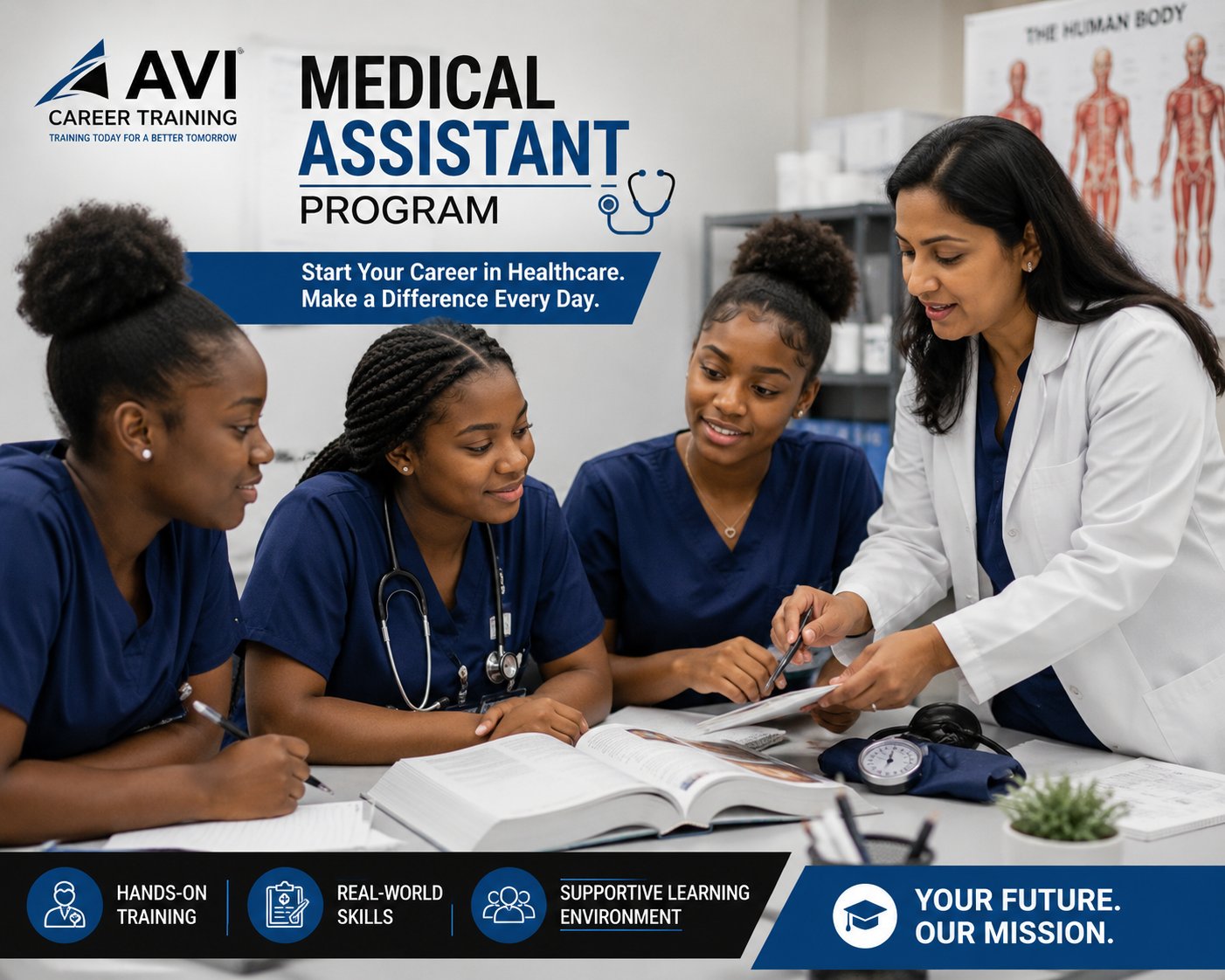
The short answer: for entry-level medical assistant positions, a bachelor’s degree does not meaningfully increase your starting salary or your odds of being hired.
According to the U.S. Bureau of Labor Statistics (BLS), the median annual wage for medical assistants nationally is approximately $42,000. The Washington, DC metro area — which includes Northern Virginia — typically pays above that national median, making this region one of the more favorable markets for MA careers on the East Coast.
BLS projects 14% job growth for medical assistants through 2032, which is classified as “much faster than average.” That demand is driven by an aging population, expanding outpatient care settings, and primary care clinic growth across the DMV region.
What Do Employers Actually Require?
Review any significant job board — Indeed, LinkedIn, or health system career portals like Inova or MedStar — and you’ll find that the overwhelming majority of MA postings list the following requirements:
A 4-year bachelor’s degree is not listed as a requirement for entry-level MA roles. Employers want the certificate, the externship hours, and the certification credential — all of which a vocational program delivers.
A Note on Virginia Licensure
Virginia does not require state licensure for medical assistants. Unlike some clinical roles regulated by the Virginia Department of Professional and Occupational Regulation (DPOR), MA practice is governed primarily by employer standards and voluntary national certification. This means your credentials are driven by the marketplace, not the state — making your choice of accredited program and certification exam the most important credential decisions you’ll make.
(Always verify current Virginia regulations directly with the Virginia Department of Health Professions, as requirements can change.)
What If You Want to Advance Beyond Medical Assisting?
That’s a completely separate conversation — and an important one to have with yourself before you invest in training. If your long-term goal is to become a Registered Nurse (RN), Physician Assistant (PA), or clinical manager, you will need further education beyond an MA certificate. But here’s the key insight: the MA certificate doesn’t prevent that path — it funds it.
Many healthcare professionals start with an MA certificate, enter the workforce, earn income, and pursue an RN or PA program later with far less financial pressure. The certificate is a strategic launch point, not a ceiling.
—
Beyond Medical Assisting — Other Fast Healthcare-Adjacent Career Paths Worth Considering
Medical assisting is one vocational path — but it’s not the only one. A growing number of career-changers and prospective students in Northern Virginia are discovering that healthcare-adjacent careers in wellness and aesthetics offer the same advantages: short training timelines, licensure-based credentials, strong job markets, and no 4-year degree required.
These careers operate at the intersection of clinical knowledge and personal care. They require hands-on skill, precision, and a genuine interest in improving how people feel and look — qualities that often attract the same people who gravitate toward medical assisting.
Three Fast-Track Career Paths to Know
Massage Therapy: Licensed Massage Therapists (LMTs) work in medical spas, chiropractic offices, physical therapy clinics, resorts, and private practice. Virginia requires licensure through DPOR — AVI Career Training’s Massage Therapy program is designed to prepare students for the Virginia licensure exam. This is a credential-based, body-work career with direct client impact.
Cosmetic Laser Technology: Cosmetic laser technicians perform non-surgical aesthetic treatments — laser hair removal, skin rejuvenation, body contouring — in medical spas and dermatology-adjacent settings. It’s a technically demanding, fast-growing specialty that sits squarely at the crossroads of healthcare and aesthetics. AVI’s Cosmetic Laser Technician program is one of the few of its kind in the Northern Virginia / Tysons Corner area.
Esthetics (Basic and Master): Licensed estheticians perform skincare treatments, chemical peels, facials, and more. AVI’s curriculum is built around inclusive techniques that work on every skin tone — a critical differentiator in the diverse DC metro market. AVI offers both Basic Esthetics and Master Esthetics tracks to match your goals.
AVI Career Training is a COE-accredited, SCHEV-certified career school located at 1595 Spring Hill Rd #720, Vienna, VA 22182 — minutes from Tysons Corner. AVI accepts the GI Bill® and offers financial aid for eligible programs. Every program is built around hands-on, licensure-focused training taught by licensed industry professionals.
If you’re evaluating hands-on healthcare career training near you in Northern Virginia or the broader DMV area, AVI is worth a serious look.
Mini-Story: The Career-Changer Who Didn’t Want Four More Years
Consider someone like Marcus — a 34-year-old warehouse supervisor in Fairfax County who spent months researching healthcare careers after a back injury made his physical job unsustainable. He looked into medical assisting seriously, attended two information sessions at local colleges, and ran the numbers: a 4-year degree would cost him around $60,000 and delay his career transition by years. A certificate program was faster, but he was still uncertain about the MA path.
Then a friend mentioned cosmetic laser training. Marcus had never considered aesthetics — but after researching the clinical side of laser technology and realizing it required precision, anatomy knowledge, and technical skill, it clicked. He enrolled in a Cosmetic Laser Technician program, completed his training in months, and launched a career in a medical spa environment — doing work that was challenging, well-compensated, and physically manageable. The same research instinct that led him to study medical assisting ultimately guided him to a better personal fit.
Marcus’s story isn’t unusual. The people most likely to thrive in vocational healthcare training are those willing to explore the full landscape of options — not just the most obvious one.
Mini-Story: The Recent Grad Who Skipped the Debt
Priya graduated from a Northern Virginia high school at 18 with solid grades and a genuine interest in skincare and wellness. Her parents expected college. She applied to a 4-year university, got in — and then quietly calculated what four years of tuition debt would look like against an esthetician’s earnings in the DC metro area.
She enrolled in AVI Career Training’s Esthetics program instead. Within a year, she was licensed, working at a Tysons Corner spa, and building a loyal clientele. By the time her friends graduated with bachelor’s degrees, Priya had two years of professional experience, a growing income, and zero student loan payments. She later added Master Esthetics credentials to expand her service menu. The vocational model didn’t limit her — it launched her ahead of the curve.
—
—
Frequently Asked Questions
Q: How long does medical assistant vocational training take compared to a degree?
A: A medical assistant certificate program typically takes 9–12 months to complete. An associate degree takes approximately 2 years, and a bachelor’s degree takes 4 years. For most entry-level MA positions, the certificate is the fastest and most cost-effective path to employment.
Q: Is a medical assistant certificate worth it without a 4-year degree?
A: Yes — for the vast majority of medical assistant roles, a certificate from an accredited program is all that employers require. Most job postings list program completion and voluntary certification (CMA or RMA), not a bachelor’s degree. The certificate delivers the core competencies employers need at a fraction of the cost.
Q: How much do medical assistants make in Virginia?
A: The U.S. Bureau of Labor Statistics reports a national median annual wage of approximately $42,000 for medical assistants. The Northern Virginia and Washington, DC metro area typically pays above the national median due to the region’s high cost of living and competitive healthcare labor market. Check the current BLS Occupational Outlook Handbook for updated figures.
Q: What is the difference between a vocational certificate and an associate degree for medical assistants?
A: A vocational certificate is typically a 9–12 month, skills-focused program that emphasizes clinical and administrative competencies through hands-on training and externship hours. An associate degree is a 2-year program that adds general education requirements alongside the MA core curriculum. Both can lead to the same entry-level MA role — the certificate is faster and less expensive.
Q: Are there faster healthcare career paths that don’t require a 4-year degree?
A: Yes. Healthcare-adjacent careers like Massage Therapy, Cosmetic Laser Technology, and Esthetics all offer licensure-based credentials achievable in under a year or two of focused training. These fields share the vocational training model’s advantages: short timelines, lower costs, and strong job markets — particularly in the Northern Virginia and DC metro area.
Q: Does Virginia require licensure for medical assistants?
A: Virginia does not currently require state licensure for medical assistants. Credentialing is driven by employer preference and voluntary national certification — the CMA exam through AAMA and the RMA exam through AMT are the most recognized. Always verify current requirements with the Virginia Department of Health Professions or the Virginia Department of Professional and Occupational Regulation (DPOR).
Q: Does AVI Career Training offer a Medical Assistant program?
A: No. AVI Career Training is a COE-accredited beauty and wellness school in Vienna, Virginia. AVI does not offer a Medical Assistant program. AVI does offer hands-on, licensure-focused programs in Massage Therapy, Cosmetic Laser Technology, Esthetics, Cosmetology, Nail Technology, and Electrolysis — all of which share the vocational training model’s advantages of short timelines and credential-based hiring.
Q: Where can I find hands-on healthcare career training near me in Northern Virginia?
A: AVI Career Training, located at 1595 Spring Hill Rd #720, Vienna, VA 22182 (near Tysons Corner), offers several healthcare-adjacent programs including Massage Therapy, Cosmetic Laser Technology, and Esthetics. AVI is COE-accredited, SCHEV-certified, and accepts the GI Bill® for eligible programs. You can reach AVI at (703) 943-9841 or visit avicareertraining.com.
—
Ready to explore a hands-on career path in the Northern Virginia area? See AVI Career Training’s programs and find the right fit for your goals.