
Medical Assistant Careers in the DMV: Pay, Jobs & Outlook
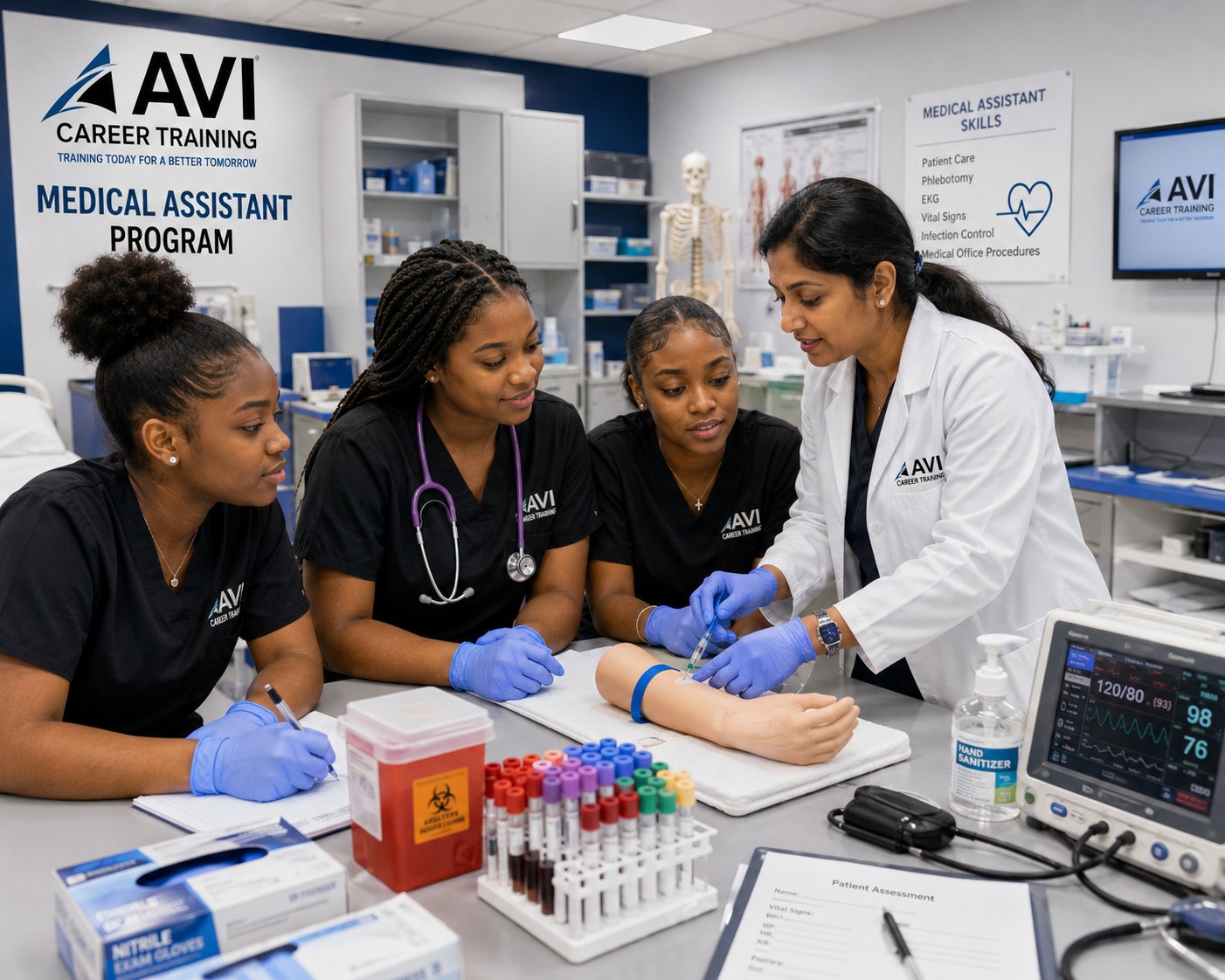
Medical assistants in the DMV earn a median annual wage above the national average — making this one of the more financially rewarding entry-level healthcare careers in the region. This guide breaks down real wage data, where the jobs are concentrated in Northern Virginia and DC, how long training takes, and what comparable hands-on health and wellness careers look like if you want to explore every option before you commit.
- The median annual wage for medical assistants in the Washington-Arlington-Alexandria metro area is approximately $44,000–$46,000, above the national median of roughly $42,000 (BLS OES, latest release).
- Top earners (90th percentile) in the DMV can reach $56,000+ annually with experience and national certification.
- Virginia does not require state licensure for medical assistants, but national certification (CMA or RMA) is strongly preferred by DMV employers.
- Certificate programs typically take 9–12 months; associate degree paths take two years.
- Adjacent wellness careers — including medical esthetics, Massage Therapy, and Cosmetic Laser Technology — offer comparable or faster training timelines with strong earning potential in the DMV’s affluent market.
—
What Does a Medical Assistant Actually Do?
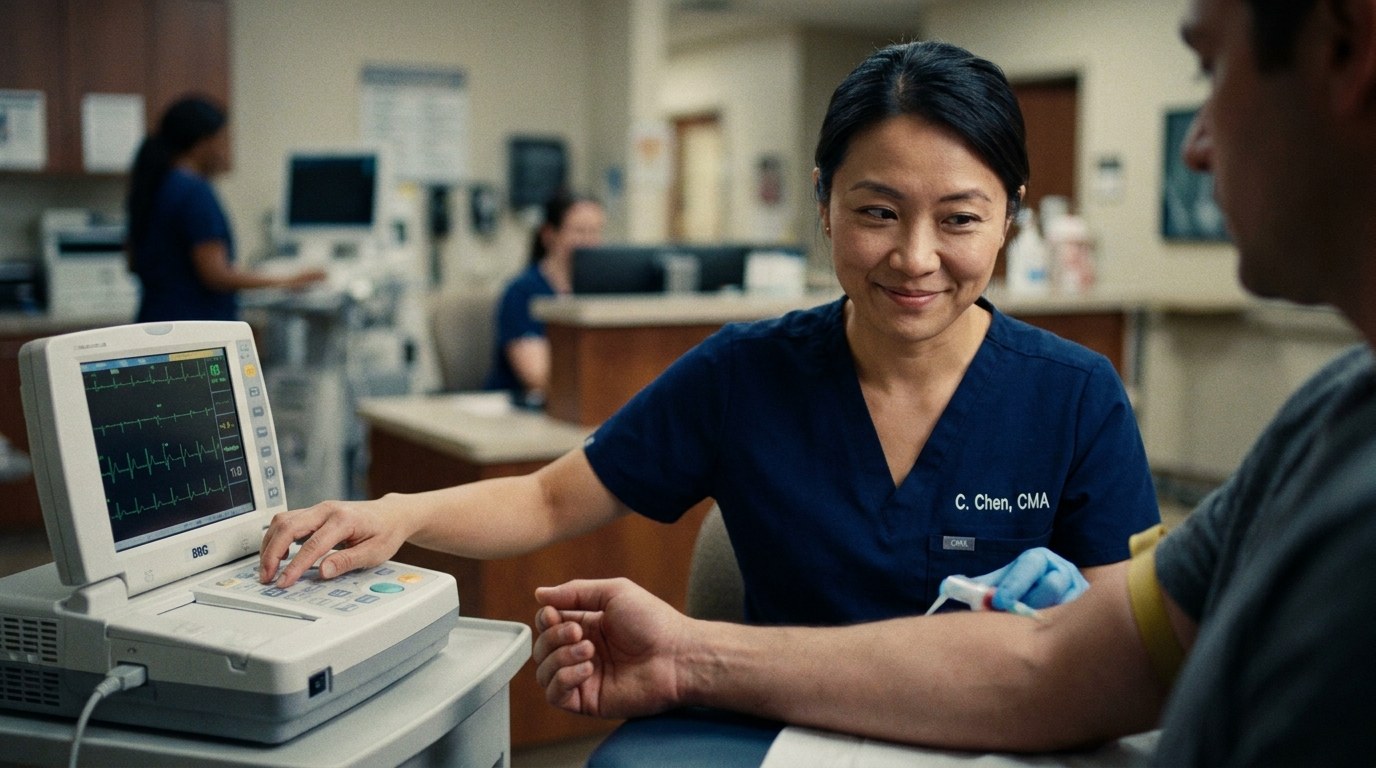
A medical assistant is a cross-trained healthcare professional who handles both clinical and administrative tasks inside physician offices, clinics, and health systems. They are the connective tissue of most outpatient healthcare settings.
On the clinical side, a medical assistant ‘s day typically includes:
On the administrative side, responsibilities often include scheduling appointments, managing electronic health records (EHR), processing insurance referrals, and handling front-desk patient intake. This dual skill set is what makes MAs so valuable — one trained person covers work that might otherwise require two separate hires.
Most medical assistants work in outpatient settings: private physician practices, multi-specialty group practices, urgent care centers, and outpatient clinics. A smaller segment works in hospitals, laboratory settings, or for specialty practices like dermatology and orthopedics.
In the DMV specifically, the demand for this skill set is amplified by one of the densest healthcare ecosystems on the East Coast. More on that shortly.
—
Medical Assistant Salaries in Virginia and the DMV
The DMV pays medical assistants meaningfully more than most of the country — and that gap widens as you gain experience and credentials.
DMV Metro Wage Data (BLS OES)
According to the U.S. Bureau of Labor Statistics Occupational Employment and Wage Statistics (OES) program, medical assistants in the Washington-Arlington-Alexandria, DC-VA-MD-WV Metropolitan Statistical Area earn the following:
(DC Metro MSA)
Annual Wage
DMV Earners
(Entry-Level)
> Always verify current figures at bls.gov/oes before making career decisions. BLS updates OES data annually, and wages in the DMV market move quickly.
How Much Does a Medical Assistant Make in Virginia Statewide?
Virginia’s statewide median for medical assistants sits slightly below the DC metro figure — reflecting the earnings premium that comes with working in higher-cost Northern Virginia versus other parts of the state. Statewide, you’re generally looking at a median in the $40,000–$43,000 range, with Fairfax County, Arlington, and Alexandria-area positions clustering at the higher end.
What Drives Higher Pay in the DMV?
Three factors push medical assistant salaries above the national average in this region:
1. Cost of living premium. Northern Virginia is one of the most expensive metro areas in the country. Healthcare employers have to pay more to attract and retain workers.
2. Employer competition. Large integrated health systems, federal health agencies, and a dense private practice market compete aggressively for qualified MAs.
3. Certification preference. DMV employers heavily favor nationally certified MAs — and certified MAs consistently earn more. Nationally certified candidates often negotiate higher starting offers.
—
Where Medical Assistants Work in Northern Virginia and DC
The DMV’s healthcare infrastructure is extraordinary by any measure — and it creates unusually stable, long-term demand for medical assistants.
Major Health Systems and Employer Types
Inova Health System is the dominant health system in Northern Virginia, operating five hospitals and dozens of outpatient clinics across Fairfax County, Loudoun, Prince William, and Alexandria. Inova regularly posts MA openings across its physician group practices and specialty clinics.
Kaiser Permanente Mid-Atlantic operates a large integrated care network across Northern Virginia and suburban Maryland, with a model that places MAs at the center of its care teams. Their Northern Virginia medical centers — including facilities in Tysons, Reston, and Burke — represent consistent hiring ground.
MedStar Health covers DC and the Maryland suburbs extensively, with Georgetown University Hospital and Washington Hospital Center anchoring an outpatient network that employs hundreds of MAs.
Private and multi-specialty practices make up the largest segment of MA employment in Northern Virginia. Fairfax County alone hosts thousands of independent and group practices in internal medicine, pediatrics, OB/GYN, dermatology, and orthopedics.
Urgent care chains — including FastMed, CareNow, and AFC Urgent Care — have expanded aggressively across the Northern Virginia suburbs and offer entry-level MA positions with relatively flexible scheduling.
Federal health facilities and contractors round out the employer picture. The National Institutes of Health (NIH) in Bethesda, the Veterans Affairs Medical Center in DC, and contracting organizations that staff Walter Reed National Military Medical Center all hire MAs and MA-adjacent clinical support staff on a regular basis.
Job Growth Outlook
The Bureau of Labor Statistics projects medical assistant employment to grow approximately 14% through 2032 — well above the average for all occupations. That projection, combined with the DMV’s population growth and aging demographic, makes this a career with durable demand rather than a short-term trend.
—
How Long Does It Take to Become a Medical Assistant in Virginia?
Most people working as medical assistants in the DMV completed a certificate or diploma program — not a four-year degree. Here’s how the typical paths break down.
Certificate Programs (9–12 Months)
The most common route. Certificate programs offered by community colleges and private career schools cover clinical skills, anatomy and physiology basics, pharmacology, medical law and ethics, and EHR software. Programs typically run 9 to 12 months full-time. Some accelerated formats exist, but be cautious — quality and employer recognition vary widely across programs.
Associate Degree Programs (2 Years)
Community colleges like Northern Virginia Community College (NOVA) offer associate degree programs in Medical Assisting. The degree provides broader academic grounding and may open doors to supervisory or specialist roles, but it requires two years of enrollment and significantly higher total tuition.
Licensure in Virginia — What You Need to Know
Virginia does not require state licensure for medical assistants. Unlike nursing or other clinical professions, MAs are not licensed by the Virginia Department of Professional and Occupational Regulation (DPOR) or any state board. However, this does not mean credentials are irrelevant.
National certification is strongly preferred by most DMV employers:
Expect many Northern Virginia job postings to list CMA or RMA as preferred or required. Earning certification before you job search gives you a concrete edge.
- MA Certificate: 9–12 months → eligible for national certification exam
- MA Associate Degree: ~24 months → broader academic credential
- Massage Therapy (AVI): Approximately 9–12 months of hands-on training → eligible for Virginia State Board exam
- Basic Esthetics (AVI): As few as 6–8 months → Virginia State Board licensure pathway
- Cosmetic Laser Technician (AVI): Focused program → fast entry into medical aesthetics
—
Exploring Similar Hands-On Healthcare Careers — Including Options at AVI Career Training
If you’re drawn to a hands-on, client-facing career in health and wellness, the medical assistant path is one option — but it’s not the only one worth knowing about.
There’s a category of careers that sits at the intersection of healthcare and aesthetics: medical esthetics, massage therapy, and cosmetic laser technology. These fields share several key features with medical assisting — direct client contact, anatomy-based knowledge, and a focus on physical wellbeing — while offering different training timelines, licensing structures, and earning trajectories.
For career-changers in the DMV, these distinctions matter.
The Medical Esthetician vs. Medical Assistant Salary Question
When people compare medical assistant vs. medical esthetician salary, the honest answer is: it depends heavily on your specialty, employer, and client base. A licensed esthetician working in a medical spa in McLean, Tysons Corner, or Arlington — serving a high-income clientele — can build a compensation picture that competes strongly with or exceeds the MA median. Add cosmetic laser certifications, and that ceiling rises further.
The DMV is one of the strongest markets in the country for medical aesthetics. The density of affluent households, the region’s culture of professional appearance, and the growth of medspa businesses across Northern Virginia create real earning opportunity for licensed wellness professionals.
Mini-Story: From Uncertain Career-Changer to Licensed Esthetician
Consider someone like Maya — a 29-year-old administrative coordinator from Fairfax who spent two years researching healthcare careers before she landed on esthetics. She had explored MA programs but was hesitant about the phlebotomy requirements and the rigid clinic scheduling. What she really wanted was client interaction, visible results, and a career that matched her interest in skincare science.
She enrolled in AVI Career Training’s Basic Esthetics program in Vienna, Virginia. Within months, she was performing facials, chemical peels, and skin analysis on real clients in AVI’s student clinic. After completing her program hours and passing the Virginia State Board exam, she landed a position at a medical spa in Tysons Corner — less than five miles from where she’d been sitting at a desk wondering what to do next.
What AVI Career Training Offers
AVI Career Training is a COE-accredited, SCHEV-certified career school located in Vienna, Virginia — in the heart of Northern Virginia, just minutes from Tysons Corner. AVI’s programs are built specifically for people who want to enter the beauty and wellness workforce with credentials that Virginia employers recognize.
Current programs that overlap with the allied health and wellness career space include:
AVI’s curriculum is built on inclusive techniques — meaning graduates are trained to work effectively on every skin tone and across diverse client populations. In the DMV’s multicultural market, that’s not a footnote; it’s a genuine professional advantage.
Mini-Story: Career Pivot Into Cosmetic Laser Technology
Consider David, a 35-year-old former pharmacy technician from Herndon who wanted out of retail pharmacy but wasn’t sure where to pivot within healthcare-adjacent work. He had excellent clinical instincts and a strong interest in dermatology but didn’t want to spend two years in an associate degree program. He researched cosmetic laser programs and found AVI’s Cosmetic Laser Technician program in Vienna.
The focused curriculum let him train on real equipment, understand the science of laser-skin interaction, and build the technical competencies medspa employers look for. He completed the program on a timeline that worked around his existing work schedule and started applying to Northern Virginia medspas before the year was out.
—
Frequently Asked Questions
Q: How much does a medical assistant make in Virginia?
A: Virginia’s statewide median annual wage for medical assistants is approximately $40,000–$43,000, according to BLS OES data. In the Northern Virginia portion of the DC metro area, that median rises to roughly $44,000–$46,000. Top earners with experience and national certification in the DMV can reach $56,000 or more annually.
Q: Where do medical assistants work in the DC metro area?
A: The majority of medical assistant jobs in the DMV are in outpatient settings: physician group practices, multi-specialty clinics, urgent care centers, and health system outpatient facilities. Major employers include Inova Health System, Kaiser Permanente Mid-Atlantic, MedStar Health, and a large network of private practices across Fairfax County, Arlington, and Montgomery County.
Q: Do medical assistants need a license in Virginia?
A: No. Virginia does not require state licensure for medical assistants. However, national certification — either CMA through the AAMA or RMA through the AMT — is strongly preferred by DMV employers and often listed as a requirement in job postings. Certification also correlates with higher starting pay.
Q: How long does it take to become a medical assistant ?
A: Certificate programs — the most common training path — typically take 9 to 12 months of full-time enrollment. Associate degree programs at community colleges like NOVA take approximately two years. After completing an accredited program, graduates are eligible to sit for the CMA or RMA national certification exam.
Q: What careers are similar to medical assistant but with faster training?
A: Several hands-on, client-facing wellness careers offer comparable or faster training timelines. Esthetics programs can lead to Virginia State Board licensure in as few as six to eight months. Cosmetic laser technician programs offer focused, fast-track training in aesthetic laser treatments. Massage therapy programs typically run 9 to 12 months and lead to Virginia State Board eligibility upon completion. All three are available at AVI Career Training in Vienna, Virginia.