Medical Assistant Careers in the DMV: Salary & Where to Work
Medical assistants in the Washington DC metro area earn a median salary between $44,000 and $48,000 per year — well above the national median — and the region’s dense network of hospitals, specialty clinics, and medical spas means job openings are plentiful for trained, certified candidates.
If you’re weighing a career as a medical assistant in Northern Virginia, DC, or Maryland, this guide answers the questions that matter most: what you’ll earn, where you’ll work, whether you need a license, and what the fastest path into the field actually looks like.
⚡ Key Takeaways
- The DC-metro median MA salary is $44,000–$48,000/year; top earners in Virginia clear $55,000+
- Virginia does not require state licensure for medical assistants, but national certification (CMA or RMA) significantly boosts hiring odds and pay
- Major DMV employers include Inova Health System, MedStar Health, Kaiser Permanente Northern Virginia, and Privia Health
- Medical assisting jobs are projected to grow 14% nationally through 2032 — faster than average for all occupations
- Fairfax County ranks among the highest healthcare employment densities in all of Virginia
—
What Does a Medical Assistant Actually Do?
Medical assistants are cross-trained healthcare professionals who handle both clinical and administrative responsibilities — making them among the most versatile members of any outpatient care team.
Clinical Duties
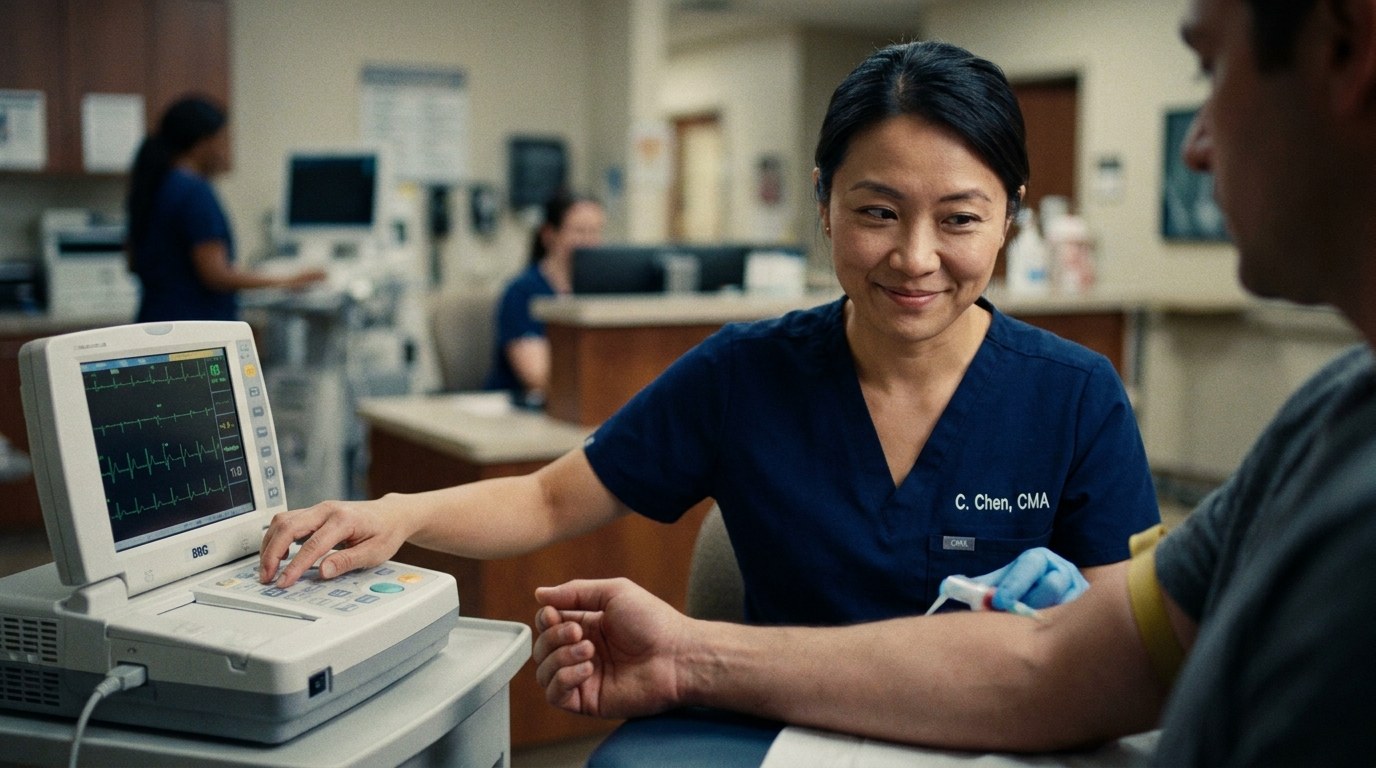
On the clinical side, your day might include taking patient vitals, drawing blood (phlebotomy), performing EKGs, administering injections, preparing exam rooms, assisting with minor procedures, and handling patient intake. In specialty settings like dermatology or plastic surgery clinics, MAs often assist with more advanced procedures — including working alongside cosmetic laser technicians during skin treatments.
Administrative Duties
On the administrative side, MAs schedule appointments, manage patient records in electronic health systems (EHR), handle prior authorizations, process insurance billing, and serve as the communication bridge between patients and providers.
This dual skill set is exactly why demand is so strong. A well-trained MA reduces the workload for physicians and nurse practitioners — and healthcare systems across the DMV know it.
Medical Assistant vs. Clinical Assistant in Virginia
You may see job postings that say “Clinical Medical Assistant” or simply “Clinical Assistant.” In Virginia, these titles are often used interchangeably. The key distinction is scope of practice: a clinical MA with formal training and national certification can typically take on a broader range of hands-on duties than an uncertified clinical assistant hired purely for administrative support. When reviewing job postings for medical assistant jobs in Northern Virginia, check the required vs. preferred credentials carefully — certification consistently unlocks higher-paying positions.
—
How Much Do Medical Assistants Earn in Virginia and DC?
The medical assistant salary in the DMV is consistently above the national average — and that gap widens significantly with certification and experience.
Virginia State Median
According to Bureau of Labor Statistics (BLS) Occupational Employment & Wage Statistics data, the median annual wage for medical assistants in Virginia falls in the $40,000–$42,000 range. That’s a solid baseline — especially for a role that typically requires months of training rather than a four-year degree.
DC Metro Area (Washington-Arlington-Alexandria MSA)
Zoom into the Washington-Arlington-Alexandria metropolitan statistical area and the numbers climb. The DC-metro median for MAs sits between $44,000 and $48,000 annually — reflecting the region’s higher cost of living, strong healthcare infrastructure, and competitive employer market.
Entry-Level vs. Experienced Pay
Entry-level MAs in Northern Virginia — those with less than one year of experience and no national certification — typically start in the $35,000–$39,000 range. That’s not a ceiling; it’s a launchpad. With two to three years of experience and a Certified Medical Assistant (CMA) credential, it’s common to land in the $44,000–$50,000 range. The top 10% of Virginia MAs earn $55,000 or more, with those working in specialty practices — dermatology, plastic surgery, cardiology, and fertility clinics — often leading that group.
How Much Do Medical Assistants Make in Virginia Compared to Neighbors?
For context: Maryland MAs in the Baltimore-DC corridor earn comparably, while DC proper sometimes edges higher due to municipal wage structures. If you live in Northern Virginia and are willing to cross the river or hop on the Metro, your earning potential increases further. Many MAs in the DMV treat their geographic flexibility as a real financial advantage.
> ⚠️ Note: Salary figures in this article are drawn from BLS Occupational Employment & Wage Statistics data. Always verify against the most current annual BLS release before making career decisions.
—
Where Do Medical Assistants Work in the DMV?
The DMV is one of the most healthcare-rich regions in the United States — and that translates directly into job opportunity for trained medical assistants.
Major Health Systems
Inova Health System is the largest private employer in Northern Virginia and consistently one of the largest hirers of medical assistants in the region. Inova operates hospitals, urgent care centers, specialty clinics, and outpatient facilities across Fairfax, Loudoun, Prince William, and Alexandria — all actively recruiting MAs.
MedStar Health spans the broader DMV, with facilities in DC, Maryland, and Northern Virginia. Their outpatient and specialty network creates steady openings for clinical MAs.
Kaiser Permanente Northern Virginia operates a dense network of medical offices across the region — Falls Church, Tyson Corner, Reston, and beyond — and is a consistent employer of MAs with a preference for certified candidates.
Privia Health is a newer but fast-growing physician management group with a strong footprint across Northern Virginia and DC. Their practice model relies heavily on well-trained MAs to support physician efficiency.
Specialty Practices & Urgent Care
Beyond health systems, allied health jobs in Fairfax County span dozens of independent specialty practices — dermatology, orthopedics, pediatrics, OB/GYN, cardiology, and behavioral health. Urgent care chains like AFC Urgent Care, Patient First, and CityMD also hire MAs at multiple Northern Virginia locations.
Fairfax County ranks among the highest healthcare employment densities in all of Virginia, according to the Fairfax County Economic Development Authority. That density means lower commute-to-opportunity ratios for residents of the Tysons Corner, Vienna, Reston, and Herndon corridors.
Medical Spas, Dermatology, and Plastic Surgery Clinics
One of the fastest-growing employment categories for MAs in Northern Virginia is the medical aesthetics space — medical spas, dermatology offices, and plastic surgery practices. These settings often blur the line between clinical care and cosmetic treatment. MAs in these environments may assist with injectable procedures, pre- and post-treatment skin assessments, and patient coordination for laser and aesthetic services.
This is also where the medical assistant career path in the DC metro intersects with beauty and wellness careers. In many medical spa settings, MAs work directly alongside cosmetic laser technicians and licensed estheticians — a collaborative model that reflects the growing overlap between healthcare and aesthetics.
—
Do You Need a License or Certification to Work as a Medical Assistant in Virginia?
Virginia does not require state licensure to work as a medical assistant — and this surprises many people researching the field.
Unlike licensed practical nurses (LPNs) or registered nurses (RNs), MAs in Virginia are not regulated by the Virginia Department of Professional and Occupational Regulation (DPOR). You are not required to pass a state licensing exam or hold a state-issued credential to legally work as an MA in Virginia.
So Why Does Certification Still Matter?
Because employers care — a lot. While Virginia doesn’t mandate a license, the vast majority of competitive healthcare employers in the DMV strongly prefer or outright require national certification. The two primary credentials are:
Certified MAs consistently earn more, get hired faster, and are trusted with a broader scope of clinical duties. In competitive DMV markets — where health systems like Inova and Kaiser have their pick of applicants — a CMA or RMA credential is often the deciding factor between two equally personable candidates.
The “No License Required” Misunderstanding
Some people interpret “no state license required” to mean “no training needed.” That’s a costly misreading. Employers expect formal, structured training — both to meet internal clinical standards and to satisfy liability and compliance requirements. Candidates who complete accredited programs and earn national certification will consistently outcompete those who don’t, regardless of what the state law says.
—
Where Healthcare and Aesthetics Careers Connect in Northern Virginia
The medical assistant career path in the DC metro doesn’t have to follow a single linear track. Many MAs use the role as a launching pad toward broader healthcare careers — or pivot into specialty niches that combine clinical skills with aesthetics.
Career Trajectory: Where MAs Go Next
Here’s how MAs in Northern Virginia commonly advance:
That last path is increasingly common in the DMV. Northern Virginia’s medical aesthetics industry has grown substantially, particularly in the Tysons Corner corridor, Reston, and Old Town Alexandria — where medical spas and dermatology practices compete for skilled, clinically-trained team members.
A Note on Career-Adjacent Training in Northern Virginia
If you’re drawn to the aesthetic side of medical settings — laser treatments, skin care, and cosmetic procedures — formal aesthetics training is a powerful complement to clinical work. AVI Career Training, located in Vienna, Virginia near the Tysons Corner area, trains students in Cosmetic Laser Technology and Esthetics specifically for careers in medical spa and dermatology environments. Many students in these programs go on to work in the same clinical settings where MAs are employed — sometimes side by side.
Destiny, a former retail manager from Centreville, Virginia, spent eight years managing people and schedules before deciding she wanted a career with real clinical purpose. She enrolled in a medical assistant training program at a local community college, earned her CMA credential, and within three months of graduating landed a full-time MA position at a Privia Health practice in Reston. Two years later, she was promoted to Lead Medical Assistant — supervising a team of four — earning just over $50,000 annually. Her advice to career changers: “The certification is what opened the door. The experience kept it open.”
Marcus graduated from a Northern Virginia MA program in the spring and wasn’t sure whether to apply to a hospital system or a specialty clinic. He’d always been interested in dermatology. He applied to a dermatology practice in McLean — and during the interview, the clinical director asked whether he had any knowledge of laser or aesthetic procedures. He didn’t — but he mentioned he was researching cosmetic laser training. He got the job. Within a year, he was cross-training with the laser technician on staff, learning the aesthetic side of the practice. The dual skill set, his supervisor told him, made him “almost impossible to replace.”
—
How to Start Your Medical Assistant Career in Northern Virginia
Starting a medical assistant career in the DC metro area is more accessible than many people expect — and the timeline from training to employment is relatively short.
What to Look for in an MA Training Program
When evaluating programs, look for these key signals:
Timeline to Employment
Most accredited MA programs run between nine months and two years, depending on whether you pursue a certificate, diploma, or associate degree. Certificate programs can position you to sit for the CMA or RMA exam within a year of starting. Combined with active job searching during your final externship rotation, many graduates in Northern Virginia are employed within 60–90 days of program completion.
Financial Aid and Funding Options
Funding options for MA training vary by program type and duration. Programs that exceed 600 clock hours and meet Title IV eligibility requirements may qualify for federal financial aid (FAFSA/Pell Grant). Some programs also accept the GI Bill® for eligible veterans. If you’re comparing programs, always ask the admissions team directly about financial aid eligibility — it varies significantly between institutions, and the difference in out-of-pocket cost can be substantial.
—
Frequently Asked Questions About Medical Assistant Careers in the DMV
Q: How much does a medical assistant make in Virginia?
A: The median annual salary for medical assistants in Virginia is approximately $40,000–$42,000, according to BLS data. In the DC metro area (Washington-Arlington-Alexandria MSA), the median climbs to $44,000–$48,000. The top 10% of Virginia MAs earn $55,000 or more, particularly in specialty and medical aesthetics settings.
Q: Where do medical assistants work in the DC area?
A: Medical assistants in the DMV work across a wide range of settings — large health systems like Inova Health System, MedStar Health, and Kaiser Permanente Northern Virginia; independent specialty practices in dermatology, cardiology, and orthopedics; urgent care chains; and rapidly growing medical spas and cosmetic clinics. Fairfax County has one of the highest concentrations of healthcare employment in Virginia.
Q: Do medical assistants need a license in Virginia?
A: No. Virginia does not require state licensure for medical assistants. The Virginia Department of Professional and Occupational Regulation (DPOR) does not regulate the MA profession at the state level. However, national certification through the AAMA (CMA) or AMT (RMA) is strongly preferred by most competitive employers and directly affects hiring and pay outcomes.
Q: What is the difference between a medical assistant and a CMA?
A: “Medical assistant” is the broad job title. “CMA” (Certified Medical Assistant) refers specifically to an MA who has passed the national certification exam administered by the American Association of Medical Assistants (AAMA). CMAs have demonstrated a standardized level of clinical and administrative competency. Most health systems in the DMV prefer or require CMA certification for clinical roles.