Medical Assistant Careers in Northern Virginia: What to Know
Northern Virginia’s healthcare and aesthetic medicine job market is one of the strongest in the country — and if you’re researching medical assistant programs in Northern Virginia, you’re already thinking smart about your career future.
This guide covers everything you need to know: what medical assistants actually do, Virginia’s licensing landscape, what MAs earn in the DC metro area, and — just as importantly — the faster, equally rewarding healthcare-adjacent careers that many Northern Virginia job seekers are quietly choosing instead.
Ready to take the next step? Apply now at AVI Career Training →
- Medical assistants in the DC metro area earn $45,000–$52,000+ annually, above the national median of ~$42,000
- Virginia does not require state licensure for medical assistants — but national certification (CMA, RMA) is strongly preferred by employers
- MA job growth is projected at 14% through 2032 — faster than average (BLS)
- Cosmetic laser technicians and licensed estheticians are hired in the same NoVA med spa and dermatology clinic environments as medical assistants
- AVI Career Training in Vienna, Virginia offers COE-accredited, hands-on programs in Cosmetic Laser Technology, Electrolysis, and Esthetics — with training timelines significantly shorter than most traditional MA programs
—
What Does a Medical Assistant Actually Do?
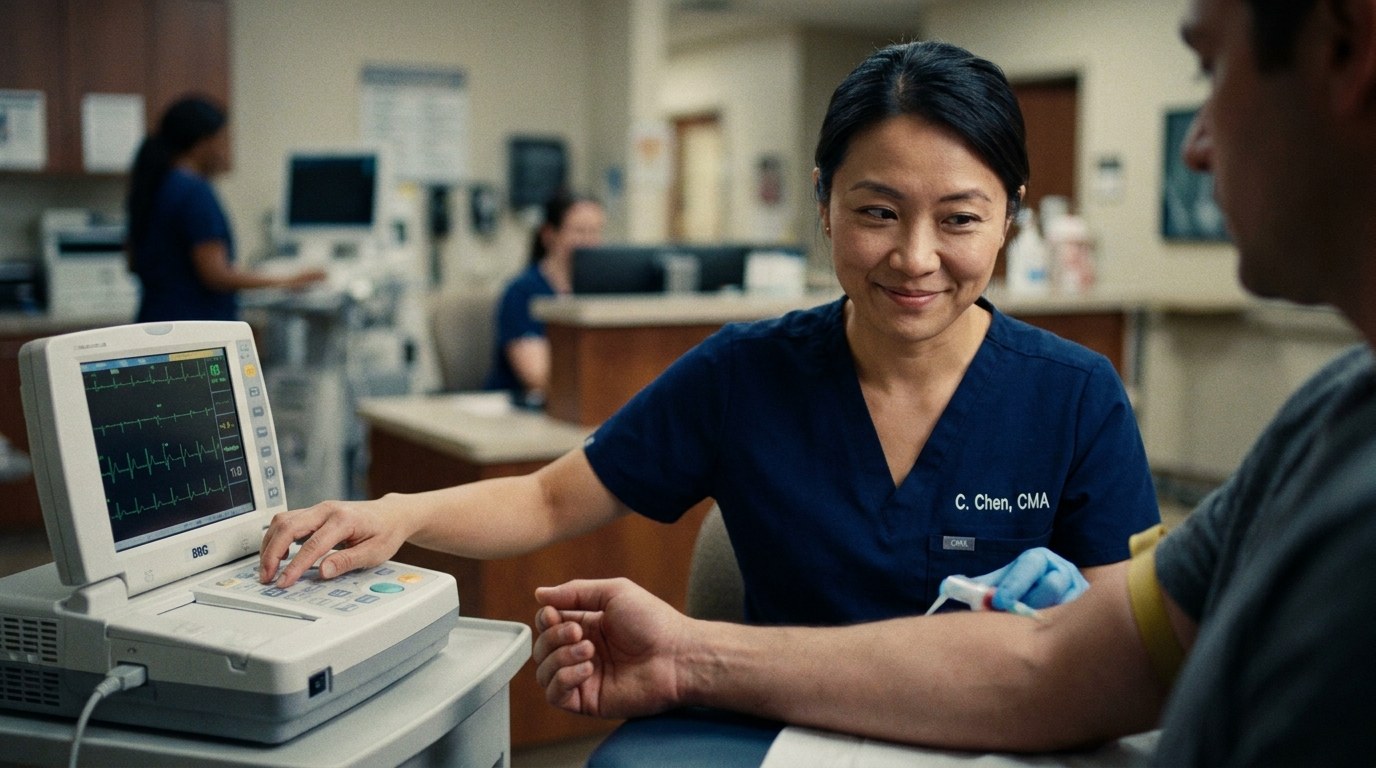
Medical assistants are the backbone of outpatient clinical settings — they handle both the clinical and administrative side of patient care.
On the clinical side, MAs take vital signs, prepare exam rooms, assist physicians during procedures, draw blood, administer injections, and in some practices, perform basic skincare prep or laser-adjacent support tasks. On the administrative side, they manage scheduling, insurance documentation, patient records, and billing.
Common work settings for medical assistants include:
The dermatology and med spa crossover is particularly relevant for Northern Virginia. The Tysons Corner, Arlington, and Fairfax corridors have seen significant growth in aesthetic medicine practices — and those settings hire both credentialed medical assistants and licensed cosmetic professionals like laser technicians and estheticians.
That distinction matters, and we’ll come back to it.
—
Virginia Licensing Requirements for Medical Assistants
Virginia does not require state licensure for medical assistants — but that doesn’t mean credentials don’t matter.
Most employers in Northern Virginia, especially in competitive clinical environments, expect candidates to hold or be working toward a nationally recognized certification. The three most common are:
National MA Certification Options
- CMA (Certified Medical Assistant) — Issued by the American Association of Medical Assistants (AAMA); requires graduation from a CAAHEP- or ABHES-accredited program
- RMA (Registered Medical Assistant) — Issued by American Medical Technologists (AMT); multiple eligibility pathways including work experience
- NCMA (National Certified Medical Assistant) — Issued by the National Center for Competency Testing (NCCT)
The absence of state licensure can feel like a green light — but it’s actually a reason to pay more attention to which training program you choose. Employers use certification as a proxy for quality. A program that prepares you to sit for the CMA or RMA exam is worth far more than one that simply issues a completion certificate.
This principle applies across the healthcare and allied health training world: look for programs tied to a recognizable credentialing body, taught by licensed professionals, and accredited by a legitimate third-party organization.
For context, the Council on Occupational Education (COE) is one such accreditor — and it’s the same body that accredits AVI Career Training in Vienna, Virginia for its allied health-adjacent programs.
—
Medical Assistant Salary & Job Outlook in Northern Virginia
The DC metro area is one of the best-paying regions in the country for medical assistants — and Northern Virginia is at the center of that opportunity.
According to the Bureau of Labor Statistics, medical assistant employment is projected to grow 14% through 2032 — faster than the average for all occupations. That demand is even more pronounced in the DC metro area, driven by:
What factors affect where you land in that salary range?
Certification status, clinical specialty, and work setting all matter. MAs working in dermatology or cosmetic medicine settings tend to earn closer to the higher end of that range, particularly with additional training in laser or skin-focused procedures.
That’s where the career landscape starts to get interesting — because some of the fastest-moving jobs in these exact settings aren’t titled “medical assistant” at all.
—
Faster Healthcare-Adjacent Career Paths Worth Considering
Here’s a question worth sitting with: What careers are similar to medical assistant but faster to complete?
For many Northern Virginia job seekers, the answer is already reshaping how they think about healthcare training — and it runs through the same Tysons Corner and Fairfax med spas where MAs work.
The Northern Virginia Aesthetic Medicine Corridor
Northern Virginia has developed one of the Mid-Atlantic’s densest concentrations of aesthetic medicine practices. Med spas, dermatology clinics, laser centers, and cosmetic surgery offices are hiring aggressively — not just for clinical administrative support, but for licensed technical specialists who can operate equipment, perform treatments, and generate direct revenue.
These roles include:
Why are these worth serious consideration alongside medical assistant programs in Northern Virginia?
- Shorter credential timeline — Many cosmetic laser and esthetics programs can be completed in months rather than a year or more
- Same work environments — Med spas, dermatology clinics, and laser centers employ both MAs and licensed beauty/wellness professionals side by side
- Clear licensing structure — In Virginia, electrologists are licensed by the Virginia Department of Professional and Occupational Regulation (DPOR), giving graduates a credential with defined regulatory standing
Meet Someone Who Made the Pivot
Consider a scenario that plays out regularly in the Northern Virginia career market: A Reston-based office administrator in her early 30s starts researching medical assistant programs, drawn by the idea of working in healthcare. After comparing program lengths and outcomes, she discovers that a Cosmetic Laser Technology program at AVI Career Training in Vienna could put her in a med spa environment — doing hands-on clinical work — in a fraction of the time. She enrolls, completes her training, and lands a role at a Tysons Corner laser clinic. Same clinical setting she envisioned. Faster path to get there.
This isn’t a one-off story. It reflects a genuine shift in how Northern Virginia job seekers are approaching allied health careers.
AVI’s Programs in This Space
AVI Career Training, located in Vienna, Virginia — minutes from Tysons Corner — offers COE-accredited training in:
Note on financial aid: These programs vary in length and financial aid eligibility. Contact AVI directly at (703) 943-9841 or apply here to discuss which programs qualify for financial aid, GI Bill® benefits, or payment plan options based on your specific program of interest.
—
Can an Esthetician Work in a Medical Setting in Virginia?
Yes — and this question comes up constantly among people exploring both the medical assistant and esthetics paths simultaneously.
Licensed estheticians in Virginia can and do work in medical settings, including:
The key distinction is scope of practice. Estheticians work within their licensed scope — skincare treatments, facials, chemical peels, waxing, and in some settings, laser-assisted services under medical supervision. They are not performing clinical nursing tasks or acting as MAs. But in the Northern Virginia aesthetic medicine corridor, where client experience and skin outcomes are central to the business model, licensed estheticians are genuinely valued team members.
For someone who loves the skin and aesthetics side of healthcare but wants to avoid the administrative-heavy world of traditional medical assisting, this path is worth a serious look.
—
What to Look For in Any Career Training Program in Northern Virginia
Whether you’re evaluating medical assistant programs in Northern Virginia or exploring allied health-adjacent alternatives, the same quality markers apply.
Accreditation First
Accreditation is not optional. It tells you that an outside body has reviewed the school’s curriculum, instructors, facilities, and student outcomes and found them to meet a defined standard.
For MA programs specifically, look for CAAHEP or ABHES accreditation if your goal is CMA certification eligibility. For broader allied health and wellness training, the Council on Occupational Education (COE) is a federally recognized accreditor covering vocational and career programs — including esthetics, laser, and electrolysis training.
AVI Career Training holds COE accreditation and SCHEV certification, meaning it meets Virginia’s standards for career school operation and has been reviewed by a national accrediting body.
Hands-On Clinical Hours
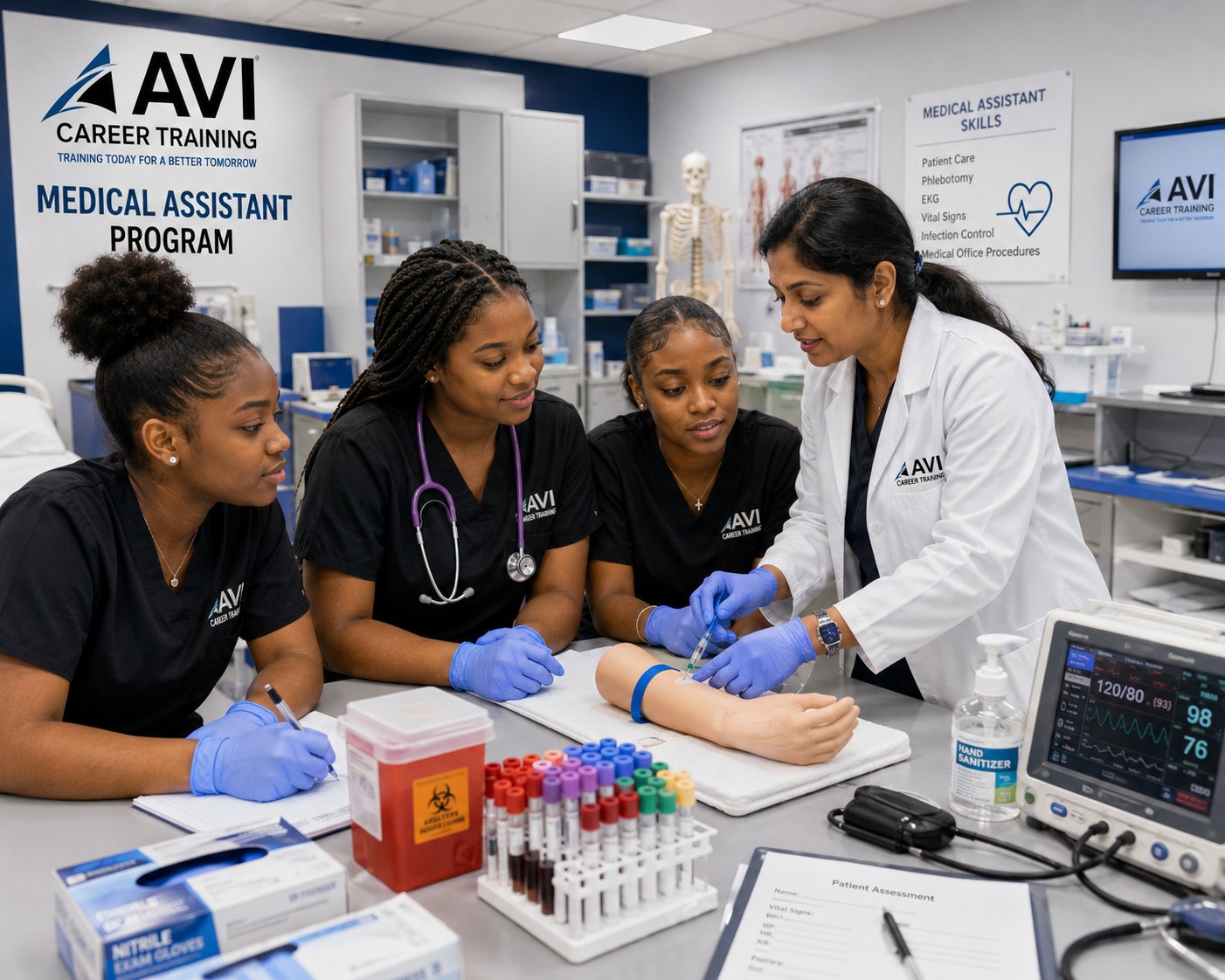
Clock hours matter. A program that gets you classroom-certified without real hands-on practice is not preparing you for the job market. Ask any program you’re considering: How many hours are clinical or practical? Are students working on real clients or just mannequins?
At AVI Career Training, students train on real clients in a professional environment — because that’s what the industry actually requires.
Licensing Exam Preparation
If your target career path requires a licensing exam (Virginia State Board for esthetics, DPOR for electrolysis, or a national certification exam for MAs), your program should be explicitly designed around preparing you to pass it. Ask programs directly: What is your pass rate on licensing exams?
Financial Aid & Veteran Benefits
Northern Virginia has one of the highest concentrations of active military, veterans, and military spouses in the country. If you’re in that community and considering a career change, GI Bill® benefits can significantly reduce your out-of-pocket training costs at eligible schools.
AVI Career Training accepts the GI Bill® for eligible programs. Financial aid availability varies by program length — reach out to admissions at (703) 943-9841 for current eligibility details.
- ✅ Accredited by a recognized accrediting body (COE, CAAHEP, ABHES, or equivalent)
- ✅ State-certified in Virginia (SCHEV for career schools)
- ✅ Hands-on training hours with real clients
- ✅ Clear licensing or certification exam prep built into the curriculum
- ✅ Financial aid, GI Bill®, or payment plan options available
- ✅ Instructors who are licensed, working professionals in the field
—
Frequently Asked Questions
Q: How long does it take to become a medical assistant in Virginia?
A: Most medical assistant programs take nine to 12 months for certificate programs, or up to two years for an associate degree. Program length varies by format (full-time vs. part-time) and whether the program includes an externship component, which is common and typically required for CMA exam eligibility.
Q: Do medical assistants need a license in Virginia?
A: No — Virginia does not require state licensure for medical assistants. However, national certification (CMA through AAMA, RMA through AMT, or NCMA through NCCT) is strongly preferred by employers and is often listed as a requirement in Northern Virginia job postings. Certification demonstrates competency and makes candidates significantly more competitive.
Q: How much do medical assistants make in Northern Virginia?
A: Medical assistants in the DC metro area typically earn between $45,000 and $52,000 per year, compared to the national median of approximately $42,000 (BLS 2023). Salary varies based on specialty (dermatology and cosmetic medicine settings often pay more), certification status, and years of experience.
Q: What careers are similar to medical assistant but faster to complete?
A: Cosmetic Laser Technician, Licensed Esthetician, and Electrologist are three healthcare-adjacent careers that can be completed faster than most MA programs and lead to work in the same med spa and dermatology clinic environments. In Virginia, electrologists are licensed through DPOR. AVI Career Training in Vienna, Virginia offers COE-accredited training in all three areas.
Q: Can an esthetician work in a medical setting in Virginia?
A: Yes. Licensed estheticians in Virginia can work in medical spas, dermatology offices, plastic surgery practices, and laser centers — within their licensed scope of practice. Many Northern Virginia med spas specifically hire licensed estheticians alongside or instead of medical assistants for skincare and treatment-focused roles.
Q: Is medical assistant a good career in Northern Virginia?
A: Yes. Northern Virginia’s density of healthcare systems, specialty clinics, federal health agencies, and growing aesthetic medicine practices makes it one of the stronger regional markets for MAs. Job growth is projected at 14% nationally through 2032, and DC metro salaries exceed the national average. That said, competition is real — certification and hands-on training experience are increasingly expected.
Q: What is AVI Career Training and what programs do they offer?
A: AVI Career Training is a COE-accredited, SCHEV-certified beauty and wellness career school located in Vienna, Virginia. AVI offers hands-on training in Cosmetology, Esthetics, Massage Therapy, Cosmetic Laser Technology, Electrolysis, and Nail Technology. The school is located at 1595 Spring Hill Rd #720, Vienna, VA 22182, and can be reached at (703) 943-9841.
—