Medical Assistant Programs in Northern Virginia: What to Know
Medical assistant programs in Northern Virginia typically take nine to 15 months to complete and cost between $5,000 and $18,000 — making them one of the fastest, most affordable entry points into healthcare. If you’re researching this path in the NoVA or DC metro area, this guide covers everything you need to compare programs, understand costs, and make a confident decision.
And if you’re still figuring out which healthcare-adjacent career actually fits your goals, keep reading — some of the most in-demand clinical careers right now aren’t medical assisting at all.
—
- Medical assistant certificate programs in Virginia run 9–15 months; associate degree paths take about 2 years
- Median pay for medical assistants in the DC-Arlington-Alexandria metro is approximately $43,000–$50,000/year (BLS)
- Virginia does not require state licensure for medical assistants — but employer-preferred certifications (CMA, RMA) add competitive value
- Northern Virginia has one of the highest concentrations of healthcare employers in the Mid-Atlantic, including Inova Health System and Kaiser Permanente
- Clinical wellness careers — cosmetic laser technology, esthetics, massage therapy — offer comparable earning potential with shorter training timelines and are available at AVI Career Training in Vienna, VA
—
What Does a Medical Assistant Actually Do?
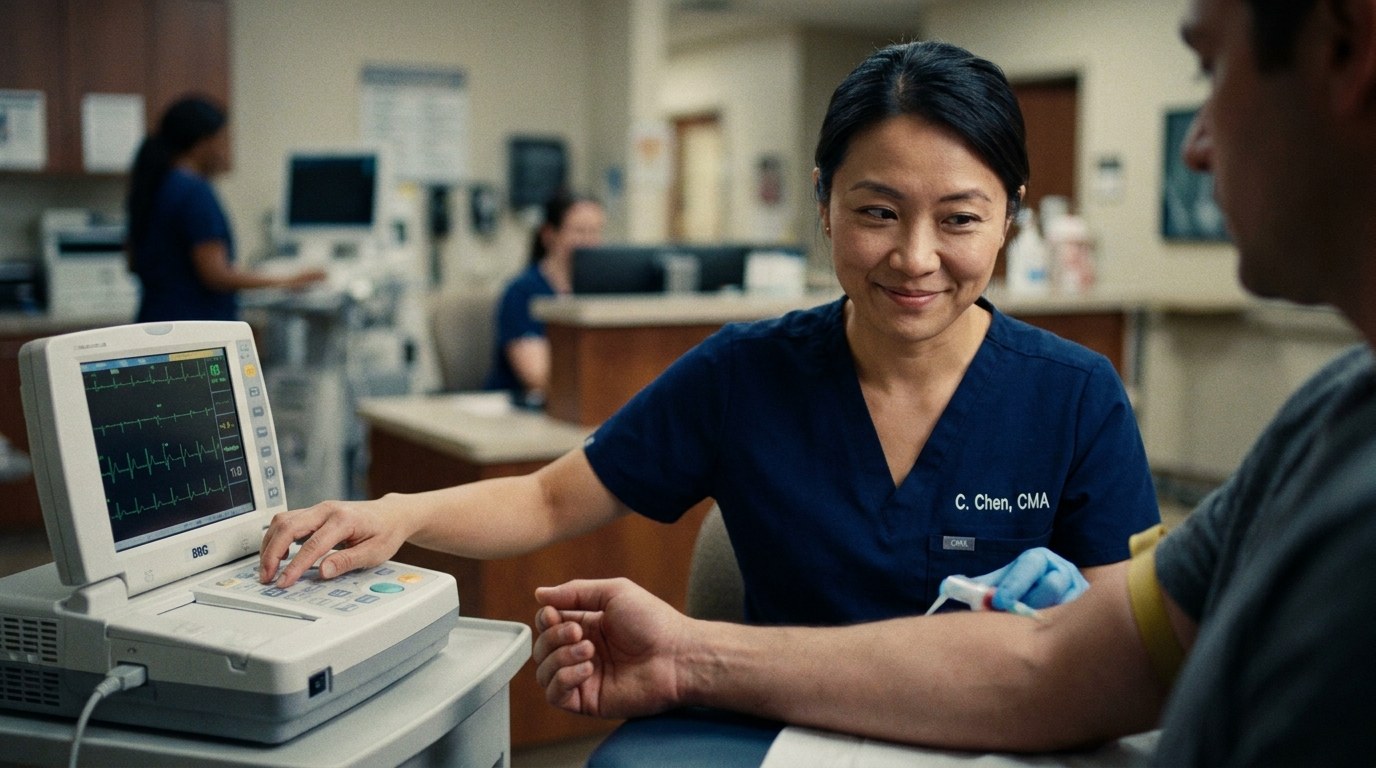
A medical assistant is a multi-tasking clinical and administrative professional who supports physicians and other providers in outpatient settings — think doctor’s offices, urgent care centers, specialty clinics, and community health centers.
The role splits roughly into two categories:
Clinical Responsibilities
Administrative Responsibilities
Most medical assistants work in physician offices (the largest employer category), followed by outpatient care centers, hospitals, and specialty practices. In Northern Virginia, you’ll also find MAs working in dermatology clinics, medical spas, and cosmetic medicine practices — environments that overlap meaningfully with wellness and esthetics careers.
—
Medical Assistant Programs in Northern Virginia — What to Look For
Not all medical assistant programs are built the same. When you’re comparing schools, these are the factors that actually matter for your career outcomes.
Accreditation
Program accreditation is the single most important factor — and the most overlooked. Medical assistant programs can be accredited by the Commission on Accreditation of Allied Health Education Programs (CAAHEP) or the Accrediting Bureau of Health Education Schools (ABHES). Graduating from an accredited program is required to sit for the Certified Medical Assistant (CMA) exam through the American Association of Medical Assistants (AAMA).
If a program isn’t accredited by one of those bodies, graduates may be limited to the Registered Medical Assistant (RMA) exam through the American Medical Technologists (AMT), which has different eligibility requirements.
Always ask a school: “Which certification exam are your graduates eligible to sit for?”
Externship Requirements
A quality medical assistant program includes a supervised externship — typically 160 to 200 hours — at an actual clinical site. This hands-on placement is where you build the real-world confidence that classroom training can’t fully provide. Ask how the school places students in extern sites and whether they have established partnerships with local healthcare facilities.
Certification Exam Prep
Look for programs that explicitly incorporate CMA or RMA exam preparation into the curriculum — not just as an afterthought. Schools that track and publish their exam pass rates are demonstrating accountability. If a school can’t tell you their graduates’ pass rate, that’s a red flag.
Format and Schedule
Northern Virginia programs range from full-time day programs (faster completion) to evening and hybrid formats designed for working adults. Know your schedule before you commit — a program that doesn’t fit your life won’t get finished.
Financial Aid Eligibility
Not all medical assistant programs — especially short certificate formats — qualify for federal Title IV financial aid (FAFSA/Pell Grant). Schools that are regionally or nationally accredited and meet minimum program length requirements are more likely to offer federal aid. Always ask specifically: “Is this program eligible for FAFSA or Title IV financial aid?” Don’t assume.
—
—
How Long Does It Take — and What Does It Cost?
Here’s a realistic breakdown of what medical assistant training looks like in Virginia’s market.
Program Length
| Program Type | Typical Length | Notes |
|---|---|---|
| Certificate / Diploma | 9–15 months | Fastest route; includes externship |
| Associate Degree (AAS) | ~2 years | Broader general education component; community colleges |
| Online / Hybrid | Varies | Clinical hours must still be completed in person |
Program Cost
Medical assistant programs in Virginia range widely in cost:
These figures typically cover tuition only. Factor in textbooks, medical scrubs, supplies, exam fees (CMA exam: approximately $125 for AAMA members), and any parking or commuting costs.
Financial Aid for Medical Assistant Programs
Financial aid availability depends entirely on the program and school. Community college programs almost always qualify for Pell Grants and federal student loans because they’re regionally accredited and meet minimum credit-hour thresholds. Private certificate programs may or may not qualify — you must ask directly.
Some NoVA healthcare training programs also accept the GI Bill® — a critical consideration given the large active-duty and veteran population in the region. Schools must be approved by the Virginia State Approving Agency (SAA) to accept GI Bill® benefits.
> ???? Pro tip: Before enrolling anywhere, ask two questions: “Is this program CAAHEP or ABHES accredited?” and “Is this program eligible for Title IV federal financial aid?” The answers will tell you a lot.
—
Medical Assistant Salary in Northern Virginia
Medical assistants in Northern Virginia earn meaningfully more than the national average — because of the region’s high cost of living, healthcare density, and competition for qualified candidates.
What affects your earning potential as an MA in Northern Virginia?
Northern Virginia’s healthcare market is one of the strongest in the Mid-Atlantic. The region is home to Inova Health System, Kaiser Permanente Mid-Atlantic, the NOVA Healthcare District, and hundreds of specialty practices concentrated in Fairfax, Arlington, and Loudoun counties. That density means real opportunity for trained healthcare workers.
A Note on Specialty Settings and Wellness-Adjacent Roles
Medical assistants who work in dermatology clinics, medical spas, and cosmetic medicine practices often report higher satisfaction and, in some cases, higher pay than those in traditional primary care offices. These settings are also where career paths in esthetics and cosmetic laser technology intersect directly with clinical medicine.
That overlap matters more than most people realize — and it’s worth exploring before you commit to one training path.
—
—
Do You Need a License to Be a Medical Assistant in Virginia?
No — Virginia does not require state licensure for medical assistants. This is one of the most common questions people ask, and the answer surprises many.
Unlike cosmetologists, estheticians, and massage therapists — who must pass Virginia Department of Professional and Occupational Regulation (DPOR) licensing exams — medical assistants in Virginia face no mandatory state credential. That said, the industry has moved strongly toward voluntary certification because employers increasingly require it.
The two most recognized credentials are:
Both require a multiple-choice exam. Certification must be renewed periodically through continuing education.
Bottom line: You won’t lose a Virginia license if you don’t certify, but you may lose job offers. Most competitive employers — especially health systems and multi-provider practices — treat CMA or RMA as a baseline requirement.
—
Not Sure Medical Assisting Is the Right Path? Explore Clinical Wellness Careers
Here’s a question worth sitting with: Are you drawn to healthcare because you want to help people look and feel better — or because you specifically want to work in a medical office?
That distinction matters. A large percentage of people who research medical assisting are actually better suited — and would be more fulfilled — in clinical wellness careers like cosmetic laser technology, esthetics, or massage therapy. These paths offer:
What’s the Difference Between a Medical Assistant and a Medical Esthetician?
A medical assistant supports physicians across a wide range of clinical and administrative functions. A medical esthetician (also called an advanced or clinical esthetician) specializes specifically in skin health — performing advanced facial treatments, pre- and post-procedure skin care in dermatology and plastic surgery offices, laser-assisted treatments, and cosmetic services under medical supervision.
Medical estheticians often work in the same offices as medical assistants — but their day looks completely different. Where an MA might draw blood and schedule appointments, a medical esthetician is performing microneedling prep, chemical peel aftercare, or laser hair removal treatments.
Both roles are valuable. They’re just different careers.
AVI Career Training — Clinical Wellness Programs in Vienna, VA
- Cosmetic Laser Technician — Train to operate laser and light-based devices for hair removal, skin rejuvenation, and aesthetic treatments in medical spa and dermatology clinic environments. This is one of the fastest-growing specialties in aesthetic medicine.
- Basic Esthetics / Master Esthetics — Comprehensive skin care training with clinical applications. Master Esthetics graduates are equipped for medical spa, dermatology, and advanced cosmetic settings. Includes clinical skin care directly applicable to medical office environments.
- Massage Therapy — Licensed clinical application of therapeutic bodywork; graduates work in wellness clinics, chiropractic offices, medical facilities, and private practice.
Why AVI? AVI Career Training is COE-accredited (Council on Occupational Education) and SCHEV-certified (Virginia’s State Council of Higher Education for Virginia). These federally recognized accreditations matter for financial aid eligibility and employer recognition.
AVI also accepts the GI Bill® — a significant differentiator for the large military and veteran community in Northern Virginia and the greater DC metro area. Our campus is located in Vienna, Virginia, just minutes from Tysons Corner, making it easily accessible from Fairfax, McLean, Reston, Arlington, and the broader NoVA region.
Ready to explore a different kind of clinical career? Apply to AVI Career Training today or call us at (703) 943-9841 to talk through which program fits your goals.
—
Real Story: From Healthcare Curiosity to Cosmetic Laser Career
Priya had spent two years as a receptionist at a dermatology practice in Fairfax. She watched medical assistants and laser technicians all day, and she kept coming back to the same thought: I want to be the person doing the treatments.
She researched medical assistant programs — but found that what she actually wanted was to work directly with aesthetic technology. After discovering AVI Career Training’s Cosmetic Laser Technician program, she enrolled and completed her training in Vienna, VA. Within three months of graduating, she was working at a medical spa in Tysons Corner, operating IPL and laser devices for clients she genuinely connected with.
“I thought I needed to become an MA to work in a clinical setting,” she said. “I didn’t realize there was a faster, more specific path to exactly what I actually wanted to do.”
—
Real Story: A Career Changer Who Chose Massage Therapy Over Medical Assisting
Marcus had been a retail manager for eight years when he decided he wanted a healthcare career. He started researching medical assistant schools near him in Fairfax, VA — but the administrative component didn’t excite him. He wanted physical, hands-on work that made a direct difference in how people felt.
A conversation with an AVI admissions advisor helped him discover Massage Therapy. He enrolled, completed his training, passed his Virginia State Board exam, and now works at a chiropractic and wellness clinic in the Vienna-Tysons area — doing exactly the kind of hands-on, client-centered work he’d been looking for.
“Nobody told me massage therapy was a clinical career. I thought it was just spas,” he said. “Finding out I could work in a medical setting changed everything.”
—
—
Frequently Asked Questions
Q: How long does it take to complete a medical assistant program in Virginia?
A: Most certificate programs in Virginia take nine to 15 months. Associate degree programs at community colleges take approximately two years and include a broader general education component.