
Medical Assistant Careers in the DMV: Complete Guide
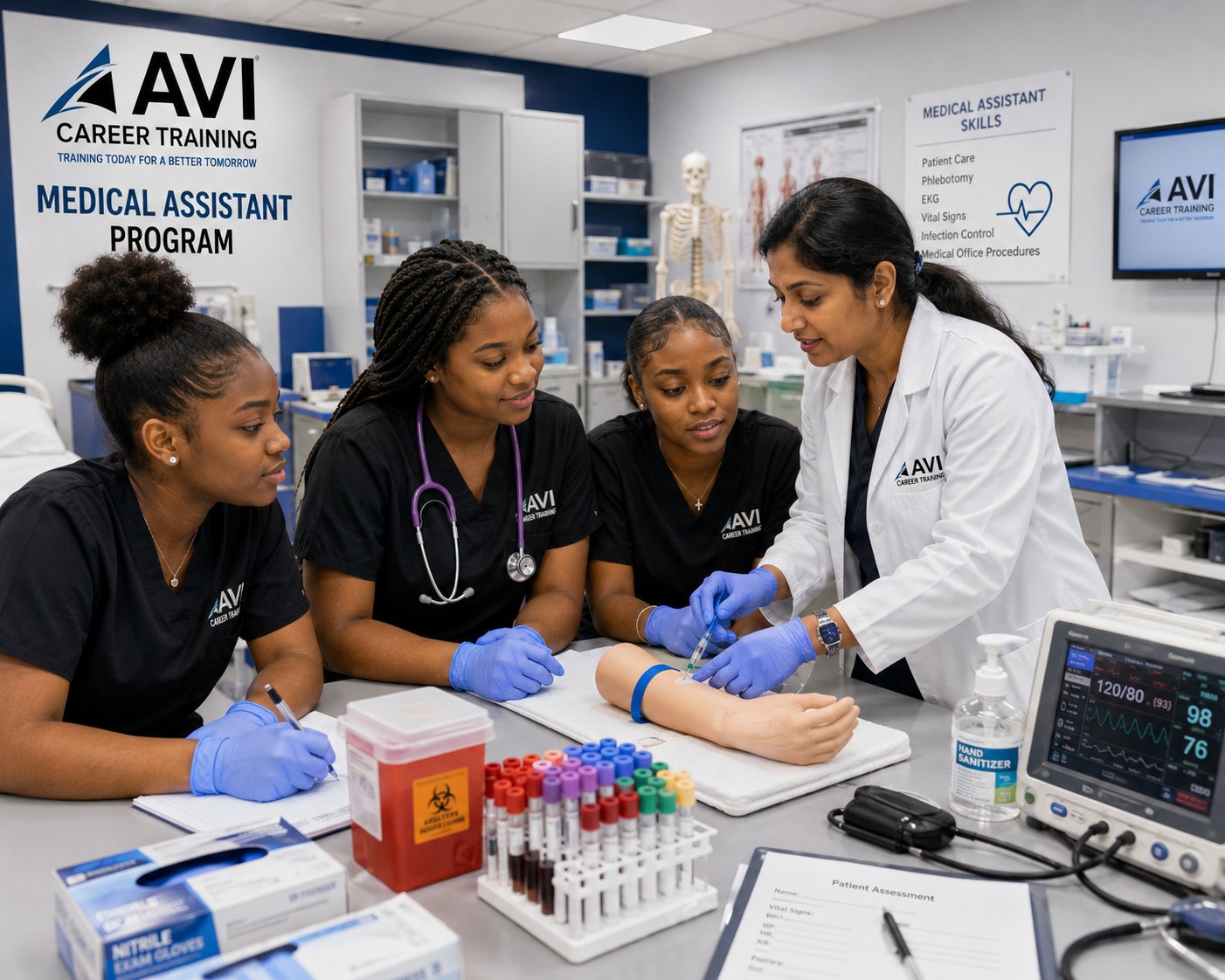
A medical assistant career in the DMV area offers above-average wages, strong job security, and a faster entry point into clinical healthcare than most nursing or technical degree paths — making it one of the most searched healthcare career tracks in Northern Virginia, Maryland, and DC.
Whether you’re weighing your first career move or transitioning out of another field, this guide covers everything you need to know: what the job actually involves, what Virginia requires (or doesn’t), what you can expect to earn in the DC metro market, and how to choose the right path for your goals — including some fast-track clinical options you may not have considered.
Explore AVI’s Clinical Aesthetics Programs →
Key Takeaways
- Virginia does not require state licensure for medical assistants — but DMV employers increasingly expect national certification (CMA or RMA).
- Medical assistants in the Washington-Arlington-Alexandria metro area earn a median of $42,000–$52,000+ annually — well above the national median.
- BLS projects 14–18% growth for medical assistants through 2032 — faster than most occupations.
- Certificate programs take as few as 9–12 months; associate degree tracks run 18–24 months.
- Clinical aesthetics careers (laser tech, esthetics, electrolysis) offer a faster, lower-cost path into medically adjacent work — with strong demand across Northern Virginia’s booming med spa sector.
—
What Does a Medical Assistant Actually Do?
A medical assistant is a multi-role clinical and administrative professional who keeps healthcare practices running — not a nurse, not a receptionist, but a trained hybrid of both.
The scope of the job depends heavily on the setting. In a primary care or family practice office, you might spend your day taking patient vitals, drawing blood, administering injections, and documenting in electronic health records (EHR). In a specialty clinic — say, a dermatology or plastic surgery practice — your duties shift toward procedure prep, equipment sterilization, pre- and post-care patient education, and potentially assisting with minor in-office procedures.
Clinical Duties
The hands-on side of the role typically includes:
Administrative Duties
Most MAs also handle operational tasks, including:
Work Environments in the DMV
In the DC metro area specifically, MAs work across a dense network of settings: large health systems like Inova Health System and Kaiser Permanente Mid-Atlantic, community clinics, urgent care centers, specialty practices (cardiology, dermatology, orthopedics), telehealth support roles, and — increasingly — medical spas and aesthetic clinics throughout Northern Virginia’s Tysons Corner corridor and beyond.
One important clarification: medical assistants are not the same as Certified Nursing Assistants (CNAs). CNAs provide direct patient care under nursing supervision, often in long-term care facilities. MAs operate across both clinical and administrative domains, typically in outpatient settings. The training is different, the scope is different, and the hiring landscape is different.
—
Medical Assistant Requirements in Virginia — Licensing, Certification & Training
Virginia does not require state licensure to work as a medical assistant — which surprises many people researching this career path.
Unlike nursing (RN, LPN) or certain allied health professions regulated by the Virginia Department of Professional and Occupational Regulation (DPOR), medical assisting is currently an unregulated occupation at the state level. That means there’s no Virginia state license to obtain, no mandatory state exam to pass.
That said — the DMV job market tells a different story.
Northern Virginia’s healthcare corridor is competitive. Employers like Inova, Children’s National, Johns Hopkins Community Physicians, and NOVA Medical Centers have access to a large applicant pool, and they use national certification as a screening tool. In practice, certification is close to a requirement for most competitive positions in this market.
The Two Main National Certifications
CMA (Certified Medical Assistant)
RMA (Registered Medical Assistant)
For most DMV-area job seekers, the CMA through AAMA carries the most name recognition with large health system employers.
Training Program Options
| Program Type | Length | Credential |
|—|—|—|
| Certificate / Diploma | 9–12 months | Certificate + CMA/RMA eligibility |
| Associate of Applied Science | 18–24 months | AAS Degree + CMA/RMA eligibility |
Certificate programs are offered through community colleges (Northern Virginia Community College, Montgomery College) and accredited career schools throughout the region. Associate degree programs provide a broader academic foundation and may open doors to advancement, but they require a longer time commitment and higher overall cost.
A note on accreditation: If you’re pursuing the CMA credential through AAMA, make sure your training program is accredited by either CAAHEP (Commission on Accreditation of Allied Health Education Programs) or ABHES (Accrediting Bureau of Health Education Schools). Graduating from a non-accredited program disqualifies you from sitting for the CMA exam.
—
—
Medical Assistant Salary & Job Outlook in the DMV
Medical assistants in the Washington-Arlington-Alexandria metro area earn significantly more than the national average — and the Northern Virginia job market for MAs is growing.
According to Bureau of Labor Statistics (BLS) Occupational Employment data, the national median annual wage for medical assistants sits in the $37,000–$42,000 range. In the DC metro area, median wages typically run 15–25% above the national figure, placing most DMV-area MAs in the $42,000–$52,000+ range depending on specialty, experience, and certification status.
DC Metro Area
Through 2032 (BLS)
Minimum Timeline
Where Salaries Climb Higher
Certain specialties and settings consistently push MA compensation above that median:
Fairfax County’s healthcare sector is one of the largest employers in the region, and Northern Virginia’s population growth has driven sustained demand for outpatient care across every specialty. That growth isn’t slowing down.
Job Outlook
BLS projects 14–18% employment growth for medical assistants through 2032 — one of the faster growth rates among all allied health occupations. That’s driven by an aging population, expanded outpatient care, and the ongoing shift away from hospital-based care toward smaller specialty and primary care practices.
In the DMV specifically, the pipeline of new healthcare facilities in Loudoun County, Prince William County, and along the Route 7 and Route 28 corridors in Northern Virginia continues to create fresh hiring demand.
—
Medical Assistant vs. Other Healthcare Career Paths — How Do You Choose?
Choosing between healthcare career paths means comparing timelines, costs, earning potential, and — critically — the kind of work environment you want to be in every day.
Here’s a practical comparison of the most common paths people consider alongside medical assisting:
| Career Path | Training Length | DMV Salary Range | Primary Setting |
|---|---|---|---|
| Medical Assistant | 9–24 months | $42K–$52K+ | Clinics, hospitals, specialty practices |
| CNA | 4–12 weeks | $32K–$42K | Long-term care, nursing homes, hospitals |
| Phlebotomist | 2–6 months | $36K–$46K | Labs, hospitals, blood banks |
| Surgical Tech | 18–24 months | $52K–$70K+ | Operating rooms, surgical centers |
| Clinical Aesthetician / Laser Tech | 8 weeks–12 months | $42K–$65K+ | Med spas, dermatology, plastic surgery |
The Work Environment Question
This is often underrated when people research healthcare careers. Consider:
Enter the Clinical Aesthetics Pathway
Here’s something many DMV-area career researchers don’t realize: the Northern Virginia medical aesthetics market is booming. The U.S. medical spa industry has grown steadily year over year, and the density of high-income households in Fairfax, Loudoun, and Arlington counties has made Northern Virginia one of the strongest regional markets for cosmetic laser, skin care, and aesthetic services in the country.
Clinical aestheticians and cosmetic laser technicians work alongside physicians, nurse practitioners, and PAs in dermatology clinics and plastic surgery offices every day. They perform laser hair removal, skin rejuvenation treatments, chemical peels, and body contouring procedures — in medical environments, under clinical supervision. The overlap with traditional healthcare is real and growing.
—
—
Exploring Clinical & Medical-Adjacent Career Training Near Washington DC
If you’re drawn to working in a medical environment but want a faster path, a lower cost of entry, or a role that focuses on results-driven aesthetic treatments rather than administrative and clinical support tasks — there’s a growing category of careers worth serious consideration.
AVI Career Training, a COE-accredited (Council on Occupational Education) and SCHEV-certified career school in Vienna, Virginia, offers programs that directly feed into Northern Virginia’s medical aesthetics market.
Real Student Story: From Healthcare Research to Laser Tech
Denise had spent six months researching MA programs in the DMV when a friend mentioned that she’d gotten hired at a Northern Virginia dermatology clinic after completing a laser technology program — not a two-year degree. Denise looked into the clinical side of aesthetic careers and realized the scope of work matched what drew her to healthcare in the first place: hands-on treatment, visible results, direct client interaction. She enrolled in a Cosmetic Laser Technology program, completed her training, and was hired by a Tysons-area med spa within weeks of finishing. Her starting rate put her solidly within the same range she’d projected for an MA role — without the two-year timeline.
AVI’s Medically Adjacent Programs
Cosmetic Laser Technology (NO FINANCIAL AID FOR THIS PROGRAM)
AVI’s Cosmetic Laser Technology program trains students to operate laser and light-based devices used in medical aesthetics — laser hair removal, skin rejuvenation, photofacials, body contouring. Graduates work in med spas, dermatology clinics, and plastic surgery offices across the DMV. This is a genuinely clinical skill set — device safety, contraindications, skin assessment, treatment documentation — delivered in a fraction of the time of an MA degree program.
Basic Esthetics and Master Esthetics
AVI’s Esthetics programs prepare students for Virginia State Board licensure as licensed estheticians. Advanced esthetics training — particularly at the Master Esthetics level — opens doors to clinical settings: medical offices, oncology support esthetics, and aesthetic clinics where licensed estheticians work alongside physicians and dermatologists.
Electrolysis
Electrolysis is the only FDA-recognized permanent hair removal method, and electrologists frequently work in dermatology and plastic surgery practices alongside medical staff. Virginia requires electrologists to be licensed through DPOR — AVI’s Electrolysis program prepares students for that licensure.
Massage Therapy
Licensed massage therapists increasingly work in clinical settings — physical therapy offices, integrative medicine practices, and surgical recovery environments. AVI’s Massage Therapy program prepares students for Virginia licensure through DPOR.
Why This Matters for DMV Healthcare Career Seekers
These programs are not a substitute for medical assisting — and AVI doesn’t pretend otherwise. But if you’re at the research stage of your healthcare career exploration and you’re drawn to the clinical side of aesthetics specifically, the training investment, timeline, and earning potential across AVI’s programs compare favorably to the MA pathway — especially for roles in Northern Virginia’s growing medical spa and aesthetic medicine sector.
Explore AVI’s Clinical Aesthetics Programs →
—
Real Student Story: The Career Changer Who Didn’t Want a Two-Year Commitment
Marcus, a 34-year-old restaurant manager from Fairfax, was serious about changing careers into something with more stability and growth potential. He researched MA programs at NOVA and found the 18-month timeline difficult to manage alongside his financial obligations. A conversation with an AVI admissions advisor opened his eyes to the Cosmetic Laser Technology and Electrolysis tracks — programs he could complete while working part-time, with a clear path to employment in the Northern Virginia medical aesthetics market. He finished his program and landed a role at a dermatology practice in the Tysons corridor. His income stabilized within his first year. The two-year MA path wasn’t the only door into a medical environment — it was just the most visible one he’d seen advertised.
—
Frequently Asked Questions About Medical Assistant Careers in the DMV
Q: How long does it take to become a medical assistant in Virginia?
A: Most medical assistant certificate programs in Virginia take 9–12 months to complete. Associate degree programs take 18–24 months. Virginia does not require state licensure, but national certification (CMA or RMA) adds exam prep time after program completion.
Q: Do medical assistants need to be certified in Virginia?
A: Virginia does not mandate state licensure for medical assistants. However, most competitive DMV-area employers — particularly large health systems like Inova and Kaiser Permanente — strongly prefer or effectively require national certification (CMA through AAMA or RMA through AMT). Certification is voluntary but practically essential in this market.
Q: What is the average salary of a medical assistant in the DC metro area?
A: Medical assistants in the Washington-Arlington-Alexandria metropolitan area earn a median of approximately $42,000–$52,000+ annually, according to BLS occupational employment data. This is significantly above the national median ($37,000–$42,000 range) due to the DC metro area’s higher cost of living and competitive healthcare labor market. Specialty settings like dermatology and surgical practices often pay above that range.
Q: What is the difference between a medical assistant and a clinical aesthetician?
A: A medical assistant performs clinical support tasks — vitals, phlebotomy, patient intake, EKGs — and administrative duties across a wide range of medical settings. A clinical aesthetician (licensed esthetician working in a medical environment) focuses specifically on skin health treatments: chemical peels, laser procedures, facials, and pre/post-surgical skin care. Both may work in dermatology or plastic surgery clinics, but their scope, training path, and daily duties are distinct. Clinical aesthetics careers often require less training time and