Medical Assistant Careers in the DMV: Complete Guide
A medical assistant career in the DMV area offers competitive pay, fast training, and strong job security — making it one of the most accessible healthcare paths in the Washington DC, Northern Virginia, and Maryland metro region.
If you’re researching whether this career is right for you, you’re in the right place. This guide covers everything: what medical assistants actually do, what they earn in the DC metro market, how to get certified in Virginia, and which other healthcare-adjacent careers are worth your attention.
Apply to AVI Career Training today to take the first step toward a hands-on healthcare career in Northern Virginia.
—
Key Takeaways
- Medical assistants in the Washington-Arlington-Alexandria MSA earn 10–20% above the national median, which sits at approximately $42,000/year nationally (BLS).
- Virginia does not require state licensure for medical assistants — national certification (CMA or RMA) is voluntary but strongly preferred by DMV employers.
- Certificate programs typically take 9–12 months to complete; associate degree programs run 18–24 months.
- BLS projects MA employment to grow approximately 14–16% through 2032 — faster than average for all occupations.
- Healthcare-adjacent careers like Massage Therapy, Esthetics, and Cosmetic Laser Technology offer similar benefits — hands-on work, no 4-year degree, strong DMV demand — with faster training timelines.
—
What Does a Medical Assistant Do?
A medical assistant is a dual-role healthcare professional who handles both clinical tasks and administrative responsibilities in outpatient settings like physician offices, urgent care clinics, and specialty practices.
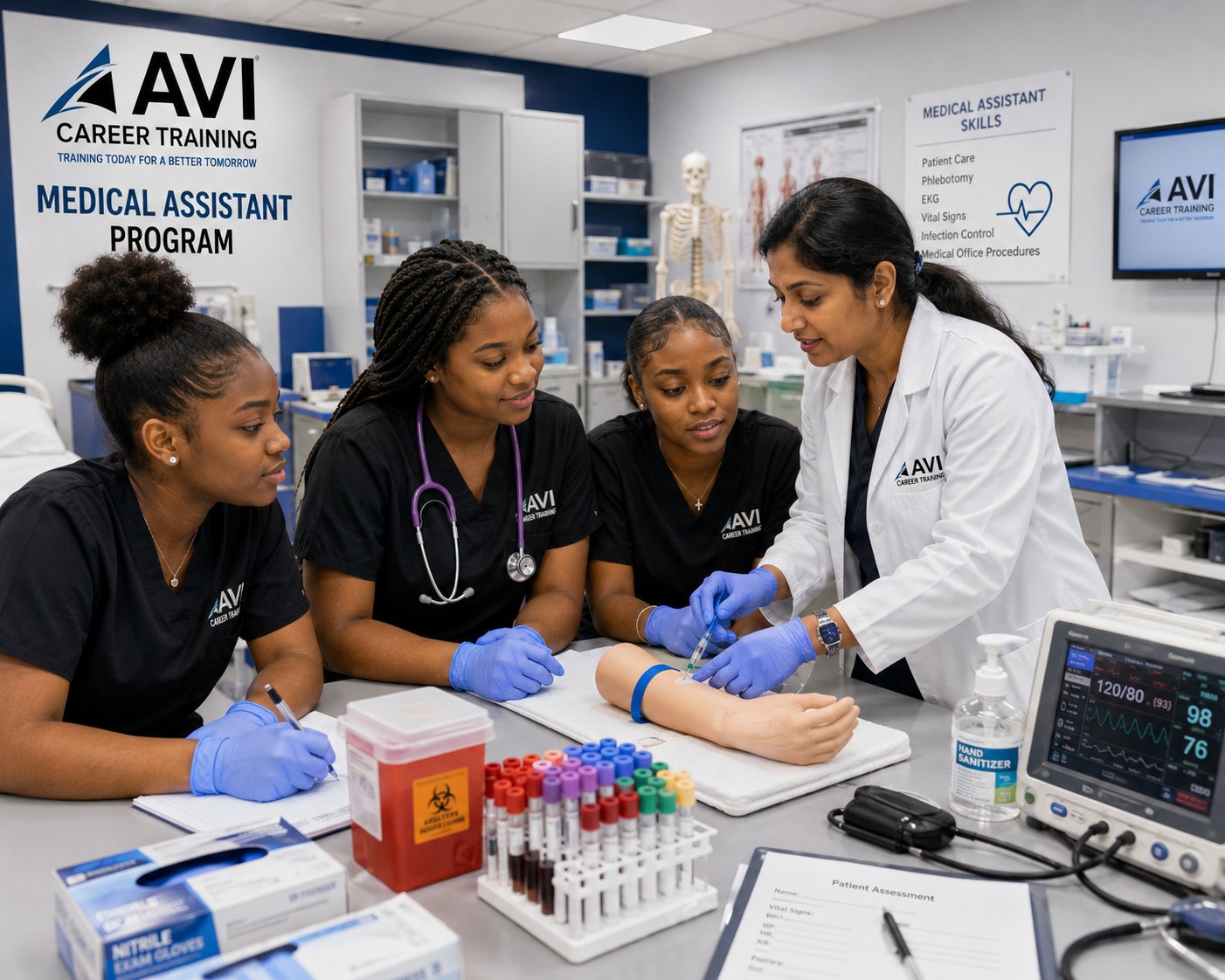
On the clinical side, that means taking vital signs, preparing exam rooms, drawing blood, administering injections, collecting specimens, and assisting physicians during patient examinations. On the administrative side, MAs schedule appointments, update electronic health records (EHR), process insurance referrals, and manage patient intake paperwork.
This dual function is what makes medical assistants indispensable — and it’s also what distinguishes the role from other healthcare positions.
How Is a Medical Assistant Different from a Nurse or Administrative Staff?
Medical assistants are not nurses. Registered Nurses (RNs) and Licensed Practical Nurses (LPNs) require significantly more education, hold independent clinical licenses, and perform a wider range of patient care functions — including administering IV medications and developing care plans.
Medical assistants are also not the same as front-desk administrative staff. While both may handle scheduling or phone calls, MAs cross into the clinical space regularly, working directly alongside physicians and nurses in the exam room.
Think of the MA as the connective tissue of a busy outpatient clinic — keeping patients moving, providers supported, and records current.
Where Do Medical Assistants Work in the DMV?
The vast majority of medical assistants in the DC metro area work in:
—
Medical Assistant Salary & Job Outlook in Northern Virginia, DC, and Maryland
The DMV area consistently ranks among the highest-paying markets for medical assistants in the country — and that gap over the national average is meaningful.
What Medical Assistants Earn in the DC Metro Area
Nationally, the Bureau of Labor Statistics (BLS) reports a median annual wage for medical assistants of approximately $42,000 (verify current figure at BLS.gov). The Washington-Arlington-Alexandria metropolitan statistical area (MSA) typically runs 10–20% above that national median, putting experienced DMV-area MAs well into the $46,000–$52,000+ range depending on specialty, employer, and certification status.
On an hourly basis, DMV-area medical assistants generally earn between $19 and $26 per hour, with the higher end going to those working in specialty practices or holding national certification.
Why the DMV Market Pays More
Several structural factors push MA wages higher in this region:
High cost of living premium — Employers in Northern Virginia and DC compete for workers in one of the most expensive metro areas in the country, which drives compensation up across healthcare support roles.
Concentration of major health systems — Inova Health System, MedStar Health, Kaiser Permanente, Children’s National, and the Veterans Affairs medical centers all maintain large outpatient footprints across the DMV. Competition among these systems for qualified staff supports stronger wages.
Federal government and contractor presence — Military installations, VA facilities, and federal health agencies around the DMV create steady, mission-critical demand for medical support staff.
Job Growth Outlook
The BLS projects medical assistant employment to grow approximately 14–16% through 2032 — a rate described as “much faster than average” for all occupations. Locally, DMV demand is driven by:
—
How to Become a Medical Assistant in Virginia — Step by Step
Becoming a medical assistant in Virginia is more straightforward than many career changers expect — and you do not need a 4-year degree to get started.
Step 1: Choose Your Training Program
Most DMV-area employers prefer candidates who have completed a formal MA training program. Your two main options are:
When selecting a program, look for accreditation from CAAHEP (Commission on Accreditation of Allied Health Education Programs) or ABHES (Accrediting Bureau of Health Education Schools). Graduation from an accredited program is required to sit for the CMA exam through AAMA.
Step 2: Complete Your Clinical Externship
Accredited MA programs include a clinical externship component — typically 160–200 hours in a real healthcare setting. This is where you move from classroom theory to hands-on patient care. Your externship site is your first professional reference and often your first job lead.
Step 3: Get Nationally Certified
Virginia does not require medical assistants to hold a state license. This is a critical distinction — and a common misconception in online content about this career.
What Virginia employers do expect is national certification. The two most recognized credentials are the CMA (AAMA) and the RMA (AMT), both of which are covered in detail in the next section.
Step 4: Search for Jobs in the DMV Market
With your training complete and certification in hand, you’re ready to enter one of the strongest healthcare job markets in the country. Target your search toward the region’s major health systems — Inova, MedStar, and Kaiser Permanente — as well as independent specialty practices in high-density areas like Tysons Corner, Fairfax, Rockville, and Bethesda.
—
CMA vs. RMA — Which Certification Should You Pursue?
The two dominant national credentials for medical assistants are the Certified Medical Assistant (CMA) from AAMA and the Registered Medical Assistant (RMA) from AMT. Both are respected — but they differ in eligibility requirements, exam format, and employer recognition.
Side-by-Side Comparison
| Category | CMA (AAMA) | RMA (AMT) |
|---|---|---|
| Issuing Body | American Association of Medical Assistants (AAMA) | American Medical Technologists (AMT) |
| Eligibility | Must graduate from CAAHEP- or ABHES-accredited program | Multiple pathways — accredited program OR work experience |
| Exam Length | 200 questions / 180 minutes | 210 questions |
| Exam Format | Computer-based, multiple choice | Computer-based, multiple choice |
| Renewal | Every 5 years — CEUs or re-examination | Annual — continuing education points |
| DMV Employer Recognition | Widely recognized; often listed first in job postings | Broadly accepted; strong recognition in multi-state markets |
| Best For | Recent graduates of accredited MA programs | Career changers with work experience or non-CAAHEP/ABHES grads |
Which One Do DMV Employers Prefer?
In the DC metro market, the CMA (AAMA) tends to appear more frequently in job listings at major health systems like Inova and MedStar. That said, both credentials are genuinely respected — and many DMV employers simply list “CMA or RMA” as equivalent. If you graduated from a CAAHEP- or ABHES-accredited program, the CMA is your natural first target. If you’re coming from a different background or a non-accredited program, the RMA’s multiple eligibility pathways may make it the more accessible choice.
—
> Meet Daria: Daria spent eight years managing patient scheduling at a busy Northern Virginia orthopedic practice. She watched MAs every day and knew she wanted to move into the clinical role. At 34, she enrolled in a 10-month certificate program, completed her externship at the same clinic, and earned her CMA within two months of graduation. Her starting salary jumped by more than $11,000 compared to her administrative position. Her advice: “Don’t wait. The training is faster than you think.”
—
—
Healthcare Careers in the DMV — What Else Should You Consider?
Medical assisting is an excellent career — but it’s not the only hands-on, no-4-year-degree healthcare path worth your attention in the DMV area. If you’re drawn to client-facing work, physical technique, and meaningful results for people, several adjacent careers check every one of those boxes.
Why Some Career Changers Choose Wellness Over Clinical Healthcare
The appeal of medical assisting — direct client contact, visible outcomes, no long degree program — applies equally to a growing segment of wellness and aesthetic careers. For some career changers, wellness and medical aesthetics offer advantages that clinical MA work does not:
Three Wellness Careers to Compare
Massage Therapy — Licensed Massage Therapists in Virginia complete state-board-approved training, earn their license through the Virginia Department of Professional and Occupational Regulation (VA DPOR), and work in clinical, spa, and wellness settings across the DMV. Massage therapy combines anatomy knowledge with hands-on technique — and offers genuine employment in healthcare-adjacent environments like physical therapy clinics and chiropractic offices.
Basic and Master Esthetics — Estheticians provide skin care treatments ranging from facials and chemical peels to advanced corrective services. In Virginia, esthetics credentials are regulated by VA DPOR. Medical esthetics — working in dermatology or plastic surgery offices — is one of the fastest-growing specializations in the DMV aesthetic market.
Cosmetic Laser Technology — Laser technicians perform non-surgical aesthetic procedures including laser hair removal, skin rejuvenation, and body contouring. This is one of the fastest-growing clinical-adjacent specializations in the DMV, fueled by the region’s dense concentration of medical spas and aesthetic clinics.
All three of these careers share the MA’s core appeal: they’re hands-on, they produce visible results for clients, and they don’t require four years of college.
—
> Meet Marcus: Marcus was three years into working as a patient services rep at a Fairfax County urgent care when he started researching both MA programs and massage therapy training. He was drawn to the hands-on work but wasn’t sure he wanted to stay in a strictly clinical environment. After touring a few schools, he enrolled in a Massage Therapy program in Northern Virginia. Today he splits his time between a sports medicine clinic and a private practice he built over two years. “I wanted to help people with my hands,” he says. “Massage therapy just fit who I am.”
—
Frequently Asked Questions
Q: How long does it take to become a medical assistant in Virginia?
A: Most certificate and diploma programs take 9–12 months to complete. Associate degree programs run 18–24 months. After graduating, you can sit for the CMA or RMA certification exam within a few months. Total time from starting a certificate program to working as a certified MA: typically 12–14 months.
—
Q: Do medical assistants need to be licensed in Virginia?
A: No. Virginia does not require medical assistants to hold a state license. National certification — either the CMA (AAMA) or RMA (AMT) — is voluntary under Virginia law, but DMV employers widely expect it. If you’re planning to work at a major health system like Inova or MedStar, holding a nationally recognized credential is the practical standard.