A Day in the Life of a Master Esthetics Student
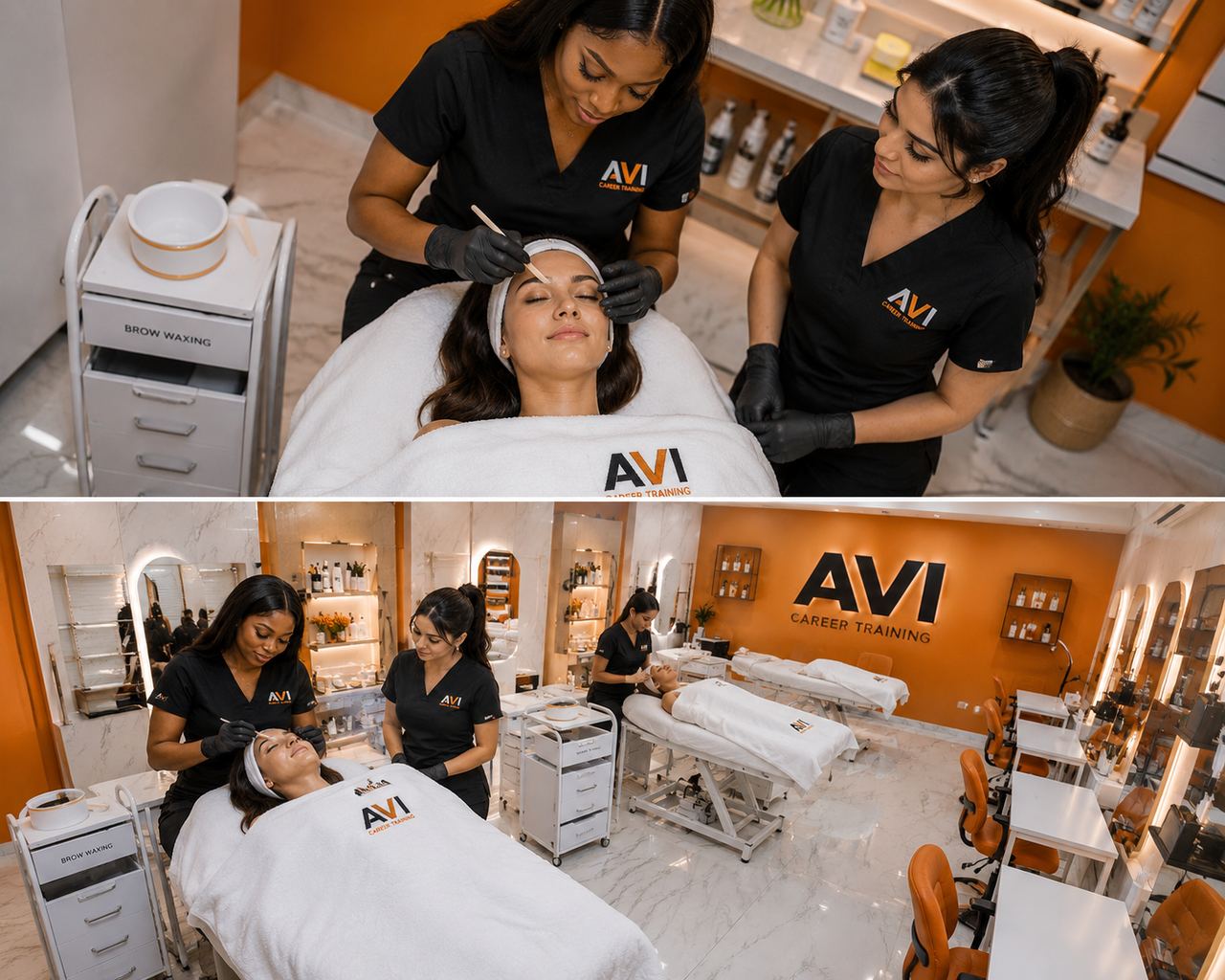
A Master Esthetics student at AVI Career Training in Vienna, Virginia spends their day doing exactly what working estheticians do — analyzing skin, performing advanced treatments, and building the professional instincts that employers in Northern Virginia’s competitive spa and medical aesthetics market demand.
If you’ve been wondering what master esthetics school is actually like before you commit, this is your inside look. Not a brochure. A real breakdown of how a typical training day unfolds — hour by hour, treatment by treatment — and what 600 hours of hands-on education adds up to by the time you graduate.
Key Takeaways
- Virginia’s Master Esthetics program requires 600 hours of training — significantly more than basic esthetics
- AVI Career Training is COE-accredited and SCHEV-certified, holding curriculum to professional industry standards every single day
- Students practice advanced modalities including chemical peels, microdermabrasion, and dermaplaning — on all Fitzpatrick skin types
- Graduates can sit for the Virginia State Board exam (administered by VA DPOR) and pursue careers in med spas, dermatology clinics, and luxury spas across the Tysons/DC corridor
- Median annual wages for estheticians in the metro DC/NoVA market range from $39,000 to $55,000+, with Master Estheticians typically at the higher end
Ready to see yourself in this picture? Apply to AVI’s Master Esthetics program and take the first step toward a career you’ll actually love.
—
Morning: Arriving at the Student Clinic
The day starts with intention, not confusion. When you arrive at AVI Career Training’s Vienna, VA campus — right in the heart of the Tysons Corner corridor — your first task isn’t sitting down and listening to a lecture. It’s preparing to receive a client.
The student clinic at AVI operates like a real spa environment. You pull your client schedule for the day, confirm your appointment lineup, and begin setting up your treatment room. Linens get sanitized and laid. Products are organized in the order you’ll use them. Equipment is checked. Before a single client walks through the door, you’ve already made a dozen professional decisions.
That transition — from student to practitioner — happens every single morning. And it’s intentional. AVI’s COE-accredited curriculum is built around one core idea: the training environment should mirror the professional environment. The habits you build in the clinic are the habits you’ll carry into every med spa, dermatology office, or luxury day spa you work in after graduation.
Quick Fact
Virginia’s Master Esthetics program requires 600 hours of training — compared to 260 hours for basic esthetics. Those extra hours are where advanced skills live.
A student’s morning might look like this:
Notice that skin analysis happens before any treatment. That’s not accidental. At AVI, reading the skin accurately — identifying conditions, contraindications, and Fitzpatrick type — is treated as a core clinical skill, not a formality. It’s the foundation every treatment is built on.
—
Hands-On Training: The Treatments You’ll Practice Every Day
Master Esthetics students at AVI perform real, advanced skincare services — and they perform them on a genuinely diverse client base, which is exactly what the Northern Virginia job market requires.
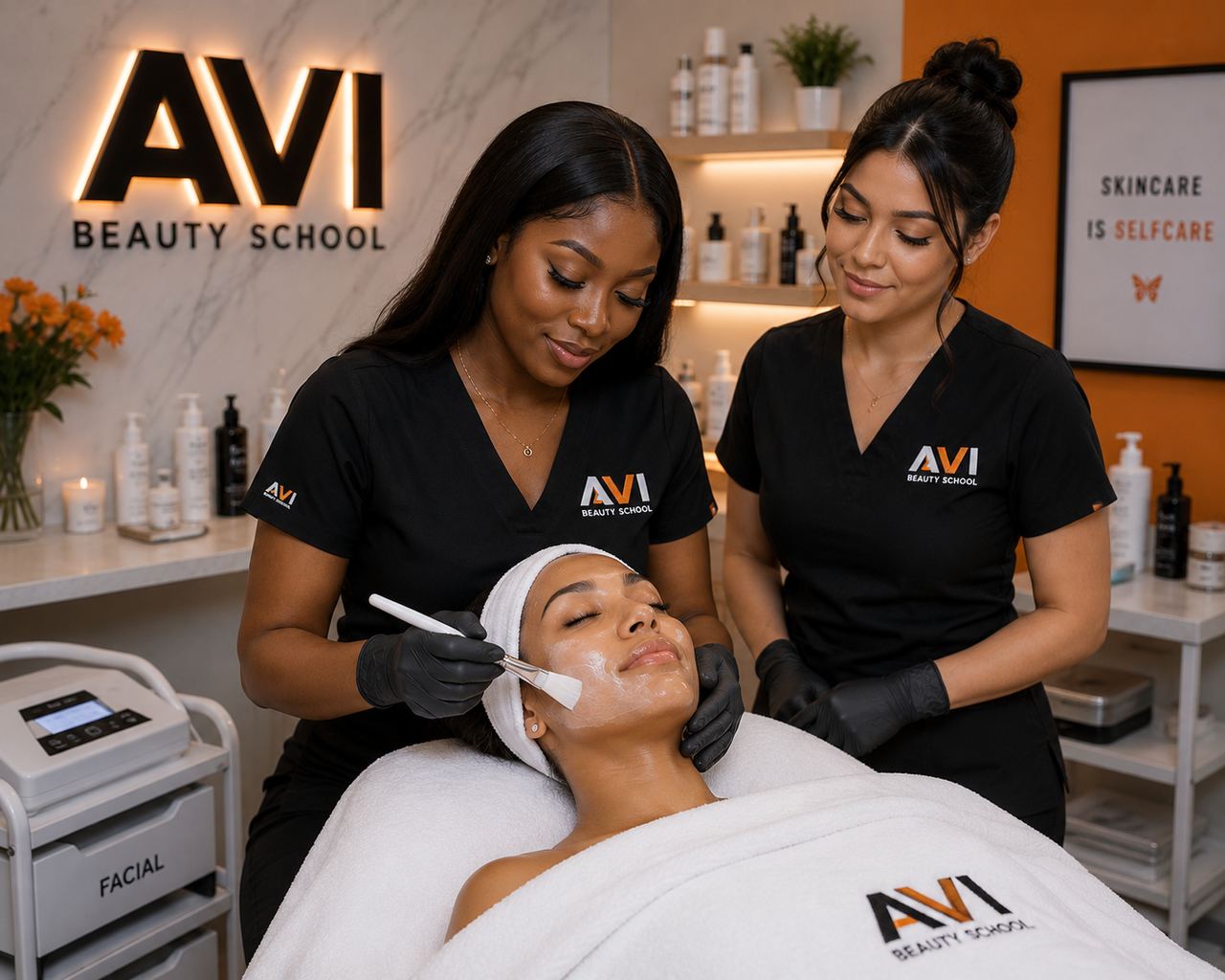
Here’s what the hands-on portion of the esthetics school daily schedule typically includes:
Facial Treatments and Advanced Extractions
Facials are the foundation, but “foundation” doesn’t mean simple. Students learn to customize protocols based on skin condition — adjusting steam timing, product concentration, and massage technique for dehydrated skin versus acne-prone skin versus hyperpigmented skin. Advanced extractions require precision and a thorough understanding of contraindications. Push too hard on the wrong lesion and you create more damage than you correct.
Chemical Peels
Chemical peels are where the science-meets-skin reality hits hardest. Students learn to select the appropriate acid type and concentration — AHAs, BHAs, TCA — based on the client’s skin condition and Fitzpatrick type. A glycolic peel applied correctly to a Fitzpatrick Type II client looks completely different in terms of timing and monitoring than the same peel on a Fitzpatrick Type V or VI client. Post-inflammatory hyperpigmentation is a real risk on deeper skin tones, and AVI’s curriculum treats that risk as essential knowledge, not a footnote. Every student learns to perform chemical peel analysis across all six Fitzpatrick types.
Microdermabrasion and Dermaplaning
These mechanical exfoliation modalities require a steady hand and an understanding of skin anatomy. Students learn proper angle, pressure, and contraindications — and they practice on real clients under instructor supervision before performing services independently. Getting comfortable with these tools takes repetition, and 600 hours of training gives you enough repetition to build genuine confidence.
Waxing and Hair Removal
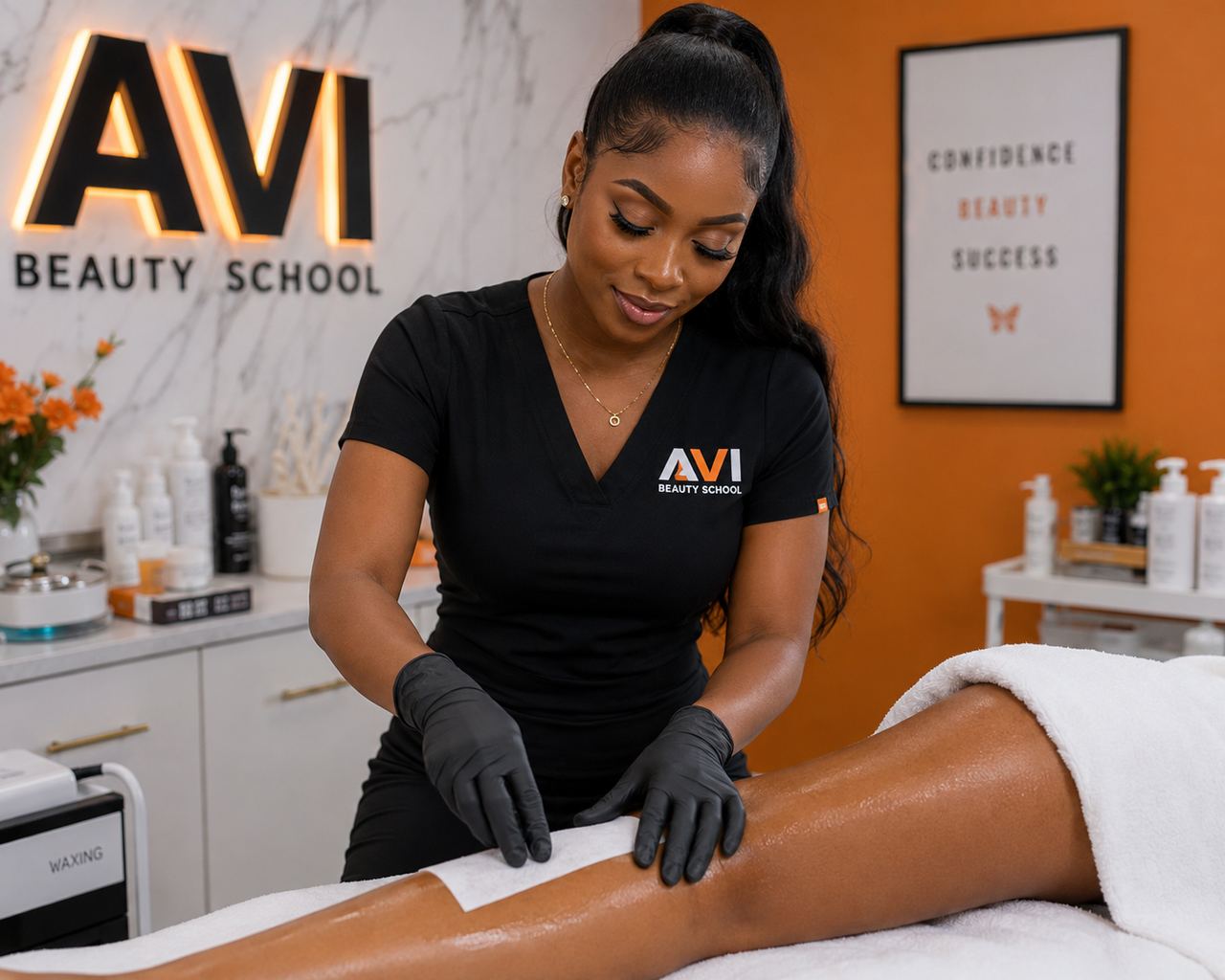
Waxing technique varies significantly by body area, hair texture, and skin sensitivity. Students practice hard and soft wax application across multiple service areas, learning how to adapt for different skin and hair types — because your future clients won’t all look the same.
Skin Device Work
Advanced esthetics training includes working with devices like high-frequency machines, galvanic current tools, and LED therapy equipment. Students learn the science behind each modality, not just the button sequence. When an employer asks “Have you worked with high-frequency before?” you’ll have a real answer.
> Meet Camille. Camille came to AVI’s Master Esthetics program (NO FINANCIAL AID FOR THIS PROGRAM) after spending eight years as a dental hygienist. She was drawn to esthetics because of the overlap in client care and anatomy — but she’d never held a dermaplaning blade in her life. By her third week of clinic hours, she had performed dermaplaning on five clients with different skin tones and textures. By month two, her instructor flagged her extractions technique as clinic-ready. She graduated, passed her Virginia State Board exam on the first attempt, and now works at a medical spa in McLean, Virginia.
—
The Classroom: Science Behind the Skin
Treatments don’t happen in a vacuum. Every time you touch a client’s skin, you’re applying science — and AVI’s classroom instruction makes sure you understand exactly what you’re applying and why.
The theory side of the esthetics school daily schedule covers:
Why the classroom matters in the clinic: A student who understands the Fitzpatrick Scale in theory performs a safer, more effective chemical peel in practice. At AVI, classroom content and clinic hours are designed to reinforce each other — not exist in separate silos.
The Virginia State Board exam — administered by the Virginia Department of Professional and Occupational Regulation (DPOR) — tests both practical skills and written theory. AVI’s curriculum is built to prepare you for both halves. Students who understand the science score better on the written portion. Students who’ve logged real clinic hours perform better in the practical exam. The two sides of your training day are connected on purpose.
—
Feedback, Evaluation, and Building Your Professional Eye
One of the most valuable things that happens in a master esthetics student’s day isn’t a treatment — it’s the debrief after the treatment.
At AVI, instructor-led evaluations are built into the clinic experience. After a service, your instructor doesn’t just say “good job” or “try harder.” They walk you through specific observations: your peel timing, your extraction pressure, your client communication, your product selection rationale. That specificity is how skills actually improve.
Peer Feedback and Self-Assessment
Students also participate in peer feedback sessions — evaluating each other’s technique with the same professional vocabulary instructors use. This does two things: it sharpens your eye for quality, and it builds the professional communication skills you’ll use every day when you’re supervising others or collaborating with dermatologists and medical staff.
Self-assessment is equally important. You’ll learn to look at your own work critically and ask: Was the product I chose the right match for this client’s Fitzpatrick type? Did I communicate contraindications clearly? Would I book this client again with confidence? That kind of self-reflection is what separates a technician from a skilled clinician.
State Board Readiness Is Built In
Everything students are evaluated on at AVI maps to what the Virginia State Board exam actually tests. The practical portion of the exam assesses real skills — sanitation protocols, client draping, service execution. Students who’ve been evaluated consistently throughout their 600 hours walk into that exam having already performed under observation dozens of times. The exam feels familiar because the training made it familiar.
> Meet Darius. Darius enrolled in AVI’s Master Esthetics program (NO FINANCIAL AID FOR THIS PROGRAM) as a career changer — he’d spent his twenties in retail management and wanted work that felt more personal and skill-based. His first week, he struggled with client consultation flow. His instructor noticed and spent two additional session debriefs specifically on intake communication. By his 200th clinic hour, Darius was consistently receiving positive client feedback cards. He now works at a luxury spa in the Tysons Corner corridor — exactly the kind of high-end environment the Northern Virginia market offers Master Estheticians.
—
What 600 Hours Adds Up To: Your Career After Graduation
Every day in the student clinic is a deposit into a professional skill set that opens doors basic esthetics credentials simply can’t.
The Difference Between Basic and Master Esthetics in Virginia
In Virginia, a basic esthetician completes 260 hours of training. A Master Esthetician completes 600 hours and earns an expanded scope of practice — meaning you’re legally authorized to perform services that basic estheticians are not. Chemical peels, advanced exfoliation, and certain device-based treatments fall within a Master Esthetician’s scope. That expanded scope is what med spas, dermatology clinics, and high-end spas in the Northern Virginia and DC metro market are specifically hiring for.
Licensing and the Virginia State Board Exam
After completing 600 hours, AVI graduates are eligible to sit for the Virginia State Board exam through DPOR. The exam includes both a written and a practical component. Passing earns you your Virginia Master Esthetician license — your legal credential to work professionally in the state.
Where Master Estheticians Work in Northern Virginia
The Tysons Corner corridor, the DC suburbs, and the broader DMV area are among the most saturated and high-paying markets for estheticians in the country. The density of:
…creates consistent demand for Master Estheticians specifically. Employers in this market aren’t looking for someone who can do a basic facial. They’re looking for clinicians who can perform chemical peels, operate skin devices, and adapt treatments intelligently across a diverse clientele.
According to Bureau of Labor Statistics data, median annual wages for estheticians in the metro DC and Northern Virginia market range from approximately $39,000 to $55,000+, with Master Estheticians typically landing at the higher end of that range — especially in medical spa and dermatology settings.
Tuition and Payment
AVI Career Training’s Master Esthetics program (NO FINANCIAL AID FOR THIS PROGRAM) is not eligible for federal financial aid (Title IV / FAFSA) because the program is under the federal threshold for Title IV eligibility. Federal student loans and Pell Grants are not available for this program.
However, AVI does offer payment plan options and can connect prospective students with private financing resources. If you’re a veteran, AVI accepts the GI Bill® — contact AVI’s admissions team directly at (703) 943-9841 to confirm current GI Bill® eligibility details for this specific program.
For current tuition figures and to discuss payment options, reach out to AVI admissions here.
—
Frequently Asked Questions
Q: How long does it take to become a master esthetician in Virginia?
A: Virginia requires 600 hours of training to qualify for the Master Esthetician license. At AVI Career Training in Vienna, VA, students complete these hours through a combination of clinic practice and classroom instruction. Completion timeline depends on your schedule and enrollment status.
Q: What is the difference between esthetics and master esthetics?
A: In Virginia, basic esthetics requires 260 hours and covers foundational services like facials and waxing. Master Esthetics requires 600 hours and includes an expanded scope of practice — chemical peels, advanced exfoliation, skin device work, and more. Master Estheticians are qualified for positions at med spas, dermatology clinics, and high-end spas that basic estheticians are not.
Q: What do master esthetics students practice in school?
A: At AVI Career Training, Master Esthetics students practice facials, chemical peels, microdermabrasion, dermaplaning, advanced extractions, waxing, and skin device modalities. They also study skin anatomy, ingredient chemistry, pathology, and contraindications in classroom sessions. All clinic work is performed on real clients under licensed instructor supervision.
Q: How many hours do you need for master esthetics in Virginia?
A: Virginia requires exactly 600 hours to sit for the Master Esthetician licensure exam administered by the Virginia Department of Professional and Occupational Regulation (DPOR). AVI’s program is built to meet that 600-hour requirement with a COE-accredited, SCHEV-certified curriculum.
Q: Is master esthetics school worth it?
A: For students targeting the Northern Virginia and DC metro job market, yes — Master Esthetics credentials open doors that basic esthetics credentials don’t. The expanded scope of practice, combined with the demand for skilled estheticians at the region’s medical spas and luxury properties, makes the 600-hour investment a meaningful career differentiator. Median wages for estheticians in this market range from $39,000 to $55,000+ annually (BLS data).
Q: What does AVI Career Training’s Master Esthetics program include?
A: AVI’s Master Esthetics program (NO FINANCIAL AID FOR THIS PROGRAM) in Vienna, Virginia includes hands-on clinic hours in the student spa, classroom instruction in skin science and anatomy, instructor-led evaluations, and comprehensive preparation for the Virginia State Board exam. AVI is COE-accredited and SCHEV-certified. The program is 600 hours.
Q: Does AVI Career Training offer financial aid for the Master Esthetics program?
A: No. AVI’s Master Esthetics program is not eligible for federal financial aid (Title IV/FAFSA) because it is under the federal hour threshold for Title IV eligibility. Payment plan options and private financing may be available. Veterans should contact AVI to confirm GI Bill® eligibility for this specific program. Call (703) 943-9841 for details.
—