
Master Esthetics: Your Healthcare Career Path in the DMV
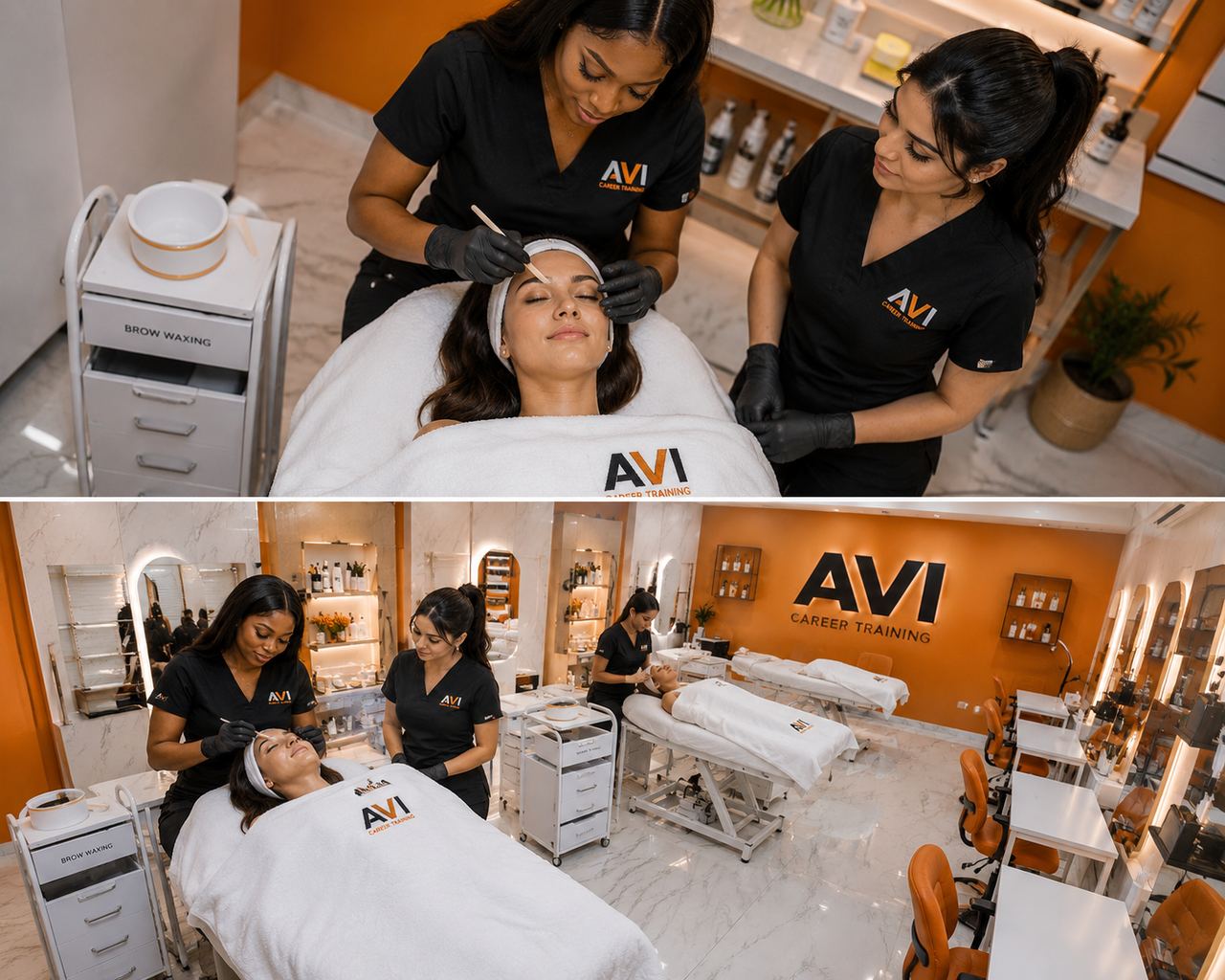
Master esthetics is one of the fastest-growing healthcare-adjacent careers in the Washington DC metro area — offering clinical work environments, strong earning potential, and a licensing path that takes less time than most people expect.
If you’ve been researching whether a master esthetics career in the DMV makes financial and professional sense, this guide gives you the full picture: what the license actually requires in Virginia, where master estheticians work in Northern Virginia, what they earn, and how to choose a program that prepares you for the clinical side of the field.
- Virginia requires 600 clock hours of Master Esthetics training to sit for licensure — matching AVI Career Training’s program length exactly.
- The DMV market pays skincare specialists 15–25% above the national median, driven by high household incomes and dense med-spa/clinical demand.
- Master estheticians in Northern Virginia work in dermatology offices, oncology support, med-spas, plastic surgery practices, and burn/wound care settings.
- The Virginia Board for Barbers and Cosmetology (administered through DPOR) governs licensure; applicants pass both a written and practical exam through PSI Exams.
- AVI Career Training’s Master Esthetics program (NO FINANCIAL AID FOR THIS PROGRAM) in Vienna, VA is COE-accredited and SCHEV-certified — two credentials worth verifying in any program you evaluate.
Ready to take the next step? Apply to AVI Career Training’s Master Esthetics program and get your questions answered by admissions.
—
What Is Master Esthetics — and Why “Healthcare” Fits
Master esthetics is an advanced, clinically oriented license that goes well beyond facials and waxing — it qualifies you to perform chemical exfoliation, laser-adjacent treatments, medical-grade protocols, and skin care in settings supervised by physicians and dermatologists.
Standard Esthetician vs. Master Esthetician: The Real Difference
The question comes up constantly: What is the difference between an esthetician and a master esthetician?
A standard esthetics license (Basic Esthetics in Virginia) covers foundational skin care: facials, extractions, basic hair removal, and retail product consultation. It’s a strong entry point — but its scope keeps you primarily in day spas and retail beauty environments.
A Master Esthetician license expands that scope substantially. In Virginia, the 600-hour Master Esthetics curriculum adds:
That expanded scope is why the word “healthcare” isn’t a stretch. Master estheticians work alongside dermatologists, plastic surgeons, oncologists, and reconstructive care teams. The settings include:
Pre/post-procedure skin prep and recovery protocols
Physician-supervised laser, peel, and injectables support
Gentle, evidence-based skin care for patients in cancer treatment
Post-surgical skin recovery and scar management support
Specialized skin care in rehabilitative or hospital settings
AVI Career Training’s Master Esthetics program in Vienna, Virginia (NO FINANCIAL AID FOR THIS PROGRAM) is built around this clinical framing — training students to enter these settings with both the technical skills and the professionalism those environments demand.
—
Virginia Licensing Requirements for Master Estheticians
Virginia requires 600 clock hours of approved Master Esthetics training — and that single number shapes every other decision you’ll make about programs, timelines, and cost.
Here is the complete licensing picture, straight from the governing authority:
Who Governs Esthetics Licensing in Virginia?
The Virginia Board for Barbers and Cosmetology, administered through the Virginia Department of Professional and Occupational Regulation (DPOR), oversees all esthetics licenses in the Commonwealth. You can verify requirements directly at the DPOR website.
The Step-by-Step Licensing Path
- Complete 600 clock hours at a DPOR-approved Master Esthetics school
- Apply to DPOR for licensure and submit proof of program completion
- Pass the written (theory) exam through PSI Exams — covers skin anatomy, chemistry, safety, and protocols
- Pass the practical exam through PSI Exams — hands-on demonstration of core esthetics skills
- Receive your Virginia Master Esthetician license and begin working
- Renew every two years to maintain active licensure
Why 600 Hours Matters for Program Selection
Not every esthetics school in Northern Virginia offers the full 600-hour Master Esthetics path. Some offer only the Basic Esthetics track (which carries a different, shorter hour requirement). When you’re comparing programs, confirm that the program is specifically approved by DPOR for Master Esthetics and that the curriculum covers the clinical modules the Virginia Board expects.
AVI Career Training’s 600-hour Master Esthetics program is SCHEV-certified (approved by the State Council of Higher Education for Virginia) and COE-accredited — two independent verifications that the curriculum meets both state and national standards.
Note: Because the Master Esthetics program is under the federal financial aid threshold, this program does not qualify for Title IV federal financial aid (FAFSA/Pell Grant). AVI offers payment plan options and private financing alternatives — contact admissions at (703) 943-9841 or through the application portal to discuss what works for your situation.
—
—
The DMV Job Market: Where Master Estheticians Actually Work
The clinical esthetician job outlook in the DC metro area is stronger than nearly any other market in the country — and the structural reasons for that are worth understanding before you commit to a program.
Why Northern Virginia and the DMV Are a Premium Market
High household income, high cosmetic spend. The Washington-Arlington-Alexandria metro consistently ranks among the top five U.S. metro areas for median household income. That income translates directly into discretionary spending on cosmetic procedures, med-spa treatments, and clinical skin care — the exact services master estheticians provide.
Med-spa density along the Tysons-Bethesda corridor. The stretch from Tysons Corner through McLean, Chevy Chase, and Bethesda has one of the highest concentrations of med-spas and aesthetic medicine practices in the Mid-Atlantic. These practices actively recruit master estheticians — not just basic estheticians — because their services require the advanced skill set.
A large, insured federal workforce. The DMV’s massive federal employee population has robust health insurance and employee wellness benefits. This drives demand for dermatology practices and skin health services — another employment channel for clinical estheticians.
Academic medical centers and cancer treatment networks. Northern Virginia, DC, and suburban Maryland are home to major hospital systems — MedStar, Inova, Johns Hopkins, and others — that either operate oncology esthetics programs or refer patients to licensed oncology-trained estheticians nearby.
What Job Titles Look Like in the DMV
When you search for master esthetician positions across Northern Virginia and DC, you’ll find them posted under several titles:
Common Job Titles for Master Estheticians in the DMV
> A quick note on “medical esthetics training Virginia” searches: many people search this phrase and land on pages about laser certification or injectables. While those are separate credentials, your Master Esthetician license is the foundational requirement before you add most of those advanced modalities.
—
Earning Potential and Career Trajectory in Northern Virginia
How much do master estheticians make in the Washington DC area? The honest answer: it depends heavily on setting, experience, and whether you’re employed or self-employed — but the DMV market consistently pays above national averages.
Salary Benchmarks: National vs. DMV
The U.S. Bureau of Labor Statistics places the national median for skincare specialists in the $42,000–$48,000 range annually. The Washington-Arlington-Alexandria MSA consistently tracks 15–25% above that national median — reflecting both the area’s cost of living premium and genuine demand pressure in the cosmetic and clinical markets.
DMV Market Estimate
DMV Market Estimate
Top Earner Range
These are estimated ranges based on BLS regional data and market positioning — individual results will vary based on setting, specialization, clientele, and business model.
Meet Destiny: A Career-Changer Who Did the Math
Destiny worked in administrative healthcare — front-desk coordination at a dermatology group in Fairfax — for six years. She watched the estheticians in the practice build client relationships, perform clinical treatments, and earn commissions on top of a solid base salary. When her position was restructured, she decided to stop watching and start training.
She enrolled in a 600-hour Master Esthetics program, completed it in under a year while working part-time, passed both PSI exams on her first attempt, and landed a clinical esthetician role at a med-spa near Tysons Corner within two months of licensing. Her base salary came in above what she had earned in administrative work — before factoring in her commission structure on chemical peel and microdermabrasion services.
Destiny’s path isn’t unusual in the DMV. The market rewards people who enter with clinical training, a professional disposition, and the ability to operate in physician-supervised environments.
Career Trajectory: Where the Path Leads
The career arc for a Master Esthetician in Northern Virginia typically moves through recognizable stages:
Stage 1 — Licensed Entry (Years 1–2)
Work as a clinical or medical esthetician in a med-spa, dermatology office, or day spa. Build your technique, your client base, and your referral relationships. Learn the business side of the practice.
Stage 2 — Clinical Specialization (Years 3–5)
Add advanced certifications: oncology esthetics (through LOEP or similar bodies), laser technician credentials, or advanced chemical peel training. These additions increase both your hourly rate and your placement options.
Stage 3 — Leadership or Independence (Year 5+)
Move into an Esthetics Director or Lead Esthetician role, or transition to suite rental / private practice. At this stage, self-employed DMV estheticians with strong clientele regularly exceed the $80K–$100K+ range by controlling their own service pricing and retail margins.
—
How to Choose the Right Master Esthetics Program in Northern Virginia
Master esthetics is a strong career in Northern Virginia — but only if you train at a program that prepares you for the clinical reality of the DMV market, not just for the Virginia Board exam.
Here is a practical checklist for evaluating any master esthetics program in Northern Virginia:
Program Evaluation Checklist
- ☑ COE Accreditation — Council on Occupational Education accreditation signals curriculum quality and national portability of your credential
- ☑ SCHEV Certification — required for Virginia-approved programs; confirms DPOR eligibility
- ☑ Full 600 clock hours — specifically for Master Esthetics (not Basic Esthetics)
- ☑ Clinical curriculum modules — look for chemical peels, microdermabrasion, oncology fundamentals, laser protocols, and paramedical applications
- ☑ Inclusive training — the program should explicitly train on all skin tones and Fitzpatrick types; the DMV’s diverse population demands it
- ☑ Licensed instructor credentials — instructors should be licensed estheticians with real-world clinical or clinical-adjacent experience
- ☑ Hands-on hours — theory matters, but client-facing practice hours are what build job-ready confidence
- ☑ Transparent tuition and payment options — since federal financial aid is not available for programs under 600 hours, schools should clearly offer payment plans or private financing alternatives
- ☑ GI Bill® acceptance — if you’re a veteran or active-duty service member, confirm the school accepts GI Bill® benefits
Why AVI Career Training Earns a Place on That List
AVI Career Training’s Master Esthetics program (NO FINANCIAL AID FOR THIS PROGRAM) in Vienna, Virginia checks every box above. Located minutes from Tysons Corner at 1595 Spring Hill Rd #720, AVI sits inside the exact corridor where the DMV’s medical esthetics economy is concentrated.
What sets AVI apart isn’t just accreditation — it’s the school’s explicit commitment to inclusive training. The curriculum teaches students to work beautifully on every skin tone, across every Fitzpatrick type. In a market as diverse as Northern Virginia and greater DC, that’s not an optional add-on. It’s a professional requirement.
AVI also accepts GI Bill® benefits for eligible programs, making it a realistic option for the significant veteran population in the DMV.
Meet Marcus: A Veteran Who Found His Clinical Home
Marcus served eight years in the Army, including a deployment where he worked alongside medical corpsmen and developed a deep appreciation for patient-centered care. After separation, he explored healthcare careers but found the traditional routes — nursing, PA programs — required years he wasn’t ready to commit to immediately.
A friend suggested esthetics. Marcus was skeptical at first. After researching the Master Esthetics path and visiting AVI’s Vienna campus, he saw the clinical scope clearly. He enrolled using his Post-9/11 GI Bill® benefits, completed the 600-hour program, and now works as a clinical esthetician at a plastic surgery practice in McLean. He handles post-surgical skin recovery protocols and patient consultations — work that feels continuous with the care-focused mindset he built in the military.
—

—
Frequently Asked Questions: Master Esthetics in the DMV
Q: What is the difference between an esthetician and a master esthetician?
A: A standard esthetician license covers foundational skin care — facials, basic waxing, and surface-level treatments. A master esthetician license adds advanced clinical skills: chemical peels, microdermabrasion, lymphatic drainage, laser protocols in supervised settings, and oncology-focused skin care. In Virginia, the master license requires 600 clock hours of approved training vs. a shorter requirement for the basic license.