
A Day in the Life of a Massage Therapy Student
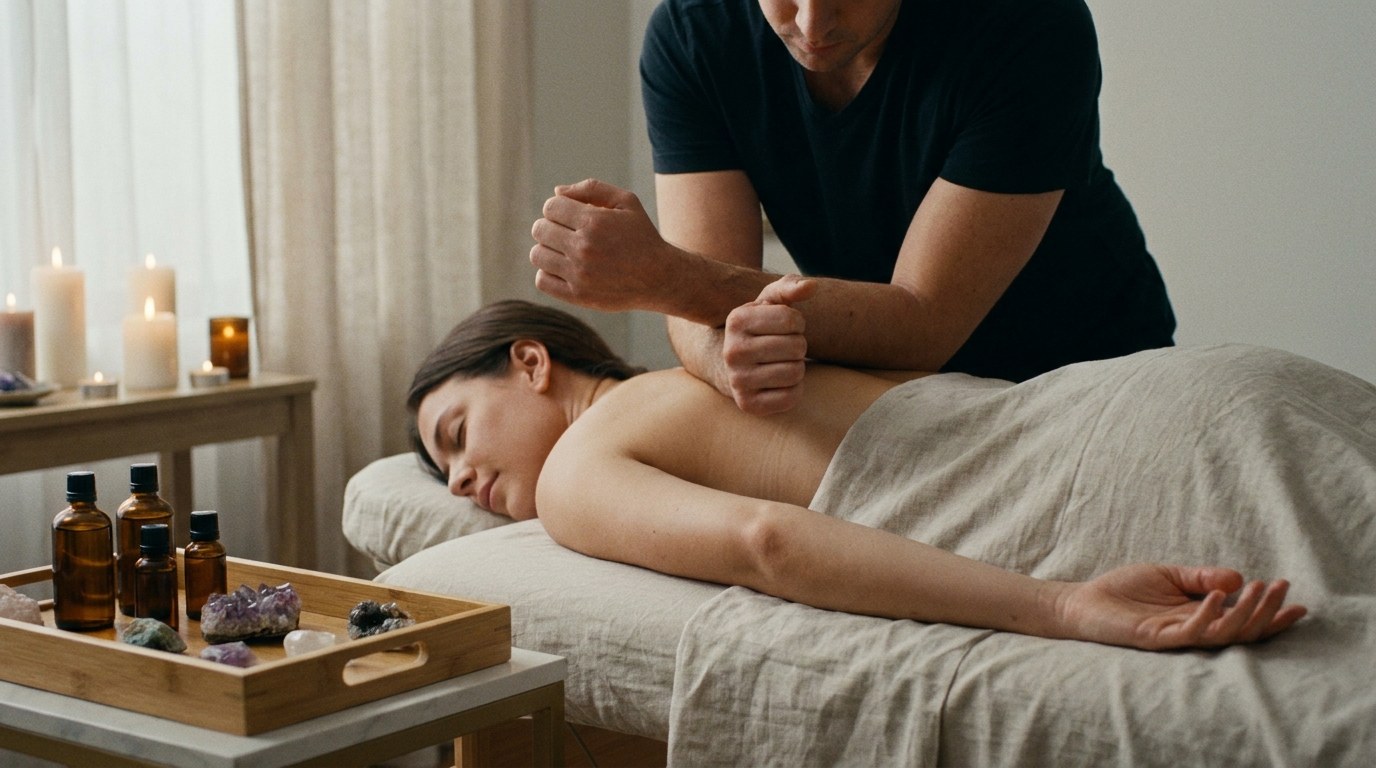
A Massage Therapy student at AVI Career Training in Vienna, Virginia spends their day moving between anatomy theory, hands-on technique practice, and supervised client sessions — building real, licensable skills inside a structured 500-hour program designed to take you from complete beginner to career-ready practitioner.
That’s the short answer. But if you’re seriously considering massage therapy school in Northern Virginia, you deserve the full picture — what a typical day actually feels like, what you’ll study, how the hours add up, and what comes next after you graduate.
This is that picture.
Key Takeaways
- AVI Career Training’s Massage Therapy program (NO FINANCIAL AID FOR THIS PROGRAM) requires 500 hours of training — meeting Virginia’s state licensing requirement
- Students split their time between academic theory (anatomy, physiology, kinesiology) and hands-on clinic practice
- Virginia requires licensure through the Virginia Board of Nursing, including passing the MBLEx exam
- AVI is COE-accredited and SCHEV-certified — credentials that matter when you apply for licensure and jobs
- The program is located in Vienna, VA — central to the Tysons Corner area, Fairfax County, Arlington, and the broader DC metro job market
Ready to see if this is the right move for you? Apply at AVI Career Training or call (703) 943-9841 to speak with an admissions advisor.
—
Morning: Starting the Day With Purpose
The morning of a Massage Therapy student at AVI doesn’t start with uncertainty — it starts with intention.
You arrive at AVI Career Training’s campus at 1595 Spring Hill Rd in Vienna, Virginia, a comfortable, professional-grade facility close to the Tysons Corner area and easily reachable from across Northern Virginia and the DC metro. You sign in, set up your workspace, and check the day’s focus — maybe it’s effleurage pressure variations in Swedish massage, or maybe it’s a review of contraindications before your next clinic session.
There’s a rhythm to the mornings here. Students arrive at roughly the same time, greet each other, and start settling into the day. That consistency matters more than it sounds. Massage therapy is a physically and emotionally present profession — you can’t show up distracted and do good work. The morning structure helps you shift into that focused, attentive mindset before you ever touch a client.
A mini-story: Marcus came to AVI after nearly a decade in IT project management. He was good at his job, but after years of back-to-back video calls and spreadsheet marathons, he wanted work that felt tangible — something where he could see the impact on a real person, in real time. His first morning at AVI, he wasn’t sure what to expect. By the end of the week, he said the morning prep routine — reviewing notes, setting up the table, checking in with classmates — felt more grounding than anything he’d done in years. “I actually look forward to coming in,” he told his instructor. “I didn’t know you could feel that way about school.”
That sense of showing up on purpose is built into the structure of AVI’s massage therapy training in Northern Virginia from day one.
—
Classroom & Theory — The Foundation Behind the Hands-On Work
What you learn in massage therapy school goes well beyond technique — the academic foundation is what separates a skilled therapist from an unsafe one.
Every working massage therapist needs to understand why a technique works, not just how to perform it. That’s why AVI’s Massage Therapy program builds serious time into classroom instruction covering:
Why Theory Makes You a Better Therapist
When a client tells you they have a herniated disc, you need to know what that means for your session plan — not guess. When someone comes in with edema in their lower legs, you need to understand whether massage is appropriate, and if so, how to modify your approach.
Theory isn’t separate from the hands-on work. It’s what makes the hands-on work safe, effective, and professional. AVI’s instructors — all licensed industry professionals — teach the academic material with direct clinical application in mind. You’re not memorizing for a test. You’re building a working knowledge base you’ll rely on every single day of your career.

This is also where students start developing the language of the profession — how to communicate clearly with clients about pressure, discomfort, goals, and limitations. Client communication is a skill, and like any skill, it gets better with practice starting early.
—
Hands-On Clinic Hours — Where Skills Become Second Nature
Hands-on massage therapy education is where everything you’ve studied in the classroom becomes something you can actually do — and do well.
AVI’s clinic hours put students in supervised, real-world practice scenarios under the guidance of licensed instructors. You’re working on actual clients, not just classmates in a drill exercise. That distinction matters enormously for your development as a practitioner.
What You Practice in the Clinic
Students at AVI work with multiple massage modalities throughout their 625-hour program, building proficiency through repetition and instructor feedback. Core techniques covered include:
Each clinic session has an instructor present — watching your body mechanics, giving real-time corrections, and helping you develop the physical intuition that only comes from doing the work repeatedly.
The Physical Reality of Clinic Practice
Here’s something the glossy brochures don’t always say: massage therapy is physically demanding. Your posture, your stance, your breathing — all of it matters. Poor body mechanics won’t just hurt your clients; they’ll hurt your career through injury and burnout. AVI’s instructors emphasize correct therapist positioning from the very first clinic session, because building good habits early is far easier than breaking bad ones later.
A mini-story: Priya had been a registered nurse for 11 years when she enrolled in AVI’s Massage Therapy program. She already understood anatomy cold — that part came easily. What surprised her was how much she had to learn about her own body. “In nursing, you’re always focused entirely on the patient,” she said. “In massage therapy school, you also learn to be aware of how you’re standing, how you’re breathing, whether you’re tensing your shoulders. It’s a completely different kind of body awareness.” By the time she graduated, Priya said she felt more physically confident in her work than she had in years. She now practices at a wellness clinic in Tysons Corner, a short drive from AVI’s Vienna campus.
—
What 500 Hours Really Builds in You
Virginia requires 625 hours of massage therapy training to sit for the licensing exam — and AVI’s program meets that requirement exactly.
But 500 hours isn’t just a number to get through. It’s a carefully structured progression that builds something you can’t shortcut: competence that holds up under pressure.
How the Hours Stack Up
Early in the program, you’re building vocabulary — learning names, structures, movements, techniques. The work feels new and sometimes unfamiliar. That’s expected.
By the midpoint, something shifts. The theory starts to feel automatic. Your hands start to understand what your brain already knows. You can hold a conversation with a client while simultaneously tracking pressure, angle, and rhythm. That multi-layered awareness — clinical, technical, and interpersonal all at once — is a skill. And 500 hours is roughly how long it takes to make it feel natural.
By the final stretch of the program, most students describe a growing sense of confidence that surprised them. Not arrogance — confidence. The kind that comes from having done something hundreds of times and knowing you can do it well.
Stamina, Professionalism, and Client Communication
Three things the 500 hours build that no one talks about enough:
Physical stamina. A working massage therapist might see four to six clients in a shift. Your body needs to be conditioned for that — and AVI’s clinic hours build that conditioning progressively, not all at once.
Professional habits. Showing up on time, documenting sessions accurately, communicating clearly with instructors and clients, maintaining appropriate boundaries — these aren’t soft skills. They’re the professional infrastructure of a sustainable career.
Client communication. You’ll learn to take a thorough client intake, adjust your session plan on the fly based on what you hear, and follow up in ways that build client trust and loyalty. In the massage therapy business, repeat clients are the foundation of a stable income.
—
From Student to Licensed Massage Therapist in Virginia — What Comes Next

Graduating from AVI’s Massage Therapy program is a major milestone — and it puts you directly on the path to licensure in Virginia.
The Virginia Licensing Process
Here’s exactly how it works:
1. Complete your 500 hours at an approved school (AVI Career Training is COE-accredited and SCHEV-certified, satisfying Virginia’s school approval requirement)
2. Pass the MBLEx — the Massage & Bodywork Licensing Examination, administered by the Federation of State Massage Therapy Boards (FSMTB) and required by Virginia for licensure
3. Apply for licensure through the Virginia Board of Nursing (which oversees massage therapy licensure in Virginia through the Virginia Department of Professional and Occupational Regulation — DPOR)
4. Receive your license and begin practicing
AVI’s program prepares you for the MBLEx throughout your training — the theory curriculum, the modality coverage, and the clinical hours all align directly with what the exam tests.
Where Northern Virginia Massage Therapists Work
The DC metro area is one of the strongest markets in the country for wellness careers. Graduates from AVI’s massage therapy training in Northern Virginia have gone on to work in:
The Northern Virginia and DC market rewards licensed, well-trained therapists — and your AVI credentials, COE accreditation, and MBLEx licensure make you competitive from day one.
A Note on Tuition and Financial Aid for This Program
AVI’s Massage Therapy program (NO FINANCIAL AID FOR THIS PROGRAM) is under 600 hours, which means it does not qualify for federal financial aid (Title IV / FAFSA). Federal student aid is not available for this program. AVI does offer payment plan options and may be able to connect you with private financing resources — contact admissions directly at (703) 943-9841 to discuss what’s available and find a path that works for your situation.
> GI Bill® recipients: Contact AVI directly to verify current GI Bill® eligibility for this specific program before enrolling.
—
Frequently Asked Questions
Q: What do you learn in massage therapy school?
A: In massage therapy school at AVI Career Training, you learn anatomy, physiology, kinesiology, pathology, and ethics in the classroom — and you practice Swedish massage, deep tissue, sports massage, prenatal massage, and reflexology in supervised clinic sessions. By graduation, you have both the theoretical knowledge and the hands-on competency required for Virginia state licensure.
Q: How long does it take to become a massage therapist in Virginia?
A: Virginia requires 625 hours of approved massage therapy training. At AVI Career Training in Vienna, VA, the Massage Therapy program is structured to meet that 625-hour requirement. The total calendar time depends on your schedule — contact AVI admissions at (703) 943-9841 for current program schedules and start dates.
Q: What is a typical day like in massage therapy school?
A: A typical day at AVI includes a mix of classroom instruction (anatomy, theory, contraindications) and hands-on clinic practice under licensed instructor supervision. Students arrive, prep their workspace, attend lecture or lab, and work directly with clients during clinic hours. The day is structured, purposeful, and physically engaging.
Q: How many hours do you need to become a licensed massage therapist in Virginia?
A: Virginia requires 625 hours of training at a state-approved massage therapy school. You must also pass the MBLEx (Massage & Bodywork Licensing Examination) and apply for licensure through the Virginia Board of Nursing under the Virginia Department of Professional and Occupational Regulation (DPOR).
Q: Is massage therapy school hard?
A: Massage therapy school is challenging in specific ways — anatomy and physiology require real study, and the physical demands of clinic practice take conditioning. But it’s not designed to weed people out. AVI’s instructors support you through the learning curve. Most students find the hands-on nature of the work more engaging than traditional academic settings.
Q: Is AVI Career Training accredited?
A: Yes. AVI Career Training is accredited by the Council on Occupational Education (COE) and certified by the State Council of Higher Education for Virginia (SCHEV). These credentials confirm that AVI meets rigorous academic and professional standards — and they matter when you apply for Virginia licensure and seek employment.
Q: Where is AVI Career Training located?
A: AVI Career Training is located at 1595 Spring Hill Rd #720, Vienna, Virginia 22182 — in the Tysons Corner area of Northern Virginia, easily accessible from Fairfax County, Arlington, DC, and the broader DMV metro area.
Q: Does AVI’s Massage Therapy program qualify for financial aid?
A: No. AVI’s Massage Therapy program (NO FINANCIAL AID FOR THIS PROGRAM) is under 600 hours and qualifies for federal financial aid (Title IV / FAFSA). Payment plan options may be available. Contact AVI admissions directly to discuss financing options.
—
Take the Next Step Toward Your Massage Therapy Career
If you’ve read this far, something about this path resonates with you. Maybe you’re ready for work that feels physical, purposeful, and deeply useful to other people. Maybe you’re done with a career that doesn’t fit who you are anymore. Maybe you’ve always been drawn to wellness and healing, and you’re finally ready to make it your profession.
AVI Career Training’s Massage Therapy program gives you the 625 hours, the hands-on training, the accredited credentials, and the instructor support to get there. You’ll graduate ready to sit for the MBLEx, apply for your Virginia license, and walk into a career in one of the strongest wellness markets in the country.
The next step is a conversation.
You can also call (703) 943-9841 to speak directly with an AVI admissions advisor — or learn more about AVI Career Training and what makes our programs different.
This is a career you can build. AVI is where you start.
—
About AVI Career Training
AVI Career Training is a COE-accredited, SCHEV-certified beauty and wellness career school located in Vienna, Virginia, serving students throughout Northern Virginia and the DC metro area — including Fairfax County, Tysons Corner, Arlington, and Washington, DC.
Address: 1595 Spring Hill Rd #720, Vienna, VA 22182
Phone: (703) 943-9841
Website: avicareertraining.com
Programs Offered: Massage Therapy, Cosmetology, Basic Esthetics, Master Esthetics, Nail Technician, Cosmetic Laser Technician, Electrolysis
Accreditations: Council on Occupational Education (COE) Accredited · State Council of Higher Education for Virginia (SCHEV) Certified
Apply: avi.edu/apply