Is Massage Therapy a Good Career? A Centreville VA Parent’s Guide
Yes — massage therapy is a genuinely good career path, especially for students in the Northern Virginia area where demand for wellness services is strong and wages consistently exceed the national median. If you’re a parent in Centreville, VA trying to figure out whether this is a smart move for your son or daughter, this guide gives you the real numbers, the exact Virginia licensing steps, and a clear path from enrollment to first paycheck — no vague promises. Start your application at AVI Career Training today.
—
- Virginia requires 500 hours of approved training to become a licensed massage therapist
- The national median salary is ~$49,860/year; Northern Virginia wages typically run higher
- BLS projects massage therapist employment to grow ~18% through 2032 — faster than average
- AVI Career Training’s 500-hour Massage Therapy program in Vienna, VA is roughly a 15-minute drive from Centreville
- AVI is COE Accredited and SCHEV Certified; the GI Bill® is accepted for eligible veterans and dependents
- ⚠️ Federal financial aid (FAFSA/Title IV) is NOT available for this program — see payment options below
—
What Does a Massage Therapist Actually Do Day to Day?
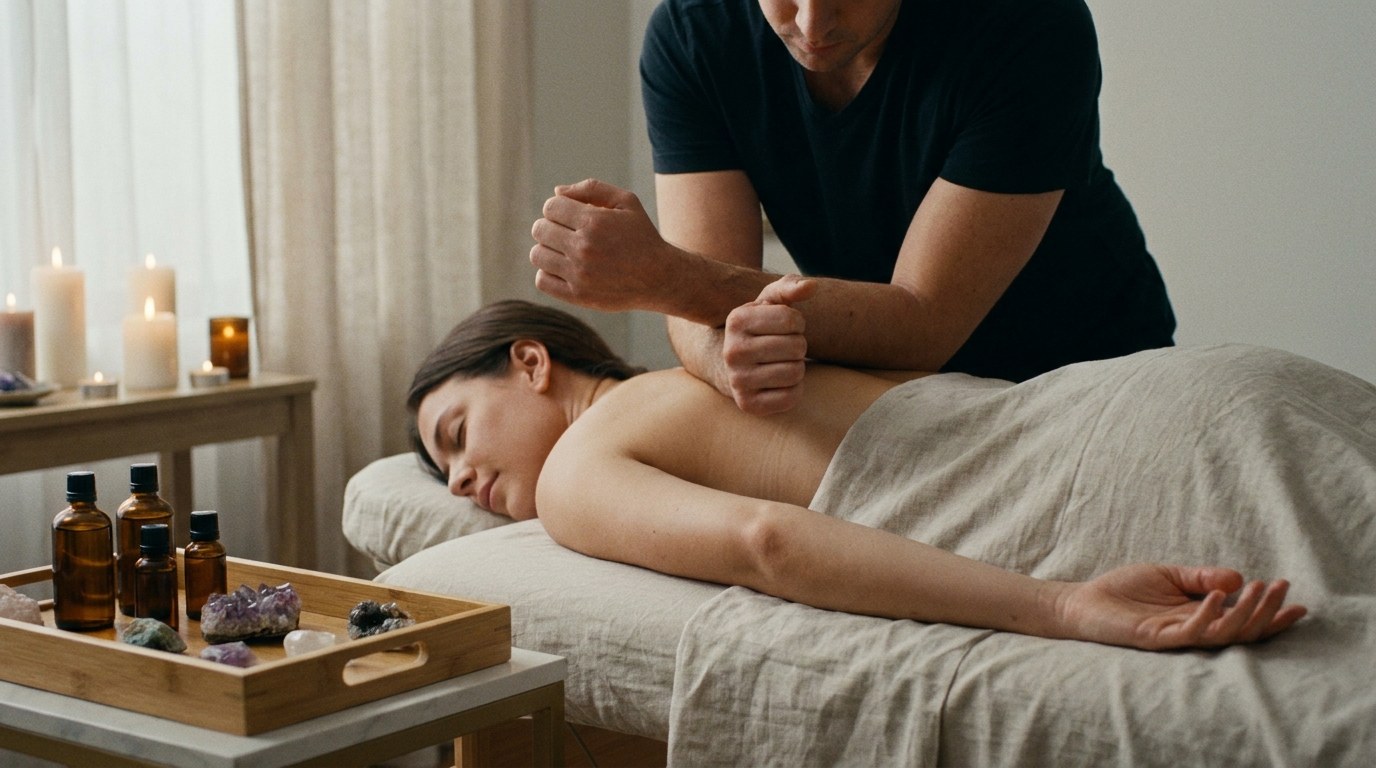
A licensed massage therapist helps clients manage pain, reduce stress, recover from injuries, and improve overall physical function — using hands-on techniques applied to muscles, connective tissue, and soft tissue. It’s skilled, purposeful work that goes far beyond what most parents picture when they first hear “spa job.”
A Typical Workday
Your child’s day might look very different depending on where they work. In a chiropractic or sports medicine clinic, they could start the morning working with an athlete recovering from a hamstring tear, then see two or three patients referred by a physician for soft-tissue pain management. In a resort spa, sessions are booked back-to-back with built-in transition time — Swedish massage, deep tissue, hot stone, aromatherapy. In a hospital or rehabilitation center, the work is more clinical: patients dealing with post-surgical recovery, cancer treatment side effects, or chronic conditions.
Most full-time massage therapists see between four and eight clients per day, with sessions ranging from 30 minutes to 90 minutes. Between sessions, they sanitize equipment, document session notes, and sometimes consult with other practitioners on a client’s care plan.
Where Licensed MTs Work
- Day spas and resort spas (strong market around Tysons Corner and Reston)
- Chiropractic and physical therapy offices
- Sports performance and athletic training centers
- Hospitals, cancer centers, and rehabilitation facilities
- Corporate wellness programs (a growing sector in the DC metro area)
- Private practice / self-employed mobile massage
- Hotel spas near major conference centers
The Physical Reality
Massage therapy is physically demanding — your child will be on their feet for most of their shift and using their hands, forearms, and body weight all day. Proper body mechanics (taught in every reputable program) protect against repetitive strain. MTs who use good technique and vary their service offerings tend to have long, sustainable careers. It’s worth discussing with your child whether they enjoy hands-on physical work and being in a service-oriented role — both are core to daily satisfaction in this field.
—
Massage Therapist Salary and Job Outlook in Northern Virginia
The Northern Virginia and DC metro market pays massage therapists above the national median — and job growth projections make this one of the stronger bets in the allied health and wellness space right now.
National and Regional Earnings
(BLS, bls.gov)
(faster than average — BLS)
vs. national average
According to the Bureau of Labor Statistics, the national median annual wage for massage therapists is approximately $49,860 — but wages in the Washington, DC metropolitan area, which includes Fairfax County and the Centreville corridor, consistently track higher due to cost of living and strong consumer spending on wellness services.
Entry-Level vs. Experienced Pay
A newly licensed MT in Northern Virginia entering the workforce at a spa or chiropractic clinic can typically expect hourly wages in the $18–$24 range before tips — which can be meaningful in high-service spa environments. After two to three years of experience with a strong client base, many MTs in this market earn $55,000–$70,000+ annually, especially those who blend employment with private clients.
The Self-Employment Multiplier
One factor that separates massage therapy from many other healthcare-adjacent careers is the self-employment ceiling. Licensed MTs who build a private practice or add mobile massage services can set their own rates — often $90–$140+ per session in the Northern Virginia market — and keep the difference that normally goes to a spa or clinic. Many working MTs do both: they maintain a part-time position at a clinic for consistent base income while building their own client roster on weekends. This dual-track model is especially common in Fairfax County, Loudoun, and Arlington.
Why Now Is a Strong Time to Enter This Field
The BLS projects approximately 18% employment growth for massage therapists through 2032 — well above the average for all occupations. Consumer spending on wellness and preventive health care has expanded significantly since 2020, and employer-sponsored wellness programs increasingly include massage therapy. For a Centreville family evaluating the long-term stability of this career, the trajectory looks solid.
—

—
Virginia Licensing Requirements — What Your Child Needs to Know
Virginia’s massage therapy licensure path is straightforward — and it moves faster than most parents expect. Here’s the exact sequence, step by step.
Step 1: Complete an Approved 500-Hour Program
Virginia requires candidates to complete a minimum of 500 hours of massage therapy training at a school approved by the Virginia Department of Professional and Occupational Regulation (DPOR). That training must cover anatomy and physiology, massage theory and techniques, pathology, ethics, business practices, and clinical hands-on hours. There is no wiggle room on the hour count — 500 hours is the threshold.
Step 2: Pass the MBLEx
After completing the program, your child applies to sit for the MBLEx — the Massage & Bodywork Licensing Examination. The MBLEx is the standard licensing exam used in most U.S. states and is administered by the Federation of State Massage Therapy Boards (FSMTB). It tests knowledge across anatomy, physiology, kinesiology, pathology, massage application, and ethics. Most students who complete a quality 500-hour program feel prepared for the exam.
Step 3: Apply for Virginia Licensure
With a passing MBLEx score in hand, your child submits a licensure application to the Virginia Department of Health Professions (DHP), which administers the program through the Virginia Board of Nursing. The application includes proof of program completion, exam scores, a background check, and the required fee. Processing times vary, but most applicants receive their license within a few weeks of submitting a complete application.
Step 4: Work as a Licensed Massage Therapist in Virginia
Once licensed, your child can legally practice massage therapy anywhere in Virginia. Licenses must be renewed regularly, and Virginia requires continuing education for renewal — meaning the learning doesn’t stop, but the ongoing investment in skills only makes practitioners more valuable over time.
Enroll in 500-hour program → Complete coursework + clinical hours → Pass MBLEx → Apply to Virginia DHP → Receive license → Begin working
That’s it. There’s no four-year degree, no graduate school, and no years of unpaid apprenticeship. A motivated student can go from first day of class to licensed professional in under a year.
—
A quick story: Darian, 22, from Centreville, wasn’t sure what he wanted to do after high school. He’d been working part-time at a sporting goods store and thinking vaguely about community college but didn’t have a specific goal. His mother, a nurse, suggested looking into massage therapy — she’d seen it work for athletic recovery throughout her career. Darian enrolled in AVI Career Training’s Massage Therapy program, completed his 500 hours, passed the MBLEx on his first attempt, and landed a position at a sports medicine clinic in Tysons Corner. Within his first year, he began taking private clients on weekends. He recently told his mother it was the first time he felt like he had an actual career, not just a job.
—
How to Choose a Massage Therapy School Near Centreville, VA
Not all massage therapy programs are the same — and as a parent, asking the right questions before your child enrolls can make the difference between a credential that opens doors and one that doesn’t. Here’s a practical checklist.
✅ Accreditation and State Approval
This is non-negotiable. Any school you consider must be approved by the Virginia Department of Professional and Occupational Regulation (DPOR) — otherwise, graduates cannot sit for the MBLEx or apply for a Virginia license. Beyond state approval, look for national accreditation through a recognized accrediting body such as the Council on Occupational Education (COE). COE accreditation signals that the school meets rigorous standards for curriculum, faculty, student services, and outcomes.
✅ Exact Program Hours
Virginia requires 500 hours. Confirm that the program you’re considering meets that threshold — and ask how many of those hours are hands-on clinical practice versus lecture. The ratio matters. A program heavy on lecture and light on practical hours produces graduates who know the theory but fumble during real sessions.
✅ Instructor Credentials
Your child’s instructors should be licensed, actively practicing or recently practicing massage therapists — not generalists. Ask the school directly: are your instructors licensed MTs? How long have they been in the field? Instruction from working professionals means your child learns current techniques and real-world insights, not just what’s in a textbook.
✅ Schedule Flexibility
Many prospective students in the Centreville area are balancing part-time work, family responsibilities, or other commitments. Ask whether the school offers day and evening schedule options, and how long the program typically takes to complete at each pace.
✅ Proximity and Commute
Commute fatigue is one of the most common reasons students drop programs before completion. A school that’s too far becomes a barrier — especially during high-demand weeks. For Centreville families, finding a program within a reasonable drive is worth prioritizing.
✅ Student Support and Job Placement
Ask every school you visit: what happens after graduation? Do you have relationships with local employers? Do you help graduates prepare for the MBLEx? Is there a career services function, or are graduates left to figure it out alone? The answer tells you a lot about how much the school values student outcomes versus just tuition revenue.
—

—
How AVI Career Training Prepares Students for a Massage Therapy Career
AVI Career Training, located at 1595 Spring Hill Rd #720, Vienna, VA 22182, is one of the most credentialed beauty and wellness career schools in Northern Virginia — and it sits approximately 15 minutes from Centreville via Route 66 or the Dulles Toll Road. For Centreville families, that commute is manageable by any measure.
The 500-Hour Massage Therapy Program
AVI’s Massage Therapy program is built around Virginia’s 500-hour licensure requirement. The curriculum covers:
- Anatomy, physiology, and kinesiology
- Massage theory and history of bodywork
- Swedish, deep tissue, and neuromuscular techniques
- Sports massage and injury-specific applications
- Pathology — contraindications and special populations
- Professional ethics and client communication
- Business practices and self-employment fundamentals
- Supervised clinical practice with real clients
The hands-on clinical component is where AVI students develop real confidence. Working with actual clients — not just classmates — in a supervised environment is how you build the muscle memory, client communication skills, and professional presence that employers notice immediately.
Credentials That Matter
AVI Career Training holds dual credentialing that matters for your child’s future:
These aren’t marketing badges. They’re quality signals that the program has been externally reviewed and meets defined standards for curriculum, faculty, and student outcomes. When your child graduates and applies for a Virginia license, these credentials mean their application moves forward without complications.
GI Bill® Acceptance — Critical for Northern Virginia Military Families
Northern Virginia has one of the highest concentrations of active-duty military personnel, veterans, and military families in the country. AVI accepts the GI Bill® for eligible veterans and dependents. If your family has earned education benefits through military service, those benefits can be applied toward tuition at AVI. Contact AVI’s admissions team at (703) 943-9841 to confirm your specific benefit eligibility.
Tuition and Payment Options
Federal financial aid (Title IV / FAFSA / Pell Grant) is NOT available for the Massage Therapy program because it is under 600 hours — the federal threshold for Title IV eligibility. Any school that implies otherwise is misleading you.
Available payment options at AVI include:
- Payment plans (ask admissions for current terms)
- Private financing options
- GI Bill® benefits for eligible veterans and dependents
- Out-of-pocket payment
AVI’s admissions team can walk you through the options that fit your family’s situation. Call (703) 943-9841 or start your inquiry online.
Why Vienna, VA Works for Centreville Families
Vienna is a short, direct drive from Centreville — no Beltway, no DC traffic. The campus is located in the Spring Hill Road business corridor near Tysons Corner, which is well-served by public transit including the Metro’s Silver Line (Spring Hill station) and multiple bus routes. Students who prefer to drive will find ample parking. The location also puts students close to a dense cluster of potential employers — spas, wellness studios, chiropractic clinics, and medical facilities throughout the Tysons, McLean, and Reston corridor.
—
Another story worth sharing: Fatima’s daughter had always been interested in health and wellness but wanted to start a career without taking on four years of student debt. Fatima, a military spouse stationed at Fort Belvoir, initially assumed the program would qualify for federal financial aid — and AVI’s admissions team was upfront with her that FAFSA is not available for this program. Instead, they walked her through a payment plan and helped her daughter confirm GI Bill® benefit eligibility. Her daughter completed the 500-hour program, passed the MBLEx, and now works full-time at a medical spa in Reston while building weekend private clients. Fatima said the transparency about costs upfront was what made her trust AVI over the other schools she’d looked at.
—
Frequently Asked Questions — Massage Therapy Career Path in Virginia
Q: How long does it take to become a licensed massage therapist in Virginia?
A: Virginia requires 500 hours of approved training. At AVI Career Training in Vienna, VA, students typically complete the program in several months depending on their schedule. After graduation, you apply to take the MBLEx exam, then submit your licensure application to the Virginia Department of Health Professions (DHP). Most students go from first day of class to licensed professional within a year.
Q: How much do massage therapists earn in Northern Virginia?
A: The national median annual wage is approximately $49,860 according to the Bureau of Labor Statistics. Northern Virginia and the DC metro market typically pay above that median. Experienced MTs with private clients or in high-end spa settings in Fairfax County, Loudoun, and Arlington can earn $55,000–$70,000+ annually. Tips and self-employment income can push earnings higher.
Q: Is massage therapy school worth the cost?
A: For most students in Northern Virginia, yes. The program is shorter and significantly less expensive than a four-year degree, and it leads directly to a licensed, in-demand career in a market with