Is Medical Assistant a Good Career? A Parent’s Guide
Yes — medical assistant is a good career for the right person, but whether it’s the best path for your child depends on timelines, costs, earning potential, and how much flexibility they want in their future. This guide gives Ashburn and Loudoun County families the honest numbers and a clear side-by-side comparison so you can make a confident decision — including some career paths you may not have considered yet. Apply Now at AVI Career Training to explore accredited programs near you.
—
- Medical assistant certificate programs in Virginia take 9–12 months; associate degree paths take 18–24 months.
- The Washington–Arlington–Alexandria metro median wage for MAs is approximately $43,000–$48,000/year (BLS, 2024).
- Virginia does not require state licensure for medical assistants — but national certification (AAMA or AMT) is increasingly expected by employers.
- Beauty and wellness careers in Northern Virginia — esthetics, massage therapy, cosmetology — offer comparable entry-level wages with clearer licensing pathways and stronger self-employment upside.
- AVI Career Training in Vienna, VA offers COE-accredited beauty and wellness programs with financial aid available and GI Bill® accepted.
—
What Does a Medical Assistant Actually Do?
A medical assistant (MA) is an entry-level healthcare professional who handles both clinical and administrative tasks in a medical setting. They are not nurses, and they are not doctors — but they are essential to keeping a physician’s office or clinic running smoothly.
Clinical Responsibilities
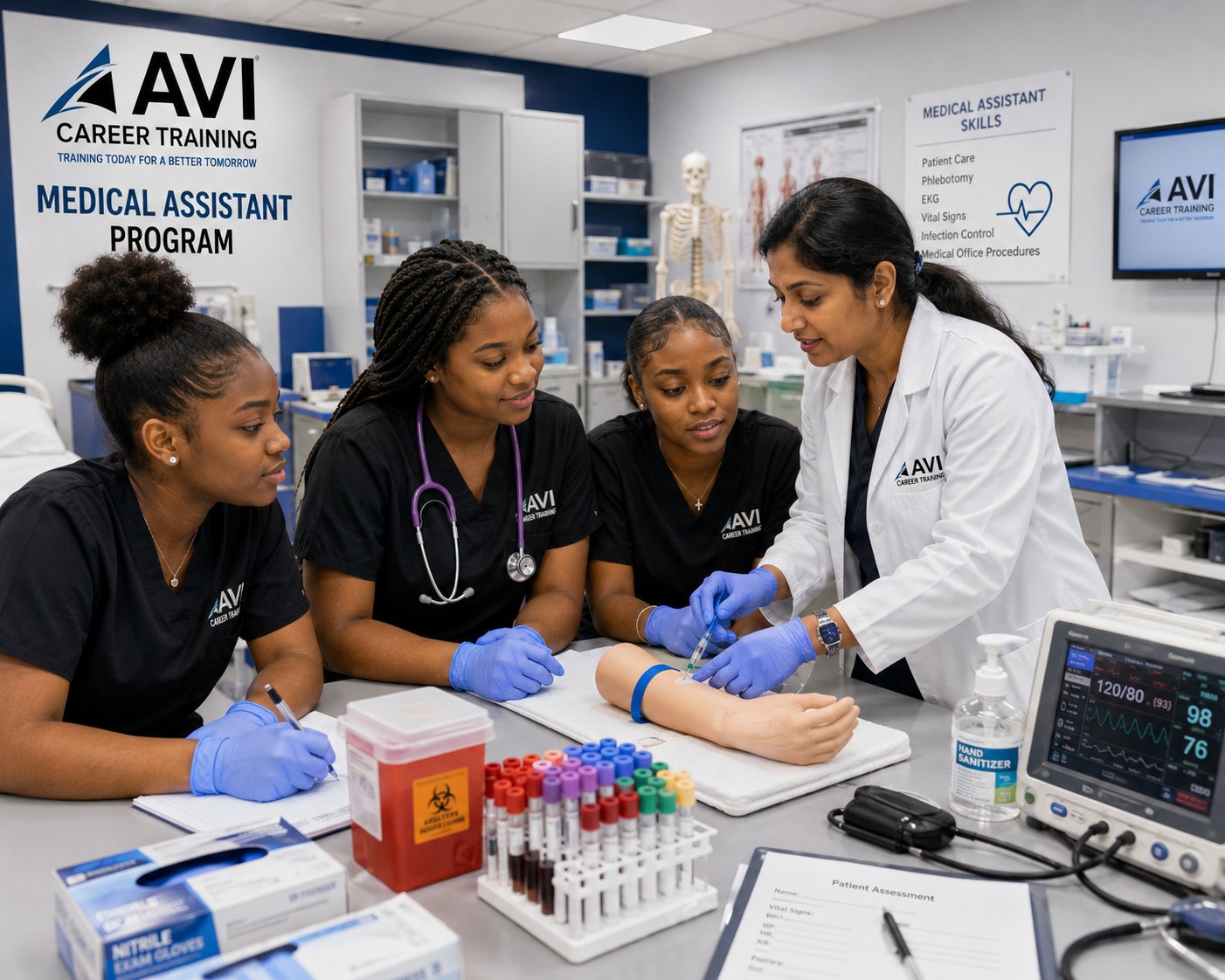
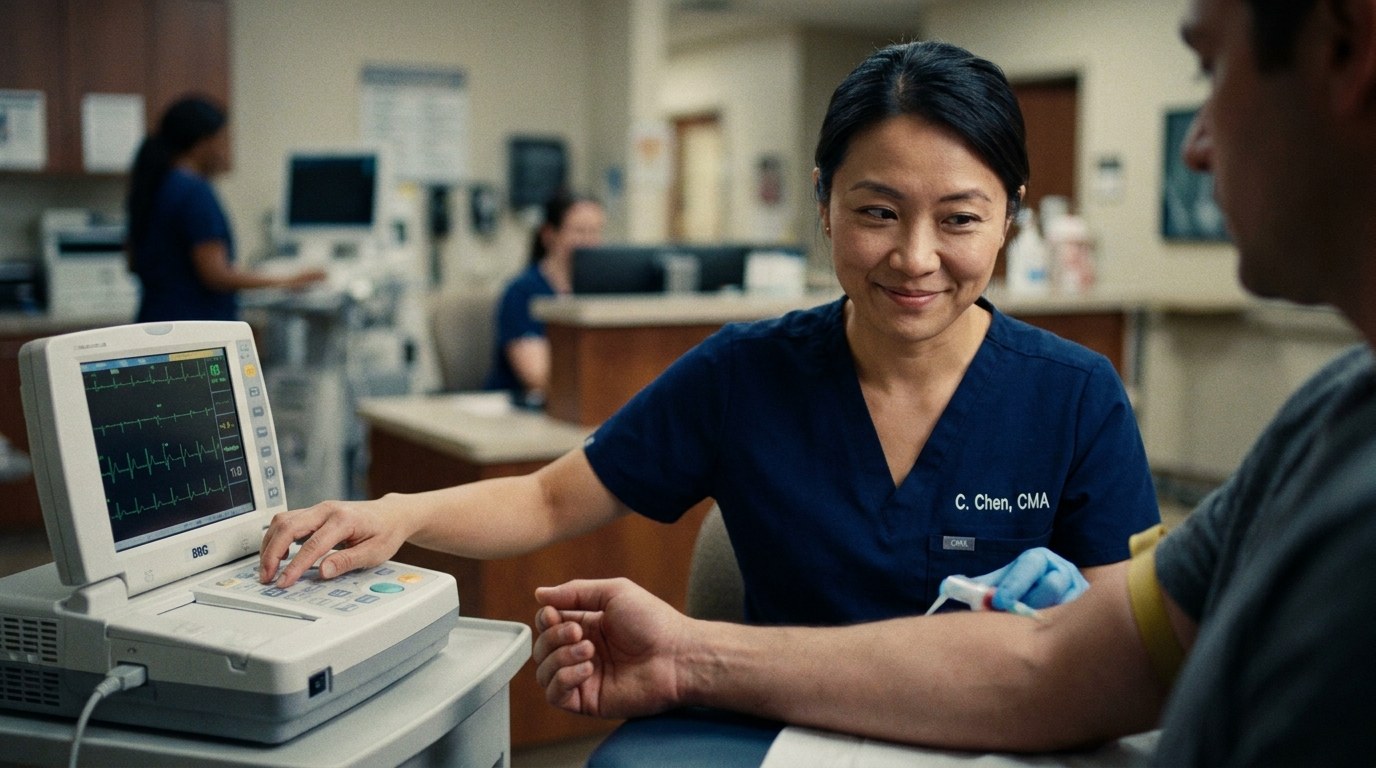
On the clinical side, MAs take patient vitals (blood pressure, temperature, pulse), prepare patients for examinations, perform basic phlebotomy (drawing blood), assist with EKG preparation, administer injections under physician supervision, and handle basic wound care. These tasks require real hands-on training and attention to detail.
Administrative Responsibilities
MAs also spend significant time on the administrative side of a practice — scheduling appointments, maintaining electronic health records (EHR), processing insurance billing, and managing patient intake paperwork. In smaller private practices, one MA may rotate between both roles throughout the same shift.
Where Do Medical Assistants Work?
The majority of MAs work in outpatient settings: physician offices, urgent care centers, dermatology clinics, pediatric practices, and specialty clinics. The Northern Virginia/DC metro area — with major healthcare systems like Inova Health System, Kaiser Permanente, and numerous private practices — is a genuinely strong market for MA employment.
How Is an MA Different from a CNA or LPN?
This is one of the most common questions parents ask, and the distinction matters:
Understanding this ladder matters because many parents assume “medical assistant” is a stepping stone to nursing. It can be — but advancement requires going back to school for additional credentials.
—
Medical Assistant Training in Virginia — What to Expect
Medical assistant training in Virginia is available through community colleges, career colleges, and private vocational schools. Here is what you need to know before enrolling anywhere.
How Long Does It Take to Become a Medical Assistant in Virginia?
Northern Virginia Community College (NOVA) offers an MA program through its Health Technology division. Private career schools in the region may offer accelerated certificate options.
Does Virginia License Medical Assistants?
No — Virginia does not require state licensure for medical assistants. This is an important nuance. Unlike nurses or cosmetologists, MAs in Virginia are not regulated by the state licensing board. However, most employers — especially larger healthcare systems — strongly prefer or require national certification through the:
These exams have specific educational prerequisites, so your child should confirm that any program they consider makes graduates eligible to sit for one of these exams.
What Does Medical Assistant Training Cost in Northern Virginia?
Costs vary significantly by program type:
Key question to ask any school: “Is this program eligible for Title IV federal financial aid (FAFSA)?” The answer depends on whether the program meets minimum hour requirements and whether the school holds the right accreditation type.
—
The Real Numbers — Salary, Job Outlook, and Career Ceiling
Medical Assistant Salary in Northern Virginia
According to the Bureau of Labor Statistics, medical assistants in the Washington–Arlington–Alexandria metropolitan division earn above the national median. The 2024 BLS data places the national median annual wage for MAs at approximately $42,000, while the Northern Virginia/DC metro typically runs several thousand dollars higher due to cost-of-living adjustments in the region.
For a recent high school graduate in Ashburn or Loudoun County, an MA salary in the $43,000–$48,000 range is a real, tangible outcome — not a promise. That said, it is worth understanding what that wage looks like long-term.
Is There a Career Ceiling for Medical Assistants?
Honestly — yes, and parents deserve to know this upfront. The MA role is an excellent entry point into healthcare, but advancement typically requires returning to school. Moving from MA to Registered Nurse (RN) requires completing an ADN or BSN program. Moving into physician assistant (PA) territory requires a master’s degree. Most MAs who want to grow their income significantly need additional education after their initial certificate.
This does not make MA a bad choice — it makes it a deliberate choice. If your child is passionate about clinical healthcare and plans to continue their education, starting as an MA makes sense. If they want to enter a career, build skills, and grow their income without returning for another degree, there are paths worth examining.
Job Outlook: Genuinely Strong
The BLS projects 14% growth in MA employment from 2022 to 2032 — much faster than the average for all occupations. An aging U.S. population and the ongoing expansion of outpatient healthcare settings are driving this demand. In the Northern Virginia market specifically, Inova, Kaiser, and the expanding network of urgent care clinics represent consistent hiring activity.
—
Medical Assistant vs. Other Career Training Paths — What Ashburn Parents Should Compare
Here is where many families stop short in their research: they compare MA training to a four-year college degree, and it looks great by comparison. But the more useful comparison is MA training against other accredited, hands-on career programs that also skip the four-year degree — specifically beauty and wellness careers.
This is not about one path being better than the other. It is about making sure your child — and you — have seen the full picture before committing.
The Side-by-Side: Medical Assistant vs. Beauty & Wellness Careers
| Factor | Medical Assistant | Beauty & Wellness (Esthetics, Massage, Cosmetology) |
|---|---|---|
| Training Length | 9–24 months | 4–12 months (program dependent) |
| Virginia State Licensing | Not required (national cert preferred) | Required — clear DPOR exam pathway |
| Entry-Level Wage (N. VA) | ~$43,000–$48,000/year | $35,000–$55,000+ (employed); higher self-employed |
| Self-Employment Option | Very limited | Strong — salon suites, private practice, mobile services |
| Career Ceiling Without More School | Moderate — advancement requires RN/PA degree | High — income grows with clientele and specialization |
| Financial Aid Availability | Depends on school/program | Available at accredited schools (COE/SCHEV); GI Bill® accepted at AVI |
Why Beauty & Wellness Deserves a Serious Look
The Northern Virginia and DC metro market for beauty and wellness services is among the strongest in the country. Tysons Corner, Reston, Leesburg, and Ashburn itself are home to high-income households that spend significantly on skincare, massage, laser treatments, and salon services. Demand is not going anywhere.
What makes beauty and wellness careers particularly compelling for Ashburn families is the combination of:
1. Clear, state-managed licensing through Virginia’s Department of Professional and Occupational Regulation (DPOR). You pass your exam, you hold your license. There is no ambiguity about who is certified and who is not.
2. Entrepreneurial freedom that healthcare entry-level roles simply cannot offer. A licensed esthetician or massage therapist can rent a suite, build a client base, and set their own rates — often within the first year of licensure.
3. Program length that gets your child earning faster. Some programs, like Nail Technician training at AVI Career Training, can be completed in as few as eight weeks of focused, hands-on instruction.
Consider a situation like this one: a 19-year-old from Ashburn who spent her senior year researching both medical assistant programs and esthetics. Her parents wanted healthcare. She wanted creative, people-centered work. She enrolled in an esthetics program, completed her training, passed her Virginia State Board exam, and within eight months of graduation was working at a medical spa in Tysons — performing chemical peels and microdermabrasion treatments for clients who specifically sought out her skills. Her hourly rate, with tips, consistently topped what she would have made starting as an MA — and she was doing work she genuinely loved.
—
How Ashburn Families Can Find the Right Career Training Program
Whether your child is seriously considering medical assistant training or exploring beauty and wellness as an alternative, the checklist for evaluating any career school is the same. Do not skip these questions.
1. Accreditation — Non-Negotiable
Any career school your child attends should hold accreditation from a recognized body. For beauty and wellness schools, look for:
For medical assistant programs, look for programmatic accreditation through CAAHEP (Commission on Accreditation of Allied Health Education Programs) or ABHES (Accrediting Bureau of Health Education Schools). Without these, graduates may not be eligible to sit for national certification exams.
2. Financial Aid — Ask the Exact Questions
Federal financial aid (Title IV / FAFSA) is only available at schools that meet specific accreditation and program hour requirements. Before assuming aid is available, ask:
3. Hands-On Curriculum, Not Just Classroom Hours
Career training is only valuable when graduates can actually perform the skills on day one. Ask schools what percentage of training time is hands-on clinical or practical work versus lecture. For cosmetology and esthetics, Virginia’s DPOR requires specific clock hours of practical training — a built-in protection for students.
4. Licensing Exam Pass Rates
Ask every school directly: “What is your students’ first-attempt pass rate on the licensing or certification exam?” A school that cannot answer this question clearly is a school to approach with caution.
5. Job Placement Support
Does the school have relationships with local employers? Do they offer resume help, interview coaching, or job boards for graduates? In competitive markets like Northern Virginia, a school with active industry connections is worth more than one without them.
—
Not every family researching career schools is thinking about a recent high school graduate. Consider a mother of two in Sterling, Virginia — in her late 30s, tired of a desk job that offered no creativity and no flexibility. She spent months researching allied health careers before a friend mentioned massage therapy. She enrolled in a Massage Therapy program, completed her training while managing her family schedule, passed her Virginia State Board exam, and built a part-time practice that grew into full-time income within 18 months. The flexibility to set her own hours — something no MA role would have offered — made all the difference.
—
Frequently Asked Questions
Q: How long does it take to become a medical assistant in Virginia?