Is Medical Assistant a Good Career? A DC Parent’s Complete Guide
Medical assistant is a good career for students who want to enter healthcare quickly without a four-year degree — but it comes with real limitations that DC-area parents need to understand before writing a tuition check.
This guide gives you the honest breakdown: what medical assistants actually earn in the Washington DC metro, how long training takes, and whether the credential opens doors or closes ceilings — plus a look at healthcare-adjacent career paths many Northern Virginia families haven’t considered yet.
Request information or apply at AVI Career Training →
Key Takeaways
- Medical assistants in the Washington-Arlington-Alexandria metro earn a median of $42,000–$48,000 annually (2024 BLS data)
- MA certificate programs in Northern Virginia typically run 9–12 months and cost $3,000–$15,000 depending on the school
- Virginia does not issue a state license for medical assistants — graduates hold a national certification, not a government-issued credential
- Healthcare-adjacent careers like Cosmetic Laser Technician and Master Esthetics can offer faster training, state licensure, and significant entrepreneurial upside
- Any career school your student considers should be accredited by a recognized body — look for COE, ABHES, CAAHEP, or SCHEV certification
—
What Medical Assistants Actually Do — And What the Job Looks Like in 2025
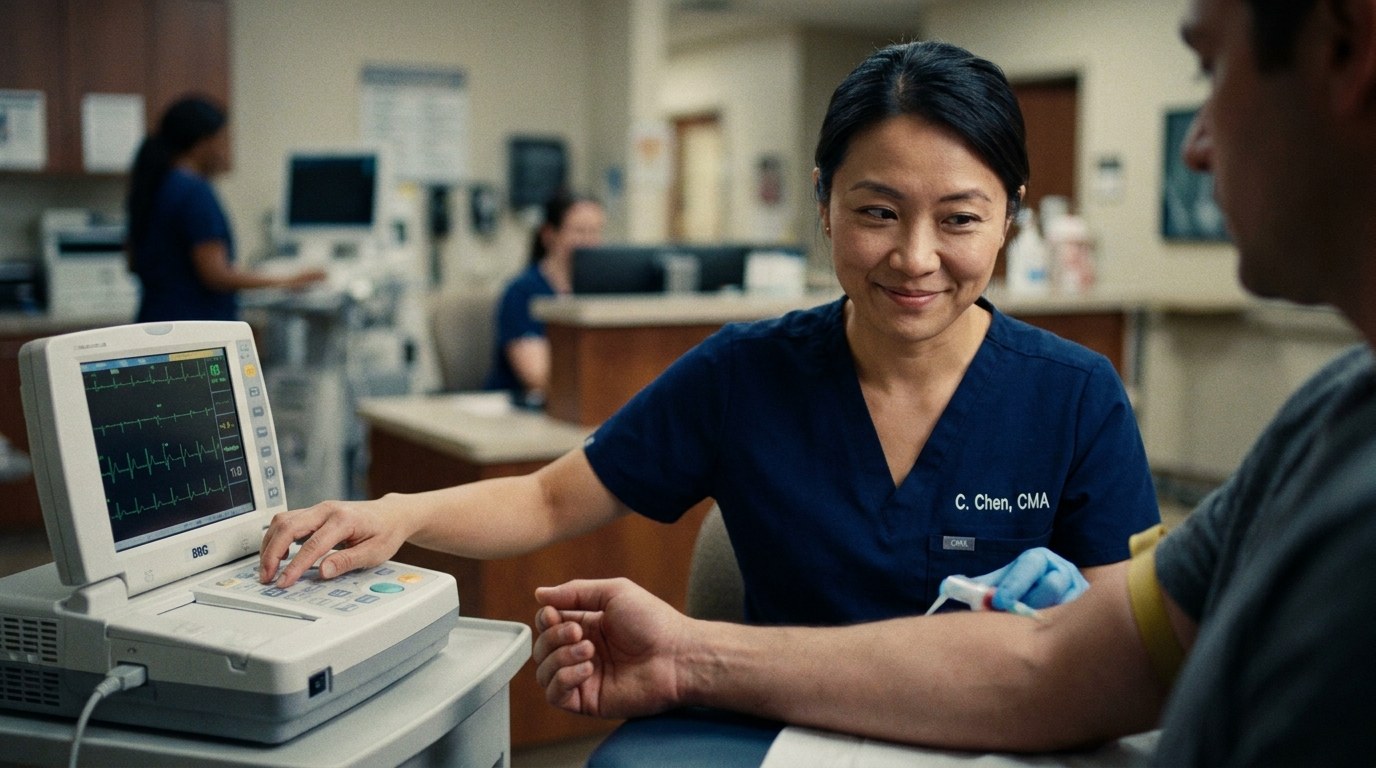
Medical assistants perform a mix of clinical and administrative tasks in physician offices, clinics, hospitals, and outpatient care centers. On the clinical side, that means taking vital signs, drawing blood, administering injections, performing EKGs, and preparing patients for exams. On the administrative side, it can include scheduling appointments, managing patient records, and handling insurance pre-authorizations.
That wide range sounds appealing — but it also means the day-to-day experience varies enormously by employer. At a busy primary care clinic, an MA might spend the entire shift rooming patients. At a specialty practice, they might split time between the front desk and back office. Your student should know going in that the job title doesn’t guarantee a specific type of work.
The Scope of Practice Issue in Virginia
Here’s something many families don’t learn until after enrollment: Virginia does not license medical assistants at the state level. That’s not a minor detail — it shapes the entire career trajectory.
In states with formal MA licensure, the credential creates a clear professional standing with defined legal protections and scope-of-practice rules. In Virginia, employers define what MAs can and cannot do — and that definition shifts from one practice to the next. A graduate’s authority to perform certain clinical tasks depends entirely on which doctor signed off on their training protocols, not on a state-issued license.
This matters for job security, professional advancement, and compensation negotiations. Compare that to careers in fields like cosmetology, esthetics, or massage therapy — where Virginia’s Department of Professional and Occupational Regulation (DPOR) issues a formal state license that every employer must recognize.
—
Medical Assistant Salary in Washington DC — What Parents Need to Know
Medical assistants in the Washington-Arlington-Alexandria metro area earn more than the national average — but the numbers still deserve a clear-eyed look.
According to the Bureau of Labor Statistics, the median annual wage for medical assistants in the DC metro sits between $42,000 and $48,000 as of 2024 data. Entry-level positions in Northern Virginia typically start closer to $36,000–$38,000. Experienced MAs in specialty practices — dermatology, orthopedics, cardiology — can push toward $52,000, though that ceiling requires years of experience and often additional certifications.
Running the ROI Math
If training costs $10,000 and your student earns $38,000 in year one, the tuition pays back in about three months of gross wages — which looks good on paper. But parents should ask a more nuanced question: what does year five or year ten look like?
Without a state license or a degree, MA career advancement often requires returning to school — either for a nursing credential (RN or LPN) or a bachelor’s degree in health administration. That’s a second tuition investment. Families should factor that possibility into the original career decision, not discover it after the fact.
—
How Long Does Medical Assistant Training Take in Northern Virginia?
Most MA certificate programs run 9 to 12 months full-time. Northern Virginia Community College (NOVA) and several private career schools in the region offer accredited programs within that range.
Graduates typically pursue one of two national certifications: the Certified Medical Assistant (CMA) credential through the American Association of Medical Assistants (AAMA), or the Registered Medical Assistant (RMA) through American Medical Technologists (AMT). Both are earned through passing a national exam — not issued by the Commonwealth of Virginia.
What Parents Should Clarify Before Enrolling
When evaluating any MA program, ask these questions directly:
These aren’t hostile questions — they’re reasonable ones. Any school worth attending will answer them without hesitation.
—
Is Medical Assistant the Right Path — Or Are There Stronger Alternatives?
Medical assistant is a legitimate entry point into healthcare for the right student. If your child genuinely wants to work in a clinical environment, support patient care, and potentially use the role as a stepping stone toward nursing or physician assistant school — it can work well. The job market is stable, the training is accessible, and DC-area employers hire MAs steadily.
But it’s not the only path worth considering. And for some students, it may not be the best one.
Here’s what many Northern Virginia families haven’t fully explored: healthcare-adjacent careers that offer state licensure, competitive earnings, and significantly more entrepreneurial flexibility.
The Career Your Student May Not Have Considered: Cosmetic Laser Technician
Cosmetic laser technology sits at the intersection of healthcare, aesthetics, and technology — and it’s one of the fastest-growing specialties in the DC metro’s medical spa market.
Laser technicians perform treatments like laser hair removal, skin resurfacing, photofacials, and body contouring. They work in medspas, dermatology clinics, plastic surgery practices, and wellness centers — the same clinical settings as many medical assistants, but with a skill set that commands higher per-treatment revenue and, often, commission-based compensation structures.
In Northern Virginia and the broader DMV area, AVI Career Training offers a Cosmetic Laser Technician program in Vienna, Virginia — one of the few COE-accredited programs in the region specifically built around hands-on laser and light-based device training.
Master Esthetics: Clinical Skincare as a Career
Esthetics is another healthcare-adjacent path many parents underestimate. A Master Esthetics credential in Virginia — issued through DPOR — qualifies graduates to perform advanced clinical skincare treatments including chemical peels, microdermabrasion, microneedling, and more. Experienced estheticians in the DC metro who build a loyal clientele routinely earn $55,000–$80,000 annually, with the ceiling higher for those who open their own practices.
The training is hands-on from day one, and AVI Career Training’s esthetics program in Vienna is built around working with diverse skin tones — a practical reality in the DMV’s multicultural market that not every school addresses seriously.
If your student is drawn to skincare science, client relationships, and the possibility of eventually owning a business, esthetics deserves a genuine look alongside — or instead of — the MA path.
Ready to explore what AVI’s programs look like up close? Schedule a visit or request information here.
—
What DC-Area Parents Should Ask Before Choosing Any Career School
Whether your student is considering a medical assistant program, an esthetics program, or any other career training path, the school vetting process matters as much as the career choice itself.
The Non-Negotiable Checklist
Accreditation — and which kind?
Not all accreditation is equal. For MA programs, look for CAAHEP or ABHES accreditation. For beauty and wellness programs, the Council on Occupational Education (COE) is the gold standard — it’s the accrediting body that governs financial aid eligibility and program quality for vocational schools. AVI Career Training holds COE accreditation and is certified by SCHEV (the State Council of Higher Education for Virginia).
Does the credential lead to a state license?
This is the most important question many families forget to ask. A national certification (like a CMA) and a state-issued license are not the same thing. Virginia issues licenses for cosmetologists, estheticians, nail technicians, massage therapists, and laser technicians through DPOR. The state does not license medical assistants. That difference matters when your student is job hunting.
What are the actual training hours — and how are they structured?
Total program hours aren’t the whole story. A program heavy on lecture and light on hands-on practice won’t prepare students for real work environments. Ask for the clinical-to-classroom ratio.
What does financial aid availability look like?
Programs under 600 hours typically do not qualify for federal financial aid (Title IV / FAFSA). Make sure you know exactly what aid your student can access before comparing sticker prices. Some programs offer payment plans or access to private financing options.
What is the school’s job placement support?
Accredited schools should be able to show you placement data, graduate outcomes, or at minimum, a clear picture of how they support students through the job search. Career coaching, industry connections, and employer relationships matter.
AVI Career Training in Vienna, Virginia offers COE-accredited programs in Cosmetic Laser Technology, Esthetics, Cosmetology, Massage Therapy, Electrolysis, and Nail Technology. Federal financial aid (Pell Grant, GI Bill®) is available for qualifying programs. The GI Bill® is accepted for eligible veterans and military-connected students.
—
Frequently Asked Questions
Q: How much does a medical assistant make in Virginia?
A: Medical assistants in Virginia earn a median salary of approximately $42,000–$48,000 per year in the Washington-Arlington-Alexandria metro area, based on 2024 Bureau of Labor Statistics data. Entry-level positions in Northern Virginia typically start between $36,000 and $38,000. Experienced MAs in specialty practices may earn up to $52,000.
Q: Is medical assistant school worth the cost?
A: It depends on your student’s long-term goals. For students planning to use the role as a bridge toward nursing or another clinical credential, yes — the investment is relatively modest and the job is plentiful. For students who want a career destination rather than a stepping stone, they should weigh the lack of Virginia state licensure and the limited earning ceiling against other training options.
Q: What are the best healthcare careers that don’t require a 4-year degree?
A: In the Northern Virginia and DC metro area, strong options include: Registered Nurse (ADN pathway — 2 years), Licensed Practical Nurse (12–18 months), Medical Assistant (9–12 months), Esthetics / Master Esthetics, Cosmetic Laser Technician, and Massage Therapy. The beauty and wellness paths on that list offer state licensure through Virginia DPOR, hands-on training, and direct earning potential without a bachelor’s degree.
Q: How long is medical assistant training in Northern Virginia?
A: Most accredited MA certificate programs in Northern Virginia — including those at NOVA — run 9 to 12 months full-time. Some accelerated private programs offer shorter tracks, but families should verify CAAHEP or ABHES accreditation and confirm that the program qualifies graduates to sit for the CMA or RMA exam before enrolling.
Q: What’s the difference between a medical assistant and a clinical esthetician?
A: A medical assistant supports physicians across a wide range of clinical tasks — vitals, injections, patient intake — in a doctor-directed environment. A clinical or master esthetician focuses specifically on advanced skincare treatments (chemical peels, microneedling, laser-adjacent procedures) and holds a Virginia DPOR-issued license. Clinical estheticians often work in medspas and dermatology practices and typically have more autonomy over their client relationships and earning potential.
Q: Does Virginia license medical assistants?
A: No. Virginia does not issue a state license for medical assistants. Graduates hold a national certification (CMA through AAMA or RMA through AMT) earned by passing a professional exam. By contrast, estheticians, cosmetologists, massage therapists, nail technicians, and laser technicians in Virginia are licensed by the Virginia Department of Professional and Occupational Regulation (DPOR).
Q: Can I get financial aid for medical assistant school in Northern Virginia?
A: It depends on the program length and the school’s accreditation. Programs under 600 hours typically do not qualify for federal financial aid (Title IV / FAFSA). Programs at COE-accredited schools like AVI Career Training that exceed 600 hours may qualify for Pell Grants, and AVI also accepts the GI Bill® for eligible students. Always ask a specific school about aid eligibility before comparing net costs.
—
—
Your Student’s Career Starts Here
Whether your student is weighing a medical assistant program or exploring healthcare-adjacent careers like Cosmetic Laser Technology or Esthetics, AVI Career Training in Vienna, Virginia can help you make an informed decision. Tour our working clinic, meet our licensed instructors, and see exactly what hands-on training looks like.
Request Information or Apply Today →
Call us at 703-943-9841