Is Massage Therapy a Good Career? A Parent’s Guide
Yes — massage therapy is a genuinely good career path, especially in Northern Virginia, where demand for licensed wellness professionals consistently outpaces supply and compensation runs well above the national average.
If you’re a parent in Falls Church, Vienna, or anywhere in the DMV area researching this for your son or daughter (or for yourself), this guide answers every question that matters: what the work actually looks like, what Virginia requires for licensure, how much therapists earn here, how long training takes, and how to choose the right school. No fluff — just the facts you need to make a confident decision.
⚡ Key Takeaways
- Virginia requires 500 clock hours of supervised training for massage therapy licensure.
- Massage therapists in the DC metro area earn a median wage 15–25% above the national average, with self-employed therapists in Northern Virginia commonly charging $80–$150+ per hour.
- The BLS projects massage therapy employment to grow 18% through 2033 — much faster than average.
- AVI Career Training’s Massage Therapy program (NO FINANCIAL AID FOR THIS PROGRAM) in Vienna, VA is COE-accredited and SCHEV-certified — about 15 minutes from Falls Church.
- Federal financial aid (FAFSA/Title IV) is not available for this program; payment plans and private financing options are available.
Ready to take the next step? Apply to AVI Career Training’s Massage Therapy program today.
—
What Does a Massage Therapy Career Actually Look Like Day-to-Day?
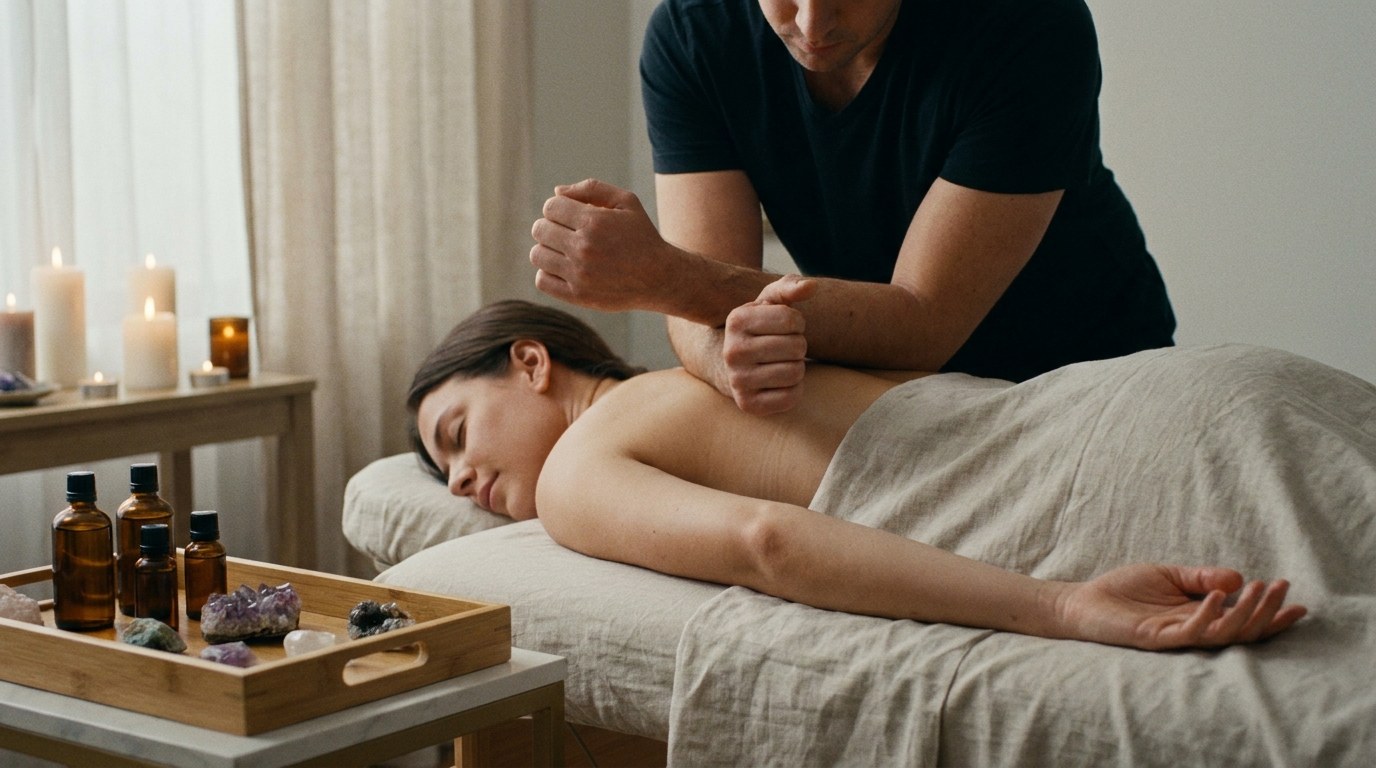
Massage therapy is a licensed, healthcare-adjacent profession — not an informal service job — and understanding that distinction matters when you’re weighing it as a long-term career path.
Licensed massage therapists (LMTs) work in a wide range of professional settings:

Schedule flexibility is a real advantage. Many therapists work part-time while building a private clientele, or choose evening and weekend hours that fit around family life. Full-time employed therapists typically see five to eight clients per day, with rest periods built in between sessions.
The physical demands are real, too. This is hands-on work. Therapists stand for most of their shift and use consistent physical effort through every session. Good body mechanics — which quality training programs emphasize — help therapists sustain long careers without injury.
A mini-story: Marcus graduated from high school in Fairfax County and wasn’t sure college was the right fit. His mom started researching skilled trades and wellness careers when she stumbled across massage therapy. Within eight months of enrolling in a 500-hour program, Marcus was licensed, working three days a week at a chiropractic clinic in Tysons Corner, and earning more than several of his college-enrolled friends working part-time retail. The credential was real, the income was real, and the path took less than a year.
—
Virginia Licensing Requirements: What Your Child Needs to Know
Virginia requires a specific, achievable set of credentials before anyone can practice massage therapy professionally — and understanding the full picture helps parents evaluate whether the timeline is realistic.
✅ Virginia Massage Therapy Licensure Checklist
- Complete 500 clock hours of supervised massage therapy training at a state-approved school
- Pass the MBLEx (Massage & Bodywork Licensing Examination)
- Hold a current CPR certification at time of application
- Submit a licensure application through the Virginia Department of Health Professions (DHP)
Virginia’s massage therapy program is regulated by the Virginia Department of Health Professions under the Board of Nursing. Licensure is issued through the Virginia Department of Professional and Occupational Regulation (DPOR).
The 500-hour requirement is non-negotiable. Schools approved by the State Council of Higher Education for Virginia (SCHEV) and accredited by the Council on Occupational Education (COE) are the credentialing bodies that matter most here. A diploma from a non-approved school won’t qualify your student to sit for the MBLEx — so choosing the right school is foundational, not optional.
The MBLEx is a nationally standardized exam administered by the Federation of State Massage Therapy Boards (FSMTB). It tests anatomy, physiology, kinesiology, pathology, and massage therapy ethics. Quality programs prepare students specifically for this exam alongside hands-on clinical skills.
CPR certification is a simple but required step — typically a one-day class your student can complete before or during their program.
—
How Much Do Massage Therapists Earn in Northern Virginia?
Massage therapists in the DC metro area earn meaningfully more than the national average — and that gap matters for families weighing the return on a training investment.
(BLS, most recent data — verify before publishing)
Above state median (BLS Metro Area data)
Common rate range in Northern Virginia
⚠️ Editorial note: Verify all salary figures against the most current BLS Occupational Outlook Handbook release before publishing.
Employed vs. self-employed earnings work differently. An employed therapist at a spa or clinic earns a predictable hourly wage or salary, often with benefits, but sees a fraction of what clients pay per session. A self-employed therapist in Northern Virginia who charges $120 per session and sees six clients per day grosses $720 in a single shift — though they also manage their own overhead, scheduling, and taxes.
Northern Virginia’s cost-of-living premium is a two-edged sword. Yes, clients in McLean, Vienna, and Falls Church expect to pay more for services — and they do. But your student will also spend more to live here. The practical takeaway: self-employment potential in this market is genuinely high, and even employed therapists in the DC metro area out-earn their counterparts in rural Virginia by a significant margin.
Employment growth adds to the appeal. The Bureau of Labor Statistics projects massage therapy employment to grow 18% through 2033 — much faster than the average for all occupations. That’s a strong signal for long-term career stability.

—
How Long Is Massage Therapy School — and What Does It Cost?
The path to becoming a licensed massage therapist in Virginia is shorter and more affordable than most parents expect.
Program Length
Virginia’s 500-hour training requirement means your student can complete their education in a fraction of the time it takes to finish a two- or four-year degree. At AVI Career Training (NO FINANCIAL AID FOR THIS PROGRAM), the Massage Therapy program is structured to take students from zero experience to MBLEx-eligible in a focused, hands-on curriculum. Depending on whether your student enrolls full-time or part-time, the timeline can range from several months to under a year.
The Falls Church to Vienna commute is approximately 15 minutes — making AVI’s campus at 1595 Spring Hill Rd #720, Vienna, VA 22182 genuinely accessible for Northern Virginia families without a long drive.
What the Program Covers
A strong 500-hour curriculum covers far more than technique. AVI’s program prepares students across:
Tuition & Financial Aid — Read This Carefully
⚠️ Important: Financial Aid Is NOT Available for This Program
Because AVI’s Massage Therapy program is under 600 hours, it does not qualify for federal financial aid (Title IV / FAFSA). Parents and students should plan accordingly. AVI offers payment plan options and private financing to help make tuition manageable. Contact AVI’s admissions team at (703) 943-9841 to discuss your options before enrolling.
A mini-story: Danielle was a working mom in Arlington who wanted to transition out of retail management. She’d looked at four-year degree programs and felt the timeline and cost were impossible with two kids at home. When she found AVI’s Massage Therapy program, the combination of a shorter training window, a realistic commute to Vienna, and a payment plan she could manage changed everything. She completed her 500 hours, passed the MBLEx on her first attempt, and now runs a small private practice on weekends while working three days a week at a wellness studio in Tysons Corner.
—
How to Choose the Right Massage Therapy School in Northern Virginia
Not all massage therapy schools are equal — and for parents in Falls Church or the broader DMV area, narrowing the field comes down to a handful of criteria that actually predict career outcomes.
Your School Evaluation Checklist
- ✅ COE Accreditation — the Council on Occupational Education is the gold standard for career schools
- ✅ SCHEV Certification — required for operating in Virginia; confirms state approval
- ✅ 500+ hours of supervised, hands-on training — not lecture-heavy or primarily online
- ✅ Licensed, working instructors — teachers who have active industry experience
- ✅ MBLEx exam preparation built into the curriculum
- ✅ Inclusive training — students learn to serve clients of every skin tone and body type
- ✅ Job placement support and career guidance
- ✅ Accessible location for Northern Virginia commuters
AVI Career Training checks every box on that list. As a COE-accredited, SCHEV-certified career school in Vienna, Virginia — in the Tysons Corner area — AVI trains students to work professionally on every client who walks through their door. That inclusive approach isn’t a marketing line; it’s built into the curriculum and reflects the real demographic diversity of the DMV’s clientele.
AVI’s instructors are licensed professionals who bring current industry knowledge into every class. The school’s location at 1595 Spring Hill Rd #720 puts it within easy reach of Falls Church, McLean, Reston, Herndon, and the broader Northern Virginia area.
—
Frequently Asked Questions
Q: How long does it take to become a licensed massage therapist in Virginia?
A: Virginia requires 500 clock hours of supervised training. At AVI Career Training in Vienna, VA, students can complete this requirement in as little as several months to under a year, depending on full-time or part-time enrollment. After completing the program, students sit for the MBLEx exam and then apply for their Virginia license through the Department of Health Professions.
Q: How much do massage therapists make in Northern Virginia?
A: Massage therapists in the DC metro area typically earn 15–25% above the national median. The BLS reports a national median annual wage around $49,860 (verify current figure). Self-employed therapists in Northern Virginia commonly charge $80–$150 or more per hour, making private practice a high-earning option for experienced therapists in this market.
Q: Is massage therapy school worth it?
A: For most students in Northern Virginia, yes. The combination of a short training timeline (500 hours), a growing job market (18% projected growth through 2033 per BLS), and above-average compensation in the DC metro area creates a strong return on investment — especially compared to multi-year degree programs with far higher tuition.
Q: What are the Virginia State Board requirements for massage therapy licensing?
A: Virginia requires: (1) completion of a 500-hour supervised program at a state-approved school, (2) passing the MBLEx exam, (3) current CPR certification, and (4) a completed application submitted to the Virginia Department of Health Professions. Licensure is regulated through the Virginia Department of Professional and Occupational Regulation (DPOR).
Q: Can my teenager start massage therapy school after high school?
A: Yes. Graduates who have completed high school (or hold a GED) can enroll in a massage therapy program immediately after graduation. Many students complete their 500-hour training and earn their Virginia license before their peers finish their first year of college — and start earning a professional wage within months of graduating high school.
Q: Is federal financial aid (FAFSA) available for massage therapy school at AVI?
A: No. AVI’s Massage Therapy program is under 600 hours and qualifies for federal financial aid (Title IV / FAFSA). AVI offers payment plan options and private financing to help make tuition accessible. Call (703) 943-9841 to speak with an admissions advisor about your financing options.
Q: What is the difference between massage therapy and cosmetology as a career?
A: Both are licensed, hands-on wellness professions — but they serve different client needs and require different training paths. Massage therapy focuses on therapeutic bodywork, pain management, and relaxation in healthcare-adjacent settings. Cosmetology covers hair, skin, and nail services in salon and spa environments. If you’re comparing these paths, AVI Career Training offers programs in both — making it easy to explore your options in one place.
—
Take the Next Step Toward a Massage Therapy Career
Massage therapy is a good career — a genuinely good one — for the right person. It offers schedule flexibility, strong earning potential in Northern Virginia, a clear and achievable licensing path, and growing demand that shows no sign of slowing down.
If your family is in Falls Church, McLean, Reston, Herndon, or anywhere in the DMV area, AVI Career Training’s campus in Vienna is close, credentialed, and ready to help your student build something real.
Have questions before you apply? Call (703) 943-9841 to speak directly with an AVI admissions advisor. Or, if you’re ready to move forward:
—
About AVI Career Training
AVI Career Training is a COE-accredited, SCHEV-certified career school located at 1595 Spring Hill Rd #720, Vienna, VA 22182 — serving students from Falls Church, McLean, Reston, Herndon, and throughout Northern Virginia. AVI offers Massage Therapy and Cosmetology programs designed to take students from enrollment to licensure on a focused, professional timeline. Note: Federal financial aid is not available for the Massage Therapy program. Call (703) 943-9841 or visit avi.edu to learn more.