
How to Choose a Cosmetology School Near Fairfax, VA
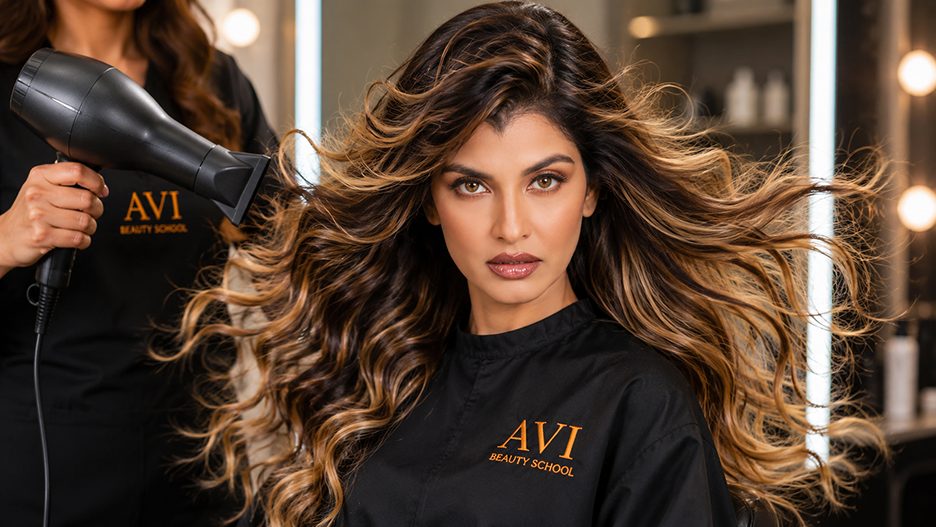
The right cosmetology school near Fairfax, VA will meet Virginia’s 1,000-hour training requirement, hold recognized accreditation, offer hands-on clinic experience, and connect you to financial aid — so you graduate job-ready, not just credentialed.
Choosing where to train is the single most consequential decision you’ll make before your career starts. The school you pick determines how well-prepared you are for the Virginia State Board exam, whether you can access federal financial aid, and whether you graduate with the full skill set today’s clients expect. This guide walks you through exactly what to look for — and what to avoid — so you can compare your options with confidence.
Key Takeaways
- Virginia requires 1,500 hours of approved cosmetology training before you can sit for the licensing exam.
- COE accreditation determines whether a school can offer federal financial aid (Title IV/FAFSA) and GI Bill® benefits.
- An inclusive curriculum — covering all skin tones and hair textures — is a concrete skill differentiator, not just a buzzword.
- Northern Virginia cosmetology wages trend above the national median due to regional cost of living and clientele.
- AVI Career Training in Vienna, VA is COE-accredited, SCHEV-certified, and approximately five miles from Fairfax — with financial aid available.
—
Start Here — What Virginia Actually Requires to Get Licensed
Virginia has a clear, non-negotiable baseline: you must complete 1,500 hours of approved cosmetology training before you are eligible to sit for the licensing exam. Every school you evaluate must meet this threshold — no exceptions, no shortcuts.
After completing your training hours, you’ll take both a written and a practical examination administered by the Virginia Department of Professional and Occupational Regulation (DPOR). Pass both, and you receive your Virginia cosmetology license. That license must be renewed every two years with continuing education.
Why the 1,500-Hour Requirement Is Your First Filter
Not every program marketed as “cosmetology training” is approved by the Virginia State Board. If a school’s program isn’t state-approved, those hours won’t count toward your license — and you’ll have to start over somewhere else.
Before you spend a single dollar or sign any enrollment agreement, confirm these two things:
1. Is the program approved by the Virginia State Board of Cosmetology?
2. Does the program deliver the full 1,500 required hours?
Any school that can’t answer yes to both questions immediately is not a viable option, regardless of price, location, or marketing.
(Virginia State Board)
(Written + Practical)
(with continuing education)
—
The 5 Factors That Separate Good Cosmetology Schools From Great Ones
Once you’ve confirmed a school meets Virginia’s minimum requirements, you’re ready to ask the questions that actually distinguish a strong program from a mediocre one. Here are the five factors that matter most.
1. Accreditation Status
Ask directly: is this school accredited by a recognized accrediting body? There’s a meaningful difference between a school that holds national accreditation from the Council on Occupational Education (COE) and one that doesn’t. Accreditation affects financial aid eligibility, program quality standards, and how employers perceive your credential. More on this in the next section — it deserves its own conversation.
2. Curriculum Inclusivity
A cosmetology curriculum should prepare you to serve every client who walks through the door. Ask whether the program covers a full range of hair textures — from fine straight hair to coily natural hair — and a full spectrum of skin tones in skincare and chemical service training. This isn’t just an equity issue; it’s a practical career skill. A stylist who can confidently work across all hair types and complexions builds a broader, more loyal clientele. Schools that train only on a narrow range of hair or skin types are setting you up to turn away future business.
3. Hands-On Clinic Hours vs. Lecture Time
Cosmetology is a performance skill. Reading about a precision cut is not the same as executing one on a real person under supervision. Ask any school you’re considering: what percentage of training hours are spent in a live client clinic setting versus a classroom? The best programs build in substantial hands-on clinic time so that by graduation, you’ve already worked on hundreds of real clients — not just mannequins.
4. Financial Aid Availability
Quality cosmetology training is an investment. The question is whether you’ll carry that investment alone or whether federal and state resources can help. Accredited schools can participate in Title IV federal financial aid programs, including Pell Grants and federal student loans. Some schools also accept the GI Bill® for eligible veterans and service members. If a school can’t offer any financial aid options, that’s worth understanding before you commit.
5. Instructor Credentials
Your instructors are the most direct determinant of your education quality. Find out whether instructors are licensed professionals with real industry experience — not just people who passed a teaching exam. The best beauty school instructors bring current industry knowledge, professional networks, and real-world technique into the classroom. Ask schools specifically about their instructors’ backgrounds before you enroll.
—
Accreditation Matters More Than You Think — Here’s Why
COE accreditation is one of the most important filters you can apply when comparing cosmetology schools near Fairfax, VA — and it’s one that many prospective students overlook until after they’ve enrolled somewhere.
The Council on Occupational Education (COE) is a nationally recognized accrediting body specifically focused on occupational and technical education programs. When a school earns COE accreditation, it means the program has been independently evaluated against rigorous standards covering curriculum quality, instructor qualifications, student outcomes, and institutional integrity.
What COE Accreditation Means for Your Wallet
Only students enrolled at accredited institutions are eligible for Title IV federal financial aid — which includes Pell Grants and federal student loans administered through FAFSA. If you attend a non-accredited school, you are not eligible for federal aid, full stop. That often means paying entirely out-of-pocket or through high-interest private financing.
The same applies to the GI Bill®. Veterans and eligible service members can only use GI Bill® benefits at schools approved to accept them — which typically requires accreditation.
What COE Accreditation Means for Your Career
Employers notice. When you apply to a salon, spa, or clinic, a credential from a COE-accredited school signals that your training met a recognized quality standard. It also provides a stronger foundation if you ever want to continue your education — some post-secondary institutions have credit transfer policies tied to accreditation status.
Non-accredited programs may appear cheaper upfront. But when you account for the absence of financial aid, potential employer skepticism, and fewer pathways for future education, the true cost is often higher.
“Are you COE-accredited or accredited by another nationally recognized body? Can I use FAFSA here?” — if the answer is no or unclear, keep looking.
—
What to Expect From Cosmetology Training Near Fairfax, VA

A quality cosmetology program near Fairfax takes you from foundational concepts to exam-ready skills in a structured progression across 1,500 training hours.
How the 1,500 Hours Break Down
Your training typically moves through several stages:
- Foundational theory: Anatomy and physiology relevant to hair and skin, sanitation and infection control, product chemistry, and salon safety
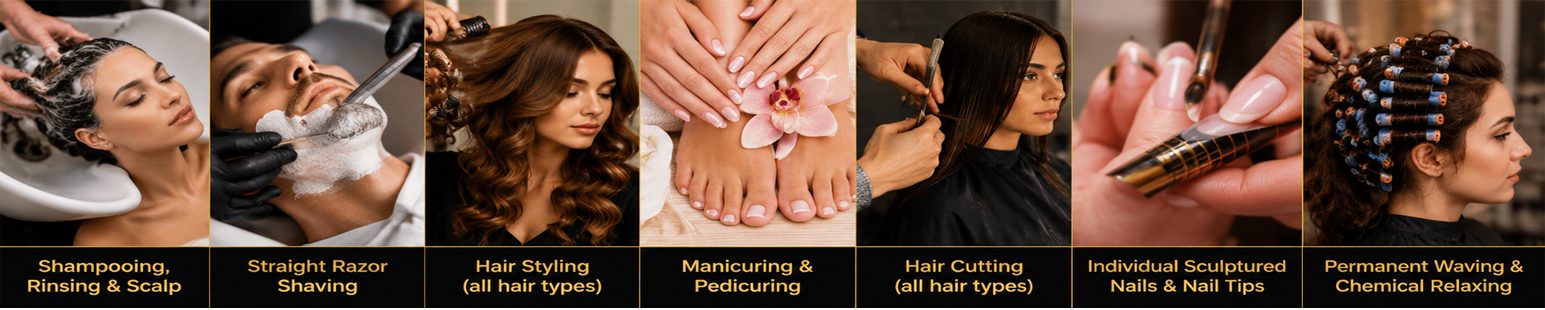
- Core technical skills: Haircutting, coloring, chemical services (perms, relaxers), hair care, and styling across hair types
- Skincare integration: Basic facial and skincare techniques as part of the broader cosmetology scope
- Nail services: Manicure and pedicure fundamentals
- Live clinic work: Real client services performed in a supervised salon clinic environment — the phase where classroom knowledge becomes actual skill
The progression is deliberate. You build technical confidence before you work on clients, and you work on clients before you sit for the Virginia State Board exam.
From Graduation to Your First Paycheck
After completing your 1,500 hours, you apply to take the DPOR-administered written and practical examinations. Once you pass both and receive your Virginia cosmetology license, you are legally authorized to work as a licensed cosmetologist in the Commonwealth.
From there, your earning trajectory depends on factors you control: where you work, whether you’re an employee or on booth rental, your specializations, and how fast you build your clientele. According to the U.S. Bureau of Labor Statistics, the national median annual wage for hairstylists and cosmetologists is approximately $33,000–$38,000. In the Northern Virginia and DC metro area, wages typically trend higher — driven by regional cost of living, disposable income in the market, and access to a high-spending clientele in areas like Tysons Corner, McLean, and Arlington.
Earnings vary significantly. A stylist just starting out at a salon earns differently than an experienced professional on booth rental or someone who builds their own clientele. Be realistic about the growth curve — and know that the DMV area gives you one of the strongest local markets in the country to build in.
> Real Student Scenario: Consider someone like Marcus, a 28-year-old military veteran from Centreville, Virginia, transitioning out of active service. He wanted a hands-on career with clear licensing milestones — something that rewarded skill, not just seniority. He enrolled at a COE-accredited school near Fairfax using his GI Bill® benefits, graduated after completing his 1,500 training hours, passed both the written and practical Virginia State Board exams, and secured a position at a salon in Tysons Corner within two months of licensing. The accreditation at his school made his GI Bill® benefits applicable — a detail he almost overlooked when first comparing programs.
—
Why Students Near Fairfax Choose AVI Career Training in Vienna
AVI Career Training is a COE-accredited, SCHEV-certified beauty and wellness school located at 1595 Spring Hill Rd #720, Vienna, VA 22182 — approximately five miles from Fairfax, in the heart of the Northern Virginia metro area.
When you apply the comparison framework from this guide to AVI, here’s what you find:
Accreditation & State Approval — Confirmed
AVI holds COE accreditation from the Council on Occupational Education and is certified by SCHEV (the State Council of Higher Education for Virginia). This means AVI’s Cosmetology program meets the quality standards required for federal financial aid eligibility and is approved by Virginia’s state education authority. You’re not taking a risk with a program that might not count.
Financial Aid — Available
Because AVI is accredited, eligible students can apply for Title IV federal financial aid through FAFSA. AVI also accepts the GI Bill®, making the program accessible to veterans and eligible service members in the Northern Virginia area. If financial aid availability is part of your decision — and for most students, it should be — AVI meets that requirement directly.
An Inclusive Curriculum Built for Every Client
AVI’s cosmetology curriculum is specifically built to train students to work beautifully on every skin tone and hair texture. That’s not a marketing line — it’s reflected in how the program is structured. In the DMV area, your future clientele will be among the most diverse in the country. Graduating with the skills to serve all of them isn’t just the right thing to do; it’s a concrete competitive advantage.
> Real Student Scenario: Consider Priya, a 34-year-old career-changer from Reston who spent a decade in retail management before deciding she wanted to build something that was hers. She had always done hair for friends and family — especially for clients with South Asian hair textures that other stylists weren’t confident with. She chose AVI in Vienna specifically because the program addressed diverse hair types in its curriculum. After completing her 1,500 training hours and passing her Virginia State Board exams, she launched a booth rental practice focused on South Asian bridal styling and keratin treatments. Today she books out three weeks in advance.
Proximity to Fairfax — Real Location Advantage
AVI’s Vienna campus is located near the Tysons Corner area, one of Northern Virginia’s major commercial and professional hubs. For students coming from Fairfax, Fair Oaks, Reston, McLean, or anywhere in Fairfax County, the commute is straightforward. You’re not traveling an hour across the DMV for a program you could access 10 minutes away.
Licensed Instructors With Industry Experience
AVI’s instructors are licensed industry professionals — not just classroom educators. That matters when you’re building performance skills. The guidance you get from someone who has worked behind the chair, handled real clients, and navigated the professional landscape is categorically different from instruction delivered purely from a textbook.
Ready to Take the Next Step?
Talk to AVI admissions about the Cosmetology program, your financial aid options, and what your path to a Virginia license looks like — on your timeline.
Apply Now at AVI Career Training
Or call us at (703) 943-9841 · Vienna, VA (Tysons Corner area)
—
Frequently Asked Questions
Q: How many hours do you need to become a cosmetologist in Virginia?
A: Virginia requires 1,000 hours of approved cosmetology training from a state-recognized school before you can sit for the Virginia State Board licensing exam. This is the minimum — not a target range — and every approved program must meet it.
Q: How long does cosmetology school take in Virginia?
A: The timeline depends on your schedule and the school’s program format. Full-time students can typically complete the 1,500 required hours in approximately 12–14 months. Part-time schedules take longer. Ask any school you’re considering for their specific completion timeline before enrolling.
Q: Is financial aid available for cosmetology school in Virginia?
A: Yes — but only at accredited schools. If a school holds COE accreditation or equivalent recognized accreditation, eligible students can apply for Title IV federal financial aid through FAFSA, including Pell Grants and federal student loans. GI Bill® benefits are also available at approved schools like AVI Career Training. Non-accredited programs are not eligible for these funding sources.
Q: What is the difference between COE-accredited and non-accredited beauty schools?
A: COE-accredited schools have been independently evaluated against rigorous standards for curriculum quality, instructor qualifications, and student outcomes by the Council on Occupational Education. Non-accredited schools have not met those standards and are ineligible to offer federal financial aid — meaning students typically pay entirely out-of-pocket. Accreditation also signals program quality to employers and provides a stronger credential foundation for your career.