How to Pivot into Cosmetology: Your 30-Day Action Plan
To become a cosmetologist in Virginia, you must complete 1,000 clock hours of accredited training, pass the Virginia State Board written and practical exams, and submit your license application — and you can be enrolled in a program within 30 days from today.
If you’ve been sitting with the idea of a career change for months — or years — this article gives you the concrete roadmap to stop thinking and start moving. Whether you’re currently working a desk job, transitioning out of the military, or just ready for work that feels meaningful, cosmetology is one of the most accessible and rewarding pivots available in the Northern Virginia / DMV area right now.
Start Your Application at AVI Career Training →
—
- Virginia requires 1,500 clock hours of cosmetology training before you can sit for licensing exams.
- The Virginia State Board exam has two components: a written test and a practical skills exam, both administered by PSI Exams.
- You can go from decision to enrolled in as few as 30 days with the right school and a clear action plan.
- Federal financial aid (FAFSA/Pell Grant) and the GI Bill® are accepted at AVI Career Training in Vienna, Virginia.
- Cosmetologists in the DC metro area earn a median wage typically in the $35,000–$52,000+ range, with additional income from tips and booth rental.
—
Why Cosmetology Is One of the Smartest Career Pivots Right Now
Cosmetology is a recession-resilient, people-centered industry — and in the Northern Virginia and greater DMV market, demand for skilled beauty professionals is consistently strong.
Think about it: salons, spas, and barbershops stayed on people’s essential lists even during economic downturns. Hair doesn’t stop growing. Weddings still happen. Self-care remains a priority. That stability matters when you’re making a career decision with real financial stakes.
According to the U.S. Bureau of Labor Statistics (BLS), employment of hairdressers, hairstylists, and cosmetologists is projected to grow steadily, with the DC metro area offering a particularly favorable market due to its density, diversity, and above-average consumer spending on personal services.
Beyond income, a career change to cosmetology offers something most office jobs can’t: you build real relationships with real people, you see the results of your work immediately, and you have a clear path toward owning your schedule — whether that means booth rental, freelance work, or eventually running your own salon.
For the diverse communities across Northern Virginia, Tysons Corner, and the broader DMV area, there’s also growing demand for cosmetologists trained to serve every skin tone and every hair texture — not just a narrow slice of the market. That’s a competitive edge worth building deliberately, and it starts with choosing the right school.
—
What Virginia Actually Requires to Get Your Cosmetology License
To become a licensed cosmetologist in Virginia, you must meet the requirements set by the Virginia Department of Professional and Occupational Regulation (DPOR) through the Virginia State Board of Cosmetology.
Here’s exactly what the process looks like:
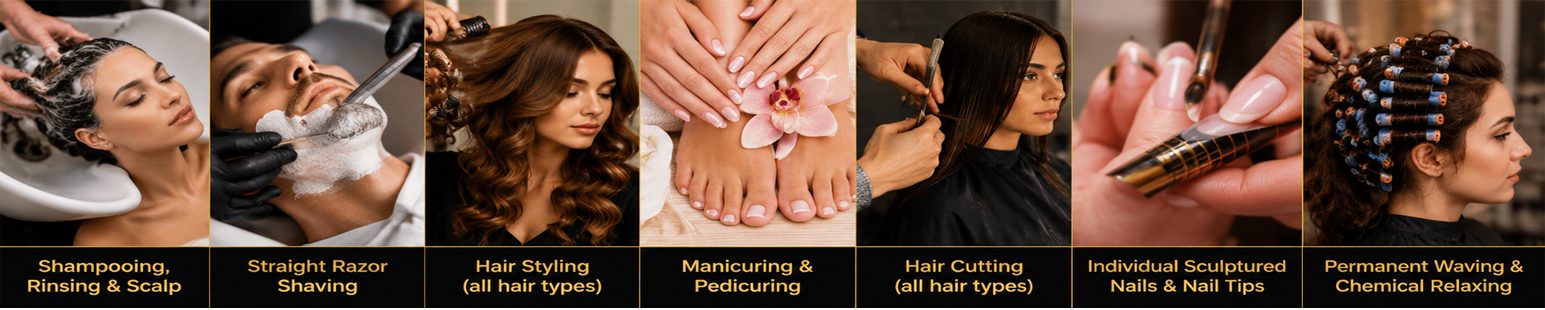
Step 1: Complete 1,500 Clock Hours at an Approved School
Virginia’s cosmetology license requirements begin with 1,000 clock hours of training at a DPOR-approved cosmetology school. These hours must be completed at an accredited institution — not self-directed or online-only. This is where your technical skills, state board preparation, and professional foundation are built.
Step 2: Pass the Virginia State Board Written Exam
After completing your training hours, you’ll sit for the written portion of the Virginia State Board exam, administered by PSI Exams. This tests your knowledge of cosmetology theory, sanitation standards, chemistry, anatomy, and Virginia state law. Your school’s curriculum should prepare you thoroughly for this exam.
Step 3: Pass the Virginia State Board Practical Exam
The practical exam, also administered by PSI Exams, tests your hands-on skills. You’ll demonstrate real cosmetology techniques — the same ones you practiced throughout your training program. This is where hours of salon-floor practice pay off.
Step 4: Submit Your License Application to DPOR
Once you’ve passed both exams, you submit your license application to the Virginia Department of Professional and Occupational Regulation (DPOR), along with the required fees. Upon approval, you’re a licensed cosmetologist in the Commonwealth of Virginia.
—
Your 30-Day Pivot Plan — From Decision to Enrolled
Here is a week-by-week action plan that takes you from “I’m thinking about this” to your first day of cosmetology training. Every step is realistic and based on how enrollment actually works at cosmetology schools in Northern Virginia.
Days 1–7: Research, Visit, and Get Clear
Day 1–2: Decide you’re doing this. Write down your “why.” Is it flexibility? Creative fulfillment? A specific income goal? Getting clear on your motivation makes every other step easier.
Day 3–4: Research accredited cosmetology schools in your area. For Northern Virginia, that means looking at schools with COE accreditation, DPOR approval, and real student outcomes — not just slick websites. AVI Career Training in Vienna, Virginia is one of the only COE-accredited, SCHEV-certified beauty schools in the Tysons Corner area.
Day 5–7: Schedule a campus tour. Walk the salon floor. Ask about class schedules, financial aid, and how they prepare students for the Virginia State Board exam. First impressions matter — and a great school will feel like a place where you belong. Schedule a visit with AVI Career Training and see the difference accreditation makes in person.
Days 8–14: Financial Aid and Documentation
Day 8–9: Complete your Free Application for Federal Student Aid (FAFSA) at studentaid.gov. COE-accredited schools like AVI Career Training qualify for federal financial aid, including the Pell Grant — which doesn’t need to be repaid.
Day 10–11: If you’re a veteran, start your GI Bill® paperwork. AVI accepts the GI Bill® and the Post-9/11 GI Bill, making it one of the more veteran-friendly beauty schools in Northern Virginia.
Day 12–14: Gather your documents — government-issued ID, Social Security number, high school diploma or GED, and any financial aid award letters. Most schools have a short checklist; AVI’s admissions team walks you through exactly what you need.
Days 15–21: Apply and Complete Enrollment
Day 15–16: Submit your application. AVI’s application process is straightforward and designed to get you moving quickly. You can apply online here or call (703) 943-9841 to speak with admissions directly.
Day 17–19: Complete any enrollment paperwork, review your financial aid package, and confirm your start date. Ask about orientation so you know exactly what to expect on Day 1.
Day 20–21: Get your supplies list and any pre-program prep materials. Some programs have recommended reading or orientation tasks — use this week to get a head start.
Days 22–30: Prepare and Start Strong
Day 22–25: Set up your schedule. If you’re currently working full time, talk with your employer now about your start date and any scheduling adjustments. Some cosmetology programs offer scheduling options that accommodate working adults — ask AVI specifically about your options.
Day 26–29: Connect with your future classmates if possible. Many schools have student groups or social media communities. Walking in knowing even one person changes the experience completely.
Day 30: First day of cosmetology training. You made it from decision to enrolled in a month.
—
What to Look for in a Cosmetology School (And Why Accreditation Matters)
Not every beauty school offers the same quality of training — and the difference between an accredited school and an unaccredited one can affect your licensing eligibility, your financial aid access, and the value of your credential in the job market.
Here’s what to evaluate when choosing a cosmetology school in Northern Virginia:
COE Accreditation
The Council on Occupational Education (COE) is one of the most respected accrediting bodies for career and technical schools in the country. COE accreditation means a school has met rigorous standards for curriculum quality, instructor credentials, facilities, and student outcomes. AVI Career Training is COE Accredited — a distinction that matters for your future employers and your licensing board.
SCHEV Certification
In Virginia, post-secondary schools must be certified by the State Council of Higher Education for Virginia (SCHEV) or approved by DPOR. AVI Career Training holds SCHEV certification, which confirms the school meets Virginia’s standards for operating as a legitimate educational institution.
Federal Financial Aid Eligibility
Only schools with the right accreditation qualify for Title IV federal financial aid — meaning FAFSA, Pell Grants, and student loans. If a school can’t accept your FAFSA, that’s a serious red flag. AVI’s COE accreditation makes financial aid available to qualifying students, which is one of the biggest practical advantages of choosing an accredited beauty school in Northern Virginia.
Inclusive Curriculum
The Northern Virginia and DC metro market is one of the most ethnically and culturally diverse regions in the country. A cosmetology school that trains you to work on only one hair type or skin tone leaves you unprepared for at least half your future clientele. AVI Career Training’s curriculum is built around inclusive techniques — training students to work beautifully on every skin tone and every hair texture. That’s not just good values; it’s good business.
State Board Exam Preparation
Ask any school you visit directly: “What is your state board exam pass rate?” A school that prepares you well for both the written and practical Virginia State Board exams is giving you a genuine return on your investment. Look for structured exam prep, mock practical sessions, and faculty who know the PSI Exams format inside and out.
—
Life After Graduation — What Your New Cosmetology Career Looks Like

A cosmetology license in Virginia opens multiple career paths — and in the Northern Virginia / DMV market, each one comes with real earning potential.
Salon Employment
Most new graduates start in a salon setting — either a franchise salon or an independent boutique. Northern Virginia has a dense concentration of salons in areas like Tysons Corner, Arlington, Fairfax, and Alexandria. Starting as an employed stylist lets you build your book of clients while earning a steady income, often with benefits.
Booth Rental
Once you’ve built a clientele, booth rental is how many cosmetologists move to full independence. You rent a chair in a salon, set your own hours, and keep the majority of what you earn. In Northern Virginia, where disposable income is high and clients are loyal, a strong book of business can translate to substantial earnings well above the median wage.
Freelance and Special Events
Weddings, editorial shoots, corporate events, and TV/film productions all need licensed cosmetologists. The DMV area’s proximity to Washington DC — with its political, media, and hospitality industries — creates consistent freelance demand that few other markets can match.
Specialization and Advancement
Your cosmetology license is also a foundation. Many professionals go on to specialize in color theory, extensions, texture services, or natural hair. Others pursue additional licensure in esthetics or nail technology. AVI Career Training offers multiple programs, so your education doesn’t have to stop at cosmetology.
Two Students Who Made the Pivot
Maria spent eight years as an administrative coordinator in Fairfax before deciding the corporate ladder wasn’t leading anywhere she wanted to go. She enrolled at AVI Career Training after a 20-minute campus tour convinced her this was different from any classroom she’d sat in before. Within 14 months of starting her 1,500-hour program, she passed both Virginia State Board exams on her first attempt. She now works at a boutique salon in McLean, building a loyal client base that includes a significant number of clients who specifically sought out her expertise in curly and natural hair textures.
James left active duty military service after 10 years and spent nearly a year unsure of his next move. A friend mentioned that AVI accepted the GI Bill® — and that the cosmetology program was faster than most degree programs. He walked in skeptical and walked out enrolled. The structure, the hands-on learning, and the clear daily progress reminded him of what he liked most about military training. He graduated and is now managing a high-volume salon in the Tysons Corner area, with plans to eventually open his own shop.
—
Frequently Asked Questions About Becoming a Cosmetologist in Virginia
Q: How long does it take to get a cosmetology license in Virginia?
A: Virginia requires 1,000 clock hours of training at an approved cosmetology school before you can sit for the State Board exams. The total timeline from first day of school to licensed cosmetologist depends on your program schedule, but most full-time students complete their hours within 12–18 months. After finishing your hours, you’ll schedule your written and practical exams through PSI Exams, then submit your license application to DPOR.
—
Q: What are the Virginia State Board cosmetology requirements?
A: To become a licensed cosmetologist in Virginia, you must: (1) complete 1,000 clock hours at a DPOR-approved school, (2) pass the Virginia State Board written exam administered by PSI Exams, (3) pass the Virginia State Board practical exam, and (4) submit a license application to the Virginia Department of Professional and Occupational Regulation (DPOR). You must also be at least 16 years of age and hold a high school diploma or GED.
—
Q: Can I go to cosmetology school while working full time?
A: Yes — many cosmetology students are currently employed when they start their programs. Scheduling varies by school, so ask your prospective school specifically about their available class times. AVI Career Training in Vienna, Virginia works with students on scheduling; contact admissions at (703) 943-9841 to discuss what options fit your current work schedule.
—
Q: Is cosmetology school worth it as a career change?
A: For most people who genuinely enjoy working with people and have an interest in beauty services, yes — cosmetology is a strong career pivot. Cosmetologists in the DC metro area earn a median wage in the $35,000–$52,000+ range, with tips and booth rental adding meaningful income on top of that. The license is earned relatively quickly compared to most degree programs, financial aid is available at accredited schools, and the career offers flexibility and entrepreneurial potential that few fields can match.
—
Q: Does financial aid cover cosmetology school in Virginia?
A: Federal financial aid — including Pell Grants and student loans through FAFSA — is available at COE-accredited schools like AVI Career Training. Pell Grants do not need to be repaid, making them one of the most valuable options for eligible students. AVI also accepts the GI Bill® and Post-9/11 GI Bill for qualifying veterans. Contact AVI’s admissions team to discuss your specific financial aid options.
—
Q: How do I know if a cosmetology school in Northern Virginia is accredited?
A: Look for two credentials: COE accreditation (from the Council on Occupational Education) and SCHEV certification or DPOR approval in Virginia. COE accreditation is a national standard for career schools and is required for federal financial aid eligibility. AVI Career Training holds both COE accreditation and SCHEV certification, making it one of the most credentialed beauty schools in Northern Virginia.
—
Q: What is AVI Career Training’s Cosmetology program?
A: AVI Career Training’s Cosmetology program in Vienna, Virginia is a 1,000-clock-hour, hands-on career training program approved by the Virginia Department of Professional and Occupational Regulation (DPOR) and offered at a COE-accredited, SCHEV-certified institution. The curriculum prepares students for both the written and practical Virginia State Board licensing exams and emphasizes inclusive techniques for all skin tones and hair textures. The program is eligible for federal financial aid and accepts the GI Bill®.
—