Esthetics School vs. a 4-Year Degree: Which Path Wins?
Esthetics vocational training gets you licensed, working, and earning in under 12 months — while a 4-year degree costs more, takes longer, and doesn’t qualify you to touch a client’s skin. For anyone serious about a career in skincare, the numbers tell a clear story.
That said, you deserve a complete, honest comparison — not a sales pitch. This guide breaks down the real costs, realistic timelines, career outcomes, and who each path actually fits. By the end, you’ll know exactly which choice makes sense for your life.
—
Key Takeaways
—
The Real Cost Comparison: Tuition, Time, and Debt
The Real Cost Comparison: Tuition, Time, and Debt
The price gap between vocational esthetics training and a 4-year college degree is enormous — and it compounds over time.
According to the College Board and the National Center for Education Statistics (NCES), the average cost of a 4-year degree ranges from approximately $40,000 at a public in-state university to $100,000 or more at a private institution. That figure covers tuition and fees alone. Add housing, books, and living expenses, and total costs can climb well past $150,000 for many students.
Vocational esthetics programs tell a very different financial story. Nationally, esthetics training programs typically cost between $5,000 and $15,000 in total tuition. That’s not a semester — that’s the entire program. For the specific cost of AVI Career Training’s Basic Esthetics program (NO FINANCIAL AID FOR THIS PROGRAM), contact AVI directly at (703) 943-9841 or visit AVI Career Training’s website — tuition details are best discussed with an admissions advisor who can walk you through all available payment options.
The Debt-to-Earning Timeline
Here’s what the cost difference actually means in real life: a student who graduates from a 4-year university with $60,000 in debt typically spends three to eight years repaying loans before their earnings feel fully their own. A vocational esthetics graduate with a fraction of that debt — or none at all — starts building financial momentum almost immediately after licensure.
A quick note on financial aid: Because AVI’s Basic Esthetics program is under 600 clock hours, it does not qualify for federal financial aid (Title IV / FAFSA). However, AVI does offer payment plan options and private financing arrangements — speak with admissions for current details. If you’re a veteran or active-duty service member, the GI Bill® is accepted at AVI for qualifying programs. Federal financial aid is available at AVI for other programs that meet the hour threshold.
—
How Long Does It Actually Take to Start Working?
How Long Does It Actually Take to Start Working?
The timeline difference between these two paths is one of the most persuasive arguments for esthetics vocational training — and it’s completely verifiable.
The Virginia Licensing Pathway
Virginia’s Department of Professional and Occupational Regulation (DPOR) requires aspiring estheticians to complete 600 hours of training at a DPOR-approved school before sitting for the Virginia State Board esthetics licensing exam. That’s the threshold — 600 hours, then the exam, then you’re a licensed esthetician.
On a full-time schedule, most students complete those 600 hours in well under a year. Factor in a short window to schedule and pass the Virginia State Board exam, and many graduates are licensed and working within 12 months of starting school — sometimes considerably less.
Compare that to a 4-year university track. Even the most employable bachelor’s degree programs require a minimum of four academic years before graduation. Students pursuing science or health-adjacent degrees may add additional time for prerequisites, internships, or graduate school. That’s four or more years of tuition payments, living expenses, and foregone income — before a single paycheck from their chosen career.
A Real-World Example: Camille’s Story
Camille was 28 and had spent six years in retail management when she decided she wanted more — more creative work, more human connection, and more control over her schedule. She looked at going back to school for a biology or health science degree, but the 4-year timeline and cost felt impossible to justify with rent and bills in the Tysons Corner area.
Instead, she enrolled in an esthetics program. Less than a year later, she passed her Virginia State Board exam, accepted a position at a medical spa in McLean, and was doing the work she’d always wanted. The career she used to imagine at 32 or 33 — after a degree — was hers at 29.
—
—
What You Learn (and What Actually Matters in the Treatment Room)
What You Learn (and What Actually Matters in the Treatment Room)
Employers hiring estheticians are not reviewing transcripts or asking about your GPA. They’re watching how you work.
Hands-On from Day One
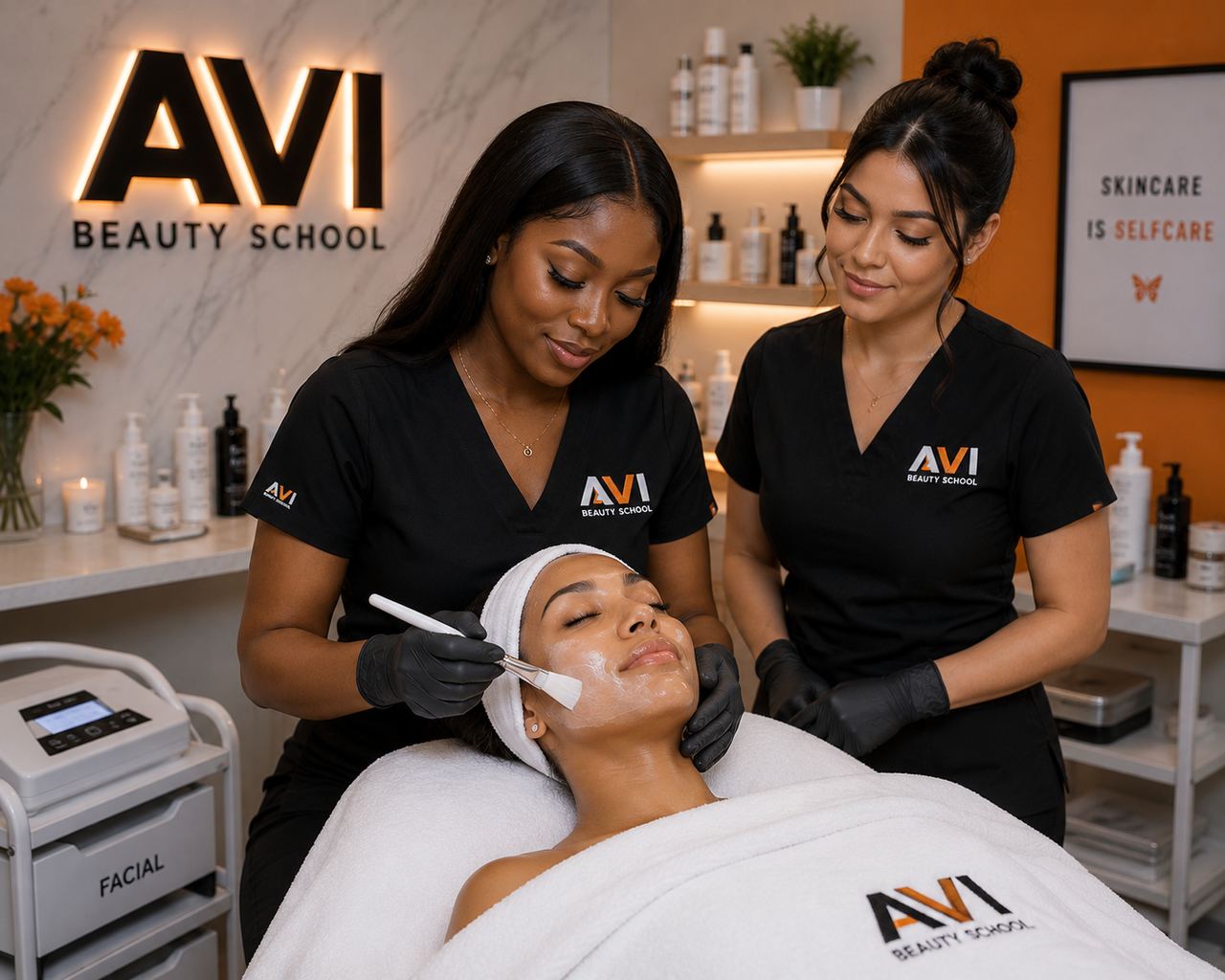
A vocational esthetics curriculum is built around the skills you’ll use every day as a working professional. At AVI Career Training in Vienna, Virginia, the Basic Esthetics program (NO FINANCIAL AID FOR THIS PROGRAM) covers:
That last point matters more than most beauty schools acknowledge. AVI’s curriculum is explicitly built around inclusive practice — training students to serve clients of all backgrounds beautifully. In a market as diverse as Northern Virginia and the greater DMV area, that’s not a soft value. It’s a professional skill set that directly affects your employability and client retention.
What a 4-Year Degree Teaches Instead
A biology, health science, or liberal arts degree provides broad academic knowledge — research methods, general science foundations, communication theory, history. That foundation has real value for careers in medicine, research, or academia. But it does not teach you how to perform a chemical exfoliation, read a Fitzpatrick scale, or safely wax a client with sensitive skin.
Worth being clear about: Some careers adjacent to esthetics — such as dermatology, plastic surgery, and aesthetic medicine — do require advanced degrees and medical licensure. If your goal is to become a dermatologist or physician, a 4-year degree (plus medical school) is the path. But if your goal is to work as a licensed esthetician — in a spa, clinic, dermatology practice, or your own business — a vocational esthetics program is the direct, appropriate, and far more efficient route.
—
Career Outcomes and Earning Potential in Northern Virginia
Career Outcomes and Earning Potential in Northern Virginia
Northern Virginia is one of the most economically active markets in the country — and the demand for licensed skin care professionals reflects that.
What Estheticians Earn in the DC Metro Area
According to the U.S. Bureau of Labor Statistics (BLS), the national median annual wage for skin care specialists is approximately $40,000–$47,000. In the DC–Arlington–Alexandria metro area — which includes Vienna, McLean, Tysons Corner, and surrounding communities — wages for skilled estheticians tend to run at or above the national median, driven by the region’s higher cost of living and concentration of medical spas, dermatology clinics, and luxury wellness facilities.
Top earners in Northern Virginia — particularly those working in medical spa or dermatology settings, those who build strong client books, or those who add specialized services — regularly exceed those median figures. Estheticians who layer commission, gratuity, and retail bonuses onto a base wage can substantially outpace what the headline number suggests.
Where Licensed Estheticians Work
Your Virginia esthetics license — not a college diploma — is the credential that unlocks every one of these settings:
A Second Story: Marcus’s Career Pivot
Marcus spent 11 years in IT in the DC area. He was good at his job but felt disconnected from it. He wanted to work with people, develop a tactile skill, and eventually run his own business. At 39, he enrolled in an esthetics program in Northern Virginia rather than going back for an expensive graduate degree in a different field.
Eighteen months after starting school, Marcus was working at a medical spa near Reston and building a private client roster on weekends. He didn’t need a 4-year degree to make the pivot. He needed 600 hours, a state board exam, and the discipline to build his book. He had all three.
—
Who Is Esthetics Vocational Training Actually Right For?
Who Is Esthetics Vocational Training Actually Right For?
Esthetics vocational training is the stronger choice for a specific, well-defined group of people. Knowing whether you’re in that group saves you years and thousands of dollars.
You’re a Great Fit If You:
Be Honest About the Limits
Vocational esthetics training does not lead to a dermatologist’s office as the physician. It does not qualify you for nursing, medicine, or clinical research. If any of those are your real goals, a 4-year degree and graduate education are genuinely necessary.
But here’s the honest truth: the vast majority of people researching esthetics programs want to do exactly what estheticians do — care for skin, connect with clients, and build a career doing skilled, rewarding, hands-on work. For that goal, a 600-hour vocational program is not the backup plan. It’s the right plan.
—
Why AVI Career Training Is the Right School in Northern Virginia
Why AVI Career Training Is the Right School in Northern Virginia
Not all esthetics programs are the same. The school you choose affects the quality of your training, your exam readiness, and your professional credibility from day one.
AVI Career Training is one of the few beauty and wellness schools in the Northern Virginia / DMV area that holds both COE Accreditation from the Council on Occupational Education and SCHEV Certification from the State Council of Higher Education for Virginia. These aren’t decorative credentials — they signal that AVI meets rigorous standards for curriculum quality, instructor qualifications, and student outcomes.
AVI’s esthetics curriculum is taught by licensed industry professionals — people who have worked in the field, not just studied it. The program is built around inclusive techniques that prepare graduates to serve clients of every skin tone and background, which is a meaningful differentiator in a market as diverse as Tysons Corner, Vienna, and greater Northern Virginia.
AVI also accepts the GI Bill® for qualifying programs, making it a strong option for veterans and active-duty service members exploring career transitions in the DMV area.
Note on financial aid for the Basic Esthetics program: Federal financial aid (Title IV / FAFSA) is not available for the Basic Esthetics program because it falls under the 600-hour threshold for federal aid eligibility. Contact AVI admissions directly at (703) 943-9841 to discuss payment plan options and private financing. Start your application here or visit AVI’s campus in Vienna, Virginia to learn more.
—

—
Frequently Asked Questions
Frequently Asked Questions
Q: How long does it take to become a licensed esthetician in Virginia?
A: Virginia requires 600 hours of training at a DPOR-approved school. On a full-time schedule, students typically complete those hours and pass the Virginia State Board licensing exam in well under 12 months.
Q: Is esthetics school worth it compared to a 4-year degree?
A: For people who want to work in skincare, yes — clearly. Esthetics vocational training costs a fraction of a 4-year degree, takes far less time, and delivers the exact credential (a state license) that employers and clients require. A 4-year degree does not qualify you to practice esthetics.
Q: How much does esthetics school cost compared to a university degree?
A: A 4-year degree costs $40,000–$100,000+ in tuition alone, according to the College Board. Vocational esthetics programs typically range from $5,000–$15,000 nationally. For AVI Career Training’s current tuition, contact admissions at (703) 943-9841.
Q: What can you do with an esthetics license without a college degree?
A: A Virginia esthetics license qualifies you to work at day spas, medical spas, dermatology offices, luxury wellness centers, and in freelance or mobile settings. You can also launch your own esthetics business. The license — not a degree — is the credential that matters in this field.
Q: Can you make good money as an esthetician in Northern Virginia?
A: Yes. BLS data shows national median wages for skin care specialists at roughly $40,000–$47,000 annually. In the DC–Arlington–Alexandria metro, including the Tysons Corner and Vienna areas, skilled estheticians — especially those working in medical spas or building strong client books — regularly earn at or above the national median, with top earners going significantly higher.
Q: Does AVI Career Training offer financial aid for the Basic Esthetics program?
A: Federal financial aid (FAFSA/Title IV) is not available for the Basic Esthetics program because it is under the 600-hour eligibility threshold. AVI does offer payment plan and private financing options — contact admissions directly to discuss. The GI Bill® is accepted at AVI for qualifying programs.
Q: What is AVI Career Training’s accreditation?
A: AVI Career Training is accredited by the Council on Occupational Education (COE) and certified by the State Council of Higher Education for Virginia (SCHEV). Both credentials confirm that AVI meets established standards for curriculum quality and student outcomes.
Q: Is esthetics vocational training recognized by employers in the DC metro area?
A: Absolutely. Employers — from day spas to medical spas to dermatology practices — hire based on state licensure and demonstrated technique, not academic pedigree. A Virginia esthetics license from a COE-accredited school is the credential that opens doors in this market.
—
Ready to Start Your Esthetics Career in Northern Virginia?
AVI Career Training’s Basic Esthetics program prepares you for the Virginia State Board exam with 600 hours of hands-on, inclusive training — in the heart of the Tysons Corner area. The fastest path to a skincare career starts here.
Apply Now at AVI Career Training →
Questions? Call (703) 943-9841 — we’re happy to walk you through it.
—