
Esthetics School in Northern Virginia | AVI Career Training
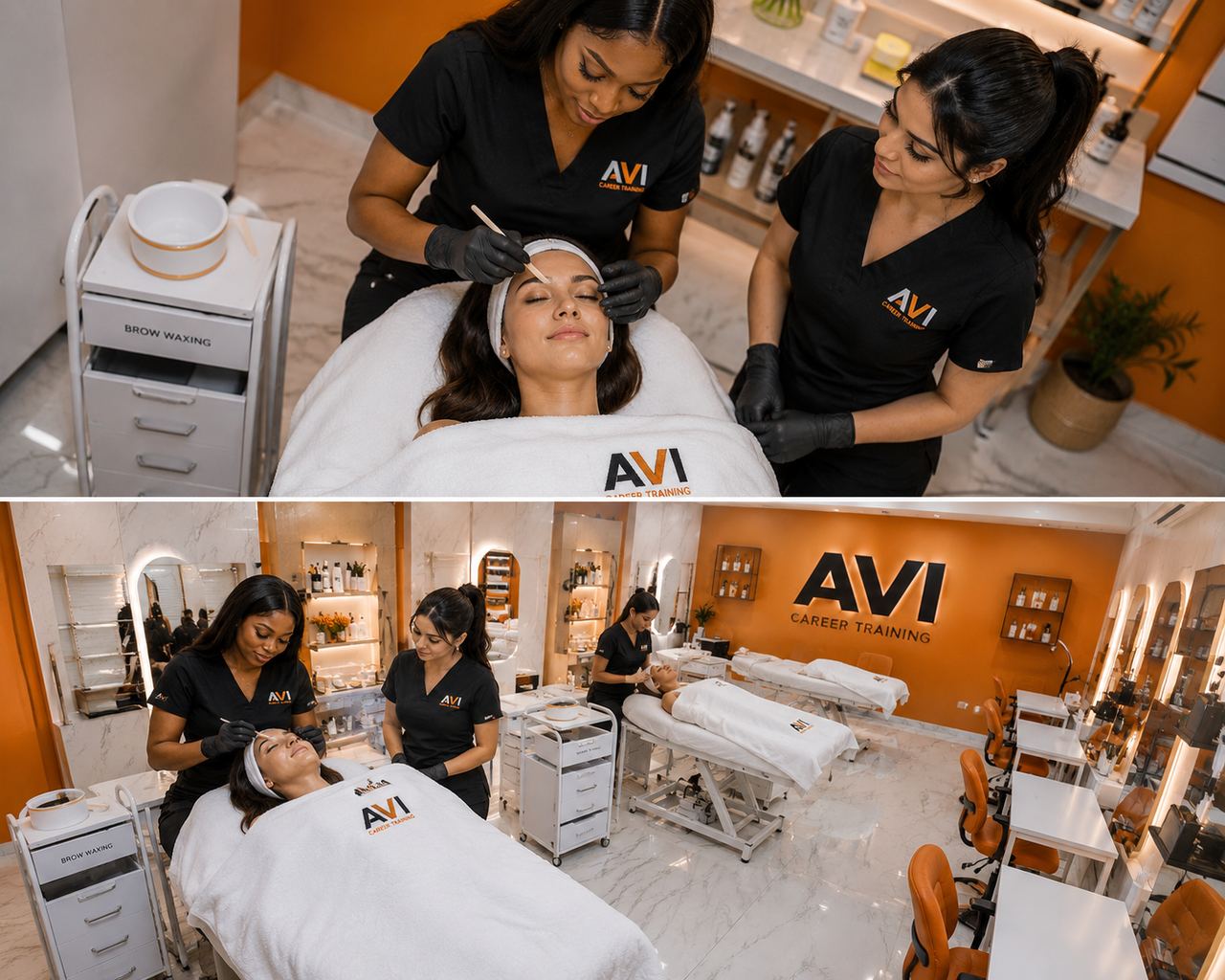
AVI Career Training’s Basic Esthetics program in Vienna, Virginia is one of Northern Virginia’s only COE-accredited, 600-hour esthetics programs that trains you to work confidently on every skin tone — and gets you exam-ready for the Virginia State Board.
If you’re looking for an esthetics school in Northern Virginia that gives you real clinical skills, a credible credential, and a clear path to licensure, you’re in the right place. AVI Career Training sits in the heart of the DC metro area — minutes from Tysons Corner and the Fairfax County job market — so your training happens where your career will actually grow.
Ready to take the first step? Apply now and start your esthetics journey at AVI.
—
- AVI’s Basic Esthetics program (NO FINANCIAL AID FOR THIS PROGRAM) is 600 hours — the exact number required by Virginia DPOR for licensure.
- Full-time students can complete the program in approximately 4–5 months.
- The licensing body is Virginia DPOR; you pass a written and practical exam to earn your license.
- BLS data shows skincare specialists in the Washington-Arlington-Alexandria metro earn a median annual wage above the national median — verify current figures at BLS.gov.
- AVI is COE Accredited and SCHEV Certified — two credentials that matter to employers and state boards alike.
—
What Is AVI’s Esthetics Program?
AVI Career Training’s Basic Esthetics program is a 600-hour, hands-on esthetics training program located at 1595 Spring Hill Rd #720, Vienna, VA 22182 — serving students from across Fairfax County, Arlington, Loudoun County, and the broader DC metro area.
What makes AVI’s program different starts on day one: inclusive skin training is built into the curriculum, not added as an afterthought. The DC metro is one of the most diverse regions in the country. Your future clients will reflect that. AVI prepares you to treat every skin tone, recognize conditions across the full Fitzpatrick scale, and recommend products and protocols that actually work for each individual sitting in your treatment chair.
This is what esthetician training in Northern Virginia should look like — and what most schools skip entirely.
—
What You’ll Learn in AVI’s Esthetics Program
AVI’s Basic Esthetics program covers the full scope of skills you need to pass your state board exam and perform confidently on real clients from your very first day of work.
Core Curriculum Areas
Skin Science & Analysis — You’ll learn the anatomy and physiology of the skin, how to read a client’s skin during a thorough consultation, and how to identify common skin conditions across all skin types and tones. This is the foundation everything else builds on.
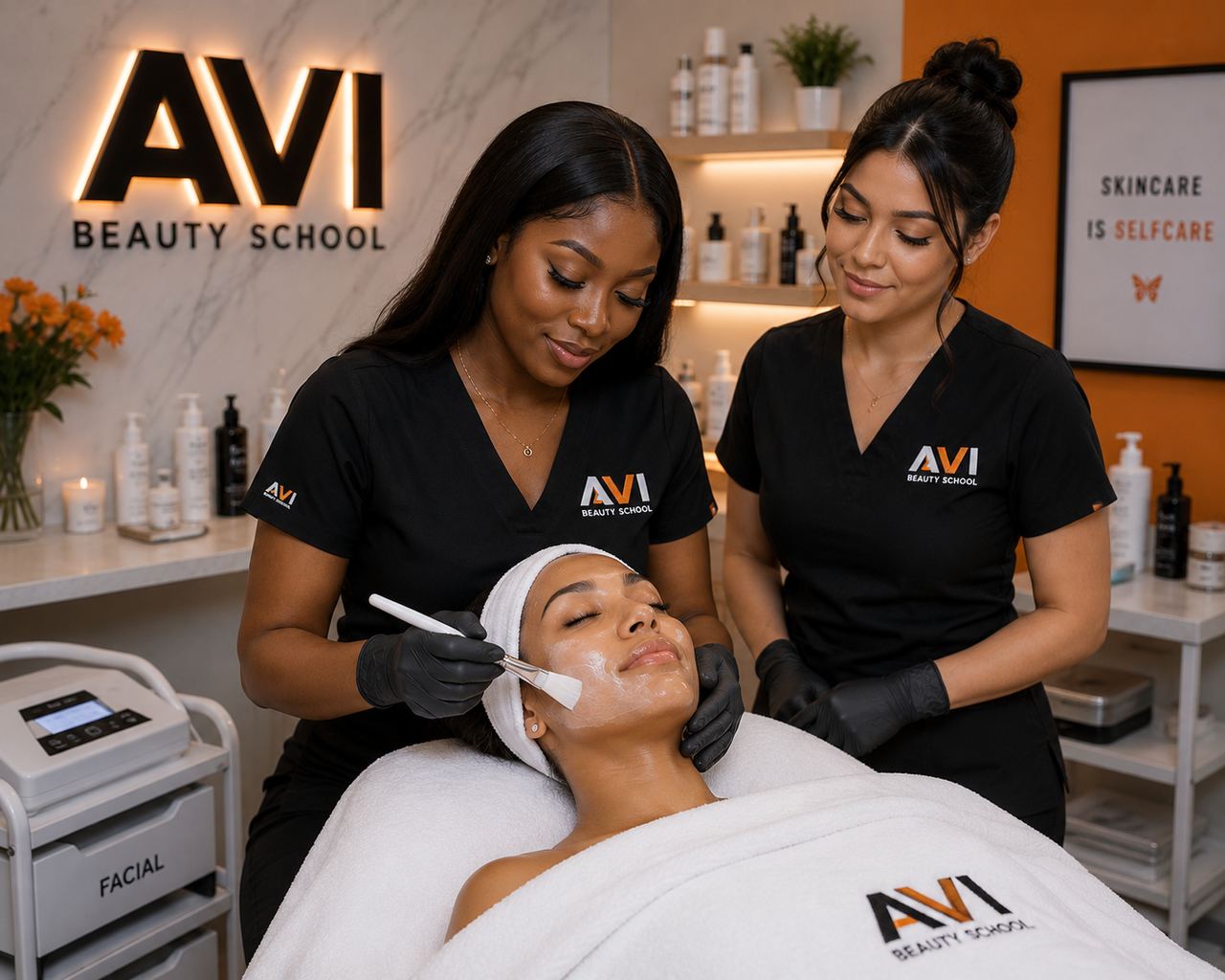
Facial Treatments — Step-by-step protocols for cleansing, steaming, extractions, masks, and massage. You’ll practice on real skin in AVI’s clinic environment so your technique is confident, not theoretical.
Chemical Exfoliation — Safe application of chemical exfoliants, understanding acids, enzyme peels, and contraindications. This is a skill medical spas and dermatology clinics hire for directly.
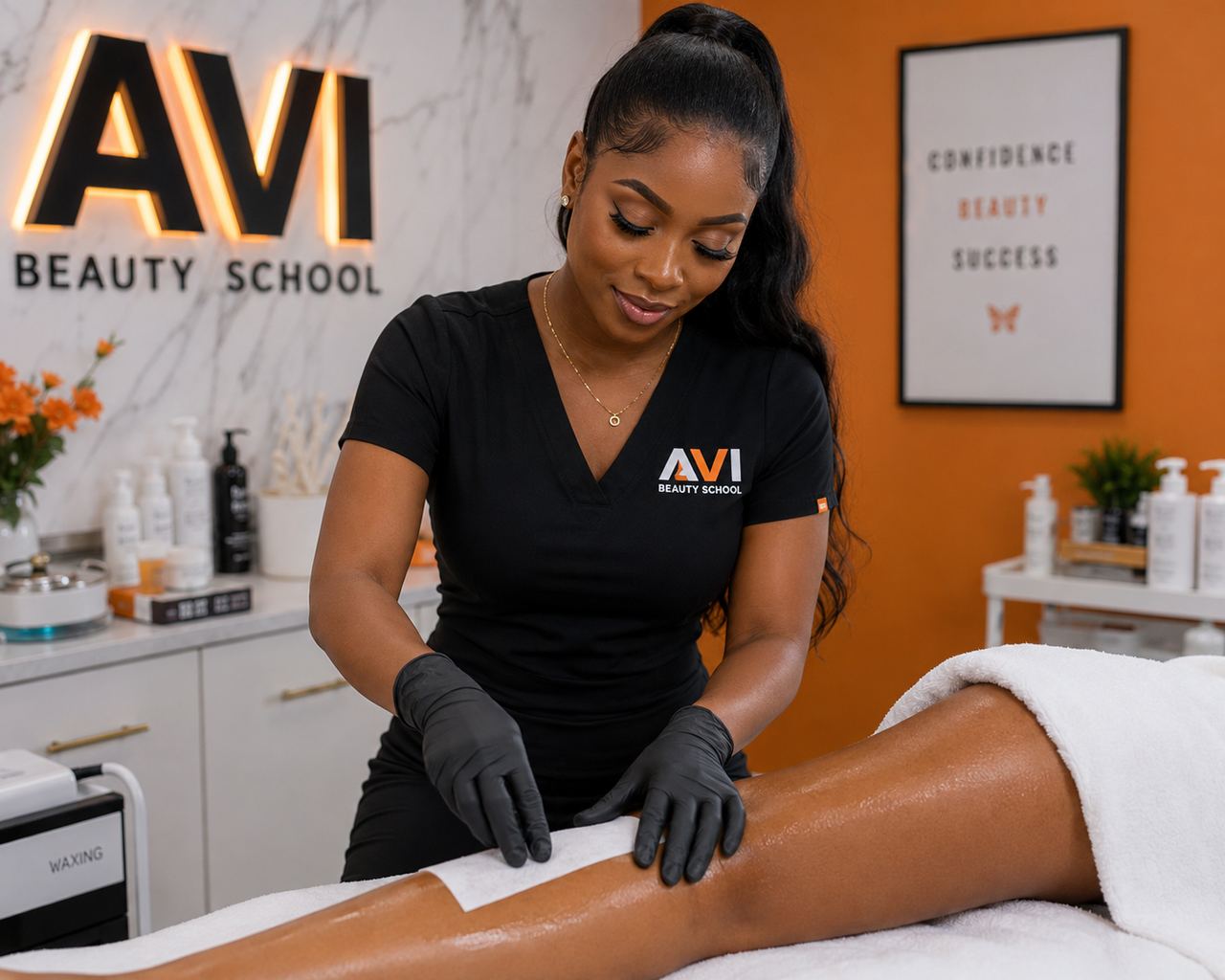
Waxing & Hair Removal — Full facial and body waxing techniques with a focus on skin safety, particularly for deeper skin tones where improper waxing can cause hyperpigmentation or damage.
Inclusive Skin Tone Training — AVI explicitly trains students to work on all skin tones using appropriate protocols, products, and analysis methods. For a school in the Northern Virginia and DC metro market, this isn’t a bonus — it’s a requirement for success.
Sanitation, Safety & State Board Prep — Virginia State Board standards for infection control, professional ethics, and exam preparation are woven throughout the curriculum, not crammed in at the end.
A Student Story: From Career Transition to Treatment Room
Picture a student — let’s call her Destiny — who spent six years in retail management before deciding she wanted a career that felt personal and creative. She enrolled in AVI’s Basic Esthetics program not knowing what a Fitzpatrick scale was. Within her first month of training, she was practicing skin analyses on classmates with widely different skin tones, learning which exfoliation methods were safe for each. By graduation, she had a portfolio of documented client treatments and walked into her Virginia State Board practical exam feeling prepared. She passed on her first attempt. Three months later, she was working at a medical spa in Tysons Corner — exactly the kind of outcome AVI’s curriculum is designed to produce.
—
Virginia Esthetician License Requirements
To become a licensed esthetician in Virginia, you must complete a state-approved 600-hour esthetics program, then pass the Virginia State Board Esthetics Exam — a two-part test with written and practical components.
The licensing authority is the Virginia Department of Professional and Occupational Regulation (DPOR). DPOR sets the training hour requirements, approves school programs, and administers the licensing process. You can verify current requirements directly on the Virginia DPOR website.
The Step-by-Step Path to Licensure
- Enroll in a DPOR-approved 600-hour esthetics program — AVI’s Basic Esthetics program meets this requirement.
- Complete all 600 program hours with required theory and practical components.
- Submit your application to Virginia DPOR along with your certificate of completion.
- Pass the written exam — covers skin science, sanitation, safety, and professional standards.
- Pass the practical exam — a hands-on skills demonstration evaluated by a Virginia State Board examiner.
- Receive your Virginia Esthetician License and begin working legally in the state.
AVI’s entire curriculum is structured around this roadmap. Every hour you spend in training maps directly to skills tested on the Virginia State Board exam. There are no surprise gaps when you sit for your test.
—
How Long Does Esthetics School Take at AVI?
Virginia requires 600 hours of training to become a licensed esthetician — and at AVI Career Training, those 600 hours are your complete program.
Here’s what that actually looks like on a calendar:
For students who need scheduling flexibility — perhaps you’re working part-time or have family responsibilities — contact AVI’s admissions team to discuss your options. The goal is to find a schedule that works for your life without stretching your timeline unnecessarily.
How Esthetics Compares to Other Programs
One of the most common questions prospective students ask is: “What’s the difference between an esthetician and a cosmetologist?” The short answer is scope and specialization. A cosmetologist’s training in Virginia requires 1,500 hours and covers hair, skin, and nails. An esthetician specializes specifically in skin care — facial treatments, exfoliation, waxing, and skin health. The 600-hour esthetics program gets you licensed and working faster, with a focused skill set that’s highly valued in medical spas, dermatology offices, and day spas throughout Northern Virginia.
If you later want to add services — particularly advanced laser and light-based treatments — AVI also offers a Cosmetic Laser Technology program that pairs naturally with your esthetics credential and opens doors into medical aesthetics practices.
—
Esthetician Career Paths and Earning Potential in Virginia
Licensed estheticians in Northern Virginia have more career options than in most parts of the country — because the DC metro market is dense with exactly the settings where estheticians thrive.
Where Estheticians Work in Northern Virginia
What Do Estheticians Earn in Virginia?
According to the Bureau of Labor Statistics (BLS), the national median annual wage for skincare specialists is approximately $39,000–$42,000. The Washington-Arlington-Alexandria DC metro area consistently tracks above the national median due to higher cost of living, dense high-income clientele, and strong demand for medical aesthetics services. Verify the most current state and metro-level data at BLS.gov — Skincare Specialists.
Earning potential also grows significantly with specialization. Estheticians who add certifications in chemical peels, dermaplaning, or laser-adjacent services — or who build a loyal client base in a medical spa setting — frequently earn well above the median.
The BLS projects approximately 17% job growth for skincare specialists through 2032 — well above average for all occupations. Confirm the most current projection figure at time of enrollment.
A Student Story: Building a Medical Spa Career From Zero
Marcus had no beauty industry background. He’d spent years in hospitality and loved working with people but wanted something with more earning potential and room to specialize. He enrolled in AVI’s Basic Esthetics program after a conversation with an AVI admissions advisor who walked him through the Virginia DPOR licensing path step by step. He completed his 600 hours on a full-time schedule in under five months. After passing both parts of the Virginia State Board exam, he was hired at a dermatology-adjacent med spa in the Tysons area — a position that offered base pay plus commission on retail products and add-on services. Within his first year, his earnings exceeded his previous hospitality salary. He’s now exploring AVI’s Cosmetic Laser Technology program as his next credential.
—
Why Choose AVI Career Training for Esthetics in Northern Virginia?
There are several schools in the region that offer esthetics programs. Here’s what sets AVI Career Training apart in ways that actually matter to your career.
COE Accreditation + SCHEV Certification
AVI is accredited by the Council on Occupational Education (COE) — one of the most respected accrediting bodies for career and technical schools in the country. AVI is also certified by the State Council of Higher Education for Virginia (SCHEV). These aren’t decorative logos on a website. COE accreditation tells employers that your training met rigorous program standards. It also matters if you ever pursue additional credentials or transfer credits. Not every esthetics school in Northern Virginia holds both.
Inclusive Training Is Core, Not Optional
AVI’s curriculum is explicitly built to train students on all skin tones. In a region as diverse as Northern Virginia and the DC metro, this is a competitive advantage on day one of your career. You’ll enter your first job able to confidently analyze, treat, and recommend for every client — not just a narrow range of skin types you practiced on during school.
Location: Vienna, Virginia — Center of the Northern Virginia Market
AVI’s campus at 1595 Spring Hill Rd #720, Vienna, VA 22182 sits in Fairfax County, minutes from Tysons Corner — one of the most commercially active corridors in the Mid-Atlantic. This location puts you close to the employers you’ll be targeting after graduation. You’re not training in a vacuum; you’re training in your future job market.
GI Bill® Acceptance
AVI accepts the GI Bill® (including the Post-9/11 GI Bill®), making the program accessible to veterans and active-duty service members transitioning into civilian careers. If you or a family member served, contact AVI’s admissions team to understand how your benefits apply.
Tuition & Payment Options
Important note about financial aid: The Basic Esthetics program (NO FINANCIAL AID FOR THIS PROGRAM) is 600 hours and does not qualify for federal financial aid (Title IV / FAFSA) because it does not meet the federal program length threshold. Federal student loans and Pell Grants are not available for this program.
AVI offers payment plan options and works with students to find private financing solutions that make training accessible. If you’re a veteran, your GI Bill® benefits may cover tuition costs — contact AVI admissions to discuss your specific situation.
—
Frequently Asked Questions
Q: How many hours do you need to become an esthetician in Virginia?
A: Virginia requires 600 hours of training at a DPOR-approved school to qualify for the esthetician licensing exam. AVI Career Training’s Basic Esthetics program is exactly 600 hours.
Q: How long does esthetician school take at AVI?
A: Full-time students typically complete the 600-hour program in approximately 4–5 months. Your exact timeline depends on your schedule and enrollment track. Contact AVI admissions at (703) 943-9841 for current scheduling details.
Q: How much do estheticians make in Virginia?
A: According to BLS data, skincare specialists nationally earn a median of approximately $39,000–$42,000 annually. The Washington-Arlington-Alexandria metro area typically tracks higher. Verify current Virginia and DC metro-specific figures at BLS.gov, as wages are updated annually.
Q: What is the difference between an esthetician and a cosmetologist?
A: An esthetician specializes in skin care — facials, waxing, chemical exfoliation, and skin health. A cosmetologist’s training covers hair, skin, and nails and requires 1,500 hours in Virginia versus 600 hours for esthetics. Esthetics is a focused, faster path to licensure in skincare specifically.
Q: Is esthetics school worth it?
A: For students in Northern Virginia and the DC metro area, yes — the regional job market is strong, with medical spas, dermatology offices, day spas, and resorts actively hiring licensed estheticians. BLS projects roughly 17% job growth for skincare specialists through 2032. The 600-hour investment gets you licensed and working in under a year.
Q: Is AVI Career Training’s esthetics program accredited?
A: Yes. AVI is COE Accredited by the Council on Occupational Education and SCHEV Certified by the State Council of Higher Education for Virginia. Both credentials validate program quality to employers and state licensing boards.
Q: Does AVI Career Training accept the GI Bill®?
A: Yes. AVI accepts the GI Bill® (including the Post-9/11 GI Bill®) for eligible veterans and service members. Contact AVI admissions directly to confirm how your benefits apply to the esthetics program.
Q: What is the Virginia State Board Esthetics Exam?
A: The Virginia State Board Esthetics Exam is a two-part licensing exam — written and practical — administered through Virginia DPOR. The written portion tests skin science, sanitation, and professional regulations. The practical portion is a hands-on skills evaluation. AVI’s curriculum prepares students for both components.
—
Ready to Start Your Esthetics Career in Northern Virginia?
AVI Career Training’s 600-hour Basic Esthetics program in Vienna, VA gives you the clinical skills, inclusive training, and state board preparation to launch your career with confidence.
Questions? Call us at (703) 943-9841 or contact AVI admissions online.