Esthetics School in Northern Virginia: Launch Your Skincare Career
AVI Career Training in Vienna, VA is one of Northern Virginia’s only COE-accredited esthetics (NO FINANCIAL AID FOR THIS PROGRAM) schools — and it’s where serious skincare careers begin. If you’re ready to turn your passion for skin health and beauty into a licensed profession, this is your roadmap from first research to first client.
The DC metro area has one of the most active beauty and wellness markets in the country. Spas, medical esthetics (NO FINANCIAL AID FOR THIS PROGRAM) clinics, and luxury salons across Fairfax County, Arlington, and the broader Northern Virginia corridor are actively hiring. Demand is real. Licensing is achievable. And the right program makes all the difference.
Ready to take the first step? Apply to AVI’s Esthetics (NO FINANCIAL AID FOR THIS PROGRAM) Program today and start building the career you’ve been working toward.
Key Takeaways
- Virginia requires 600 clock hours of esthetics training to qualify for licensure through DPOR
- AVI Career Training is COE accredited. Federal financial aid (FAFSA/Title IV) is NOT available for this program as it does not meet the minimum 600-hour requirement. AVI offers flexible payment plans and private financing options.
- Estheticians in Virginia earn a median of approximately $38,000–$48,000 per year, with medical estheticians in the DC metro often earning $55,000–$70,000+
- The BLS projects 17% job growth for skincare specialists through 2032 — faster than average for all occupations
- AVI’s curriculum covers all Fitzpatrick skin types, preparing graduates to serve every client who walks through the door
What Does an Esthetician Actually Do?
An esthetician (NO FINANCIAL AID FOR THIS PROGRAM) is a licensed skincare professional trained to analyze, treat, and improve the health and appearance of the skin. It’s a hands-on career with real variety — no two days look exactly the same.
On any given day, a working esthetician might perform:
- Facial treatments — deep cleansing, extractions, and customized masks based on a client’s skin type
- Chemical peels — controlled exfoliation treatments that address hyperpigmentation, fine lines, and uneven texture
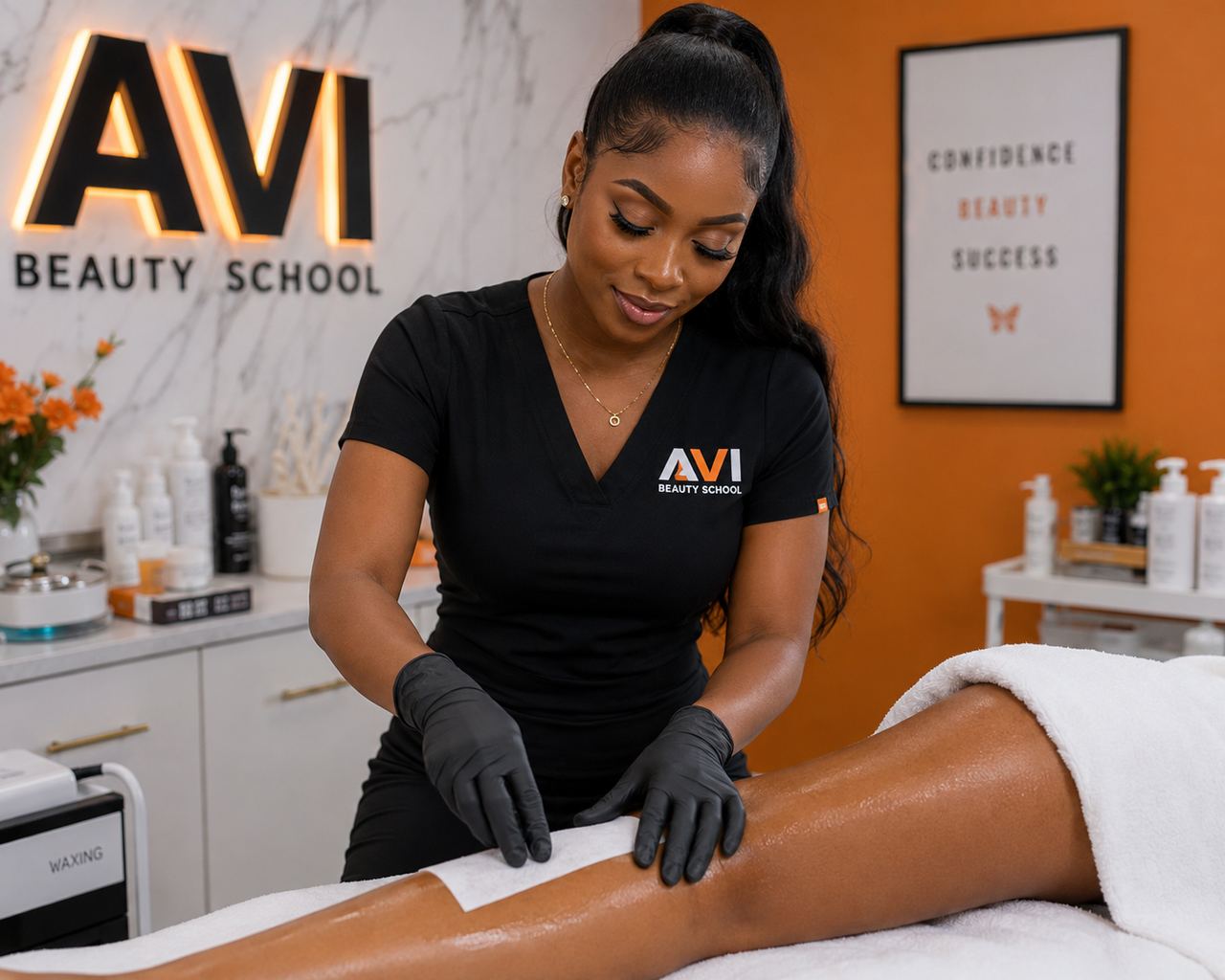
- Waxing and hair removal — from brow shaping to full-body waxing services
- Lash and brow services — tinting, shaping, and lash lifts
- Skin analysis and consultation — reading a client’s Fitzpatrick skin type, identifying concerns, and building a personalized treatment plan
That last point matters more than most people realize. Skin analysis isn’t one-size-fits-all. A well-trained esthetician (NO FINANCIAL AID FOR THIS PROGRAM) knows how to approach hyperpigmentation on deeper skin tones differently than on lighter ones — and can adjust chemical peel concentrations, extraction techniques, and product recommendations accordingly. That’s the kind of training that separates good estheticians from truly skilled ones.
Is This Career Right for You?
Esthetics (NO FINANCIAL AID FOR THIS PROGRAM) is a strong fit if you’re detail-oriented, enjoy working with people, and have a genuine interest in skin health. It’s also one of the most flexible careers in the beauty industry — you can work in day spas, dermatology offices, medical esthetics clinics, resorts, or build your own independent clientele.
If you’ve been Googling “esthetics school near me Fairfax” or wondering how to make a career pivot into skincare, that curiosity is worth exploring. The path to licensure is more straightforward than most people expect.
Virginia Esthetics License Requirements: What You Need to Know
To work as a licensed esthetician in Virginia, you must meet the requirements set by the Virginia Department of Professional and Occupational Regulation (DPOR). Here’s how the process works from start to finish.
Step 1: Complete 600 Clock Hours of Approved Training
Virginia requires 600 clock hours of esthetics (NO FINANCIAL AID FOR THIS PROGRAM) education at a state-approved school. These hours cover both theory and hands-on clinical practice — skin anatomy, sanitation, chemical applications, facial techniques, and client consultation.
Your program must be approved by DPOR and, ideally, accredited by a recognized national accreditor. COE accreditation (the Council on Occupational Education) is one of the strongest signals that a program meets rigorous educational standards.
Step 2: Pass the Virginia State Board Examinations
After completing your 600 hours, you’ll apply to sit for the Virginia State Board exams, which are administered by PSI Exams on behalf of DPOR. There are two parts:
- Written exam — covers skin theory, safety, sanitation, and Virginia state law
- Practical exam — a hands-on demonstration of esthetics techniques evaluated by a licensed examiner
Both exams must be passed before DPOR will issue your license.
Step 3: Apply for Your Virginia Esthetics License
Once you’ve passed both exams, you submit your licensure application to DPOR along with proof of education and exam results. After approval, you’re a licensed esthetician in the Commonwealth of Virginia — and you can legally begin working with clients.
A Note on Continuing Education
Virginia licensed estheticians are required to complete 4 hours of continuing education each renewal cycle to keep their license active. This is easy to meet through workshops, advanced training courses, or manufacturer-sponsored education.
For current and complete licensing requirements, always verify directly with DPOR’s Board for Barbers and Cosmetology before enrolling.
What to Look for in a Northern Virginia Esthetics Program
Not every esthetics (NO FINANCIAL AID FOR THIS PROGRAM) program is built the same. If you’re comparing schools in the NoVA/DC metro area, here are the criteria that actually matter — and that you should ask every school about