
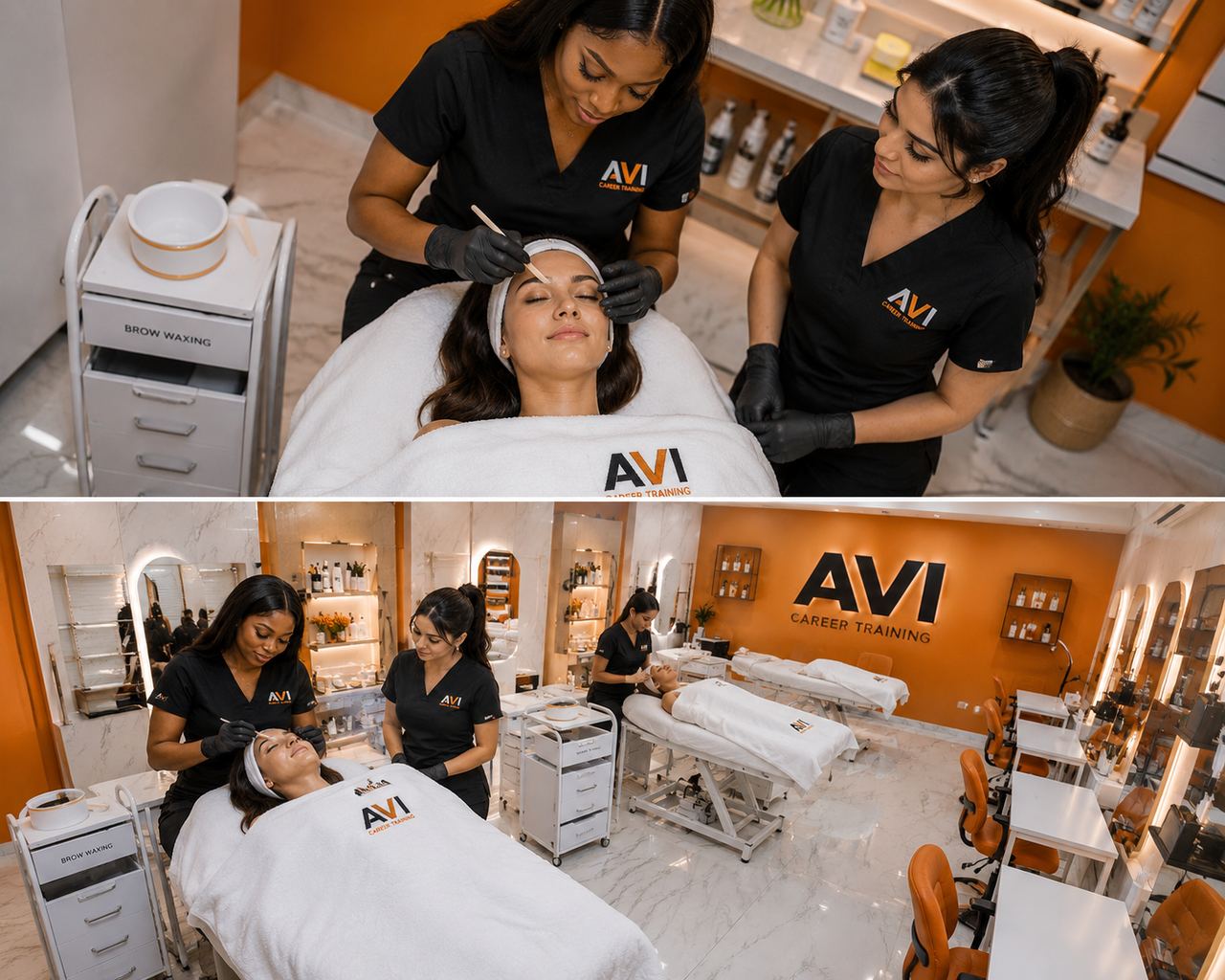
AVI Career Training in Vienna, Virginia is the closest COE-accredited esthetics school to Burke, VA — just 20–25 minutes away via I-66 or Route 123, right in the heart of Fairfax County.
If you live in Burke and you’re researching esthetics programs, you’ve probably noticed the options are scattered across the Northern Virginia and DC metro area. Commute time adds up fast when you’re logging 600 required training hours. Choosing a school nearby isn’t just about convenience — it’s about finishing what you start without burning out on the drive.
This guide walks you through everything you need to know: Virginia’s licensing requirements, what to look for in an accredited program, what AVI’s curriculum actually covers, and how to pay for it. By the end, you’ll have a clear picture of your path from Burke resident to licensed esthetician.
Apply to AVI’s Esthetics Program →
⚡ Key Takeaways
- AVI Career Training is approximately 20–25 minutes from Burke, VA — the closest COE-accredited esthetics school in Fairfax County.
- Virginia requires 600 clock hours of esthetics training at a SCHEV-certified school before you can sit for the Virginia State Board exam.
- AVI is accredited by the Council on Occupational Education (COE) and certified by SCHEV — credentials that matter for licensure.
- The GI Bill® is accepted at AVI, making the program accessible for veterans and active-duty military families in the Burke/Springfield/Fairfax area.
- Federal financial aid (FAFSA/Title IV) is NOT available for this program — tuition is covered through the GI Bill®, payment plans, or private financing.
How Far Is Burke, VA From an Esthetics School?
The closest COE-accredited esthetics school to Burke, VA is AVI Career Training — located at 1595 Spring Hill Rd, Suite 720, Vienna, Virginia 22182, approximately 20–25 minutes away under normal traffic conditions.
That proximity is more significant than it might seem. Virginia’s esthetics program requires 600 clock hours of training. When you’re completing those hours across weeks or months of classes, a 40-minute round trip versus an 80-minute one can be the difference between staying on track and dropping out entirely.
Take I-66 West to Exit 62 (Nutley St), then north to Spring Hill Rd — approximately 13 miles. Alternatively, Route 123 North connects directly through Fairfax and Oakton into Vienna. Both routes typically run 20–25 minutes outside peak rush hour.
Burke is an unincorporated community within Fairfax County — which means AVI’s Vienna campus is truly a local option. You’re not crossing into a different region or county. You’re staying within the same community you already live and work in.
For residents of neighboring areas like Springfield, Fairfax Station, Clifton, and Annandale, AVI is equally accessible. The school sits near the Tysons Corner corridor, one of Northern Virginia’s most active commercial and employment hubs — which also happens to be a prime market for licensed estheticians once you graduate.
What Virginia Requires to Become a Licensed Esthetician
In Virginia, becoming a licensed esthetician requires completing 600 clock hours at a SCHEV-certified school, passing the Virginia State Board exam, and applying for licensure through DPOR.
Here’s the exact sequence, so you know what you’re committing to from day one:
Clock hours of esthetics training required by Virginia DPOR
Parts to the Virginia State Board exam: written + practical
Minimum age to apply for an esthetics license in Virginia
Step 1: Complete 600 Hours at a SCHEV-Certified Program
Virginia’s Department of Professional and Occupational Regulation (DPOR) sets the 600 clock-hour requirement for esthetics. Those hours must be completed at a school certified by the State Council of Higher Education for Virginia (SCHEV) — the state agency that oversees private career schools.
This is a critical detail. Not every school offering “esthetics courses” in Virginia is SCHEV-certified. If you complete your training at a non-certified program, your hours may not count toward licensure. AVI Career Training is both SCHEV-certified and nationally accredited by the Council on Occupational Education (COE) — so your 600 hours here are fully recognized by the Virginia State Board.
Step 2: Pass the Virginia State Board Exam
After graduating, you’ll apply to sit for the Virginia State Board exam. The exam has two components: a written (theory) portion and a practical (hands-on) skills demonstration. AVI’s curriculum is structured to prepare you for both — theory is integrated throughout, and practical skills are drilled in a real clinic environment.
Step 3: Apply for Your Virginia Esthetician License
Once you’ve passed both portions of the exam, you submit your licensure application to DPOR. At that point, you’re a licensed esthetician in Virginia — eligible to work in any licensed salon, spa, medical aesthetics practice, or wellness center in the state.
For the most current licensing requirements, visit the Virginia DPOR Cosmetology/Esthetics page.
5 Things to Look for When Choosing an Esthetics School Near Burke, VA
Choosing the right esthetics school comes down to five factors: accreditation, curriculum depth, hands-on training hours, inclusive technique training, and financial options.
Not all esthetics programs are built the same. Here’s a practical checklist you can use when comparing any school — with context for why each point matters.
- COE or SCHEV Accreditation — As covered above, SCHEV certification is required for your hours to count toward a Virginia license. COE accreditation goes further, signaling that the program meets rigorous national standards for curriculum, faculty, and student outcomes. AVI Career Training holds both.
- Curriculum That Covers All Skin Tones — Esthetics is fundamentally about skin. If your training focuses on a narrow range of skin types, you’ll be underprepared to serve the diverse clientele you’ll actually encounter in Northern Virginia and the DC metro. Look for programs that explicitly train students on all Fitzpatrick skin types and a wide range of skin conditions.
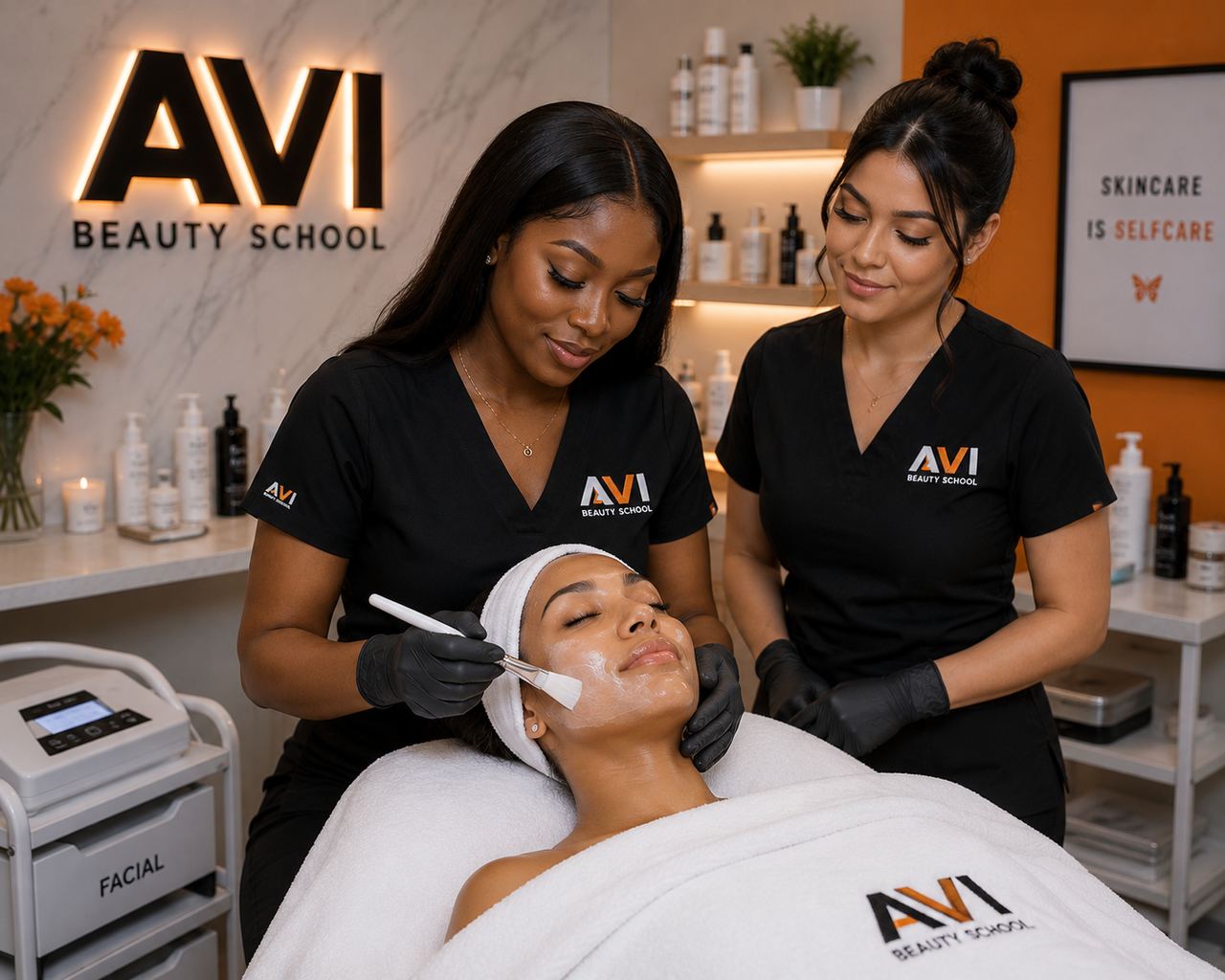
- Hands-On Clinical Training Hours — Theory alone doesn’t make a skilled esthetician. You need real-world practice — performing facials, waxing, chemical exfoliation, and skin analysis on actual clients. Ask prospective schools how many of their 600 hours are spent in a live clinic setting versus a classroom.
- Financial Options Including GI Bill® — If you’re a veteran or military family member, GI Bill® approval is a significant factor. AVI is approved to accept GI Bill® benefits. Federal financial aid (FAFSA/Title IV) is not available for this program — see the tuition section below for the full picture.
- Qualified, Licensed Instructors — Your instructors should be licensed industry professionals with real-world experience, not just classroom teachers. At AVI Career Training, instructors are credentialed practitioners who bring current industry knowledge into the classroom.
Transitioning Careers from Corporate to EstheticsConsider someone like Danielle — a Burke resident in her early 30s who spent nearly a decade in office administration. She’d always been drawn to skincare, but assumed a career change meant going back to school full-time for years. When she found AVI’s 600-hour program and mapped the Vienna campus on her phone, she was surprised: it was less than 25 minutes from her house. She enrolled, completed her hours while managing a part-time job, passed her Virginia State Board exam on the first attempt, and now works at a med spa in Tysons Corner — five minutes from where she trained.
What AVI Career Training’s Esthetics Program Covers
AVI Career Training’s Basic Esthetics program (NO FINANCIAL AID FOR THIS PROGRAM) in Vienna, Virginia delivers 600 clock hours of hands-on, inclusive training designed to prepare graduates for the full scope of the Virginia esthetician license.
The curriculum is built around one core principle: beauty education should prepare you to serve every client who walks through the door — regardless of skin tone, skin type, or background.
Core Curriculum Areas
- Skin Analysis & Consultation — You’ll learn to assess skin condition, identify concerns, and build customized treatment plans across all Fitzpatrick skin types (I through VI). This is foundational — every other service starts here.
- Facial Treatments — Deep cleansing, extractions, masks, serums, and massage techniques that address a wide range of skin concerns: acne, hyperpigmentation, aging, dehydration, and sensitivity.
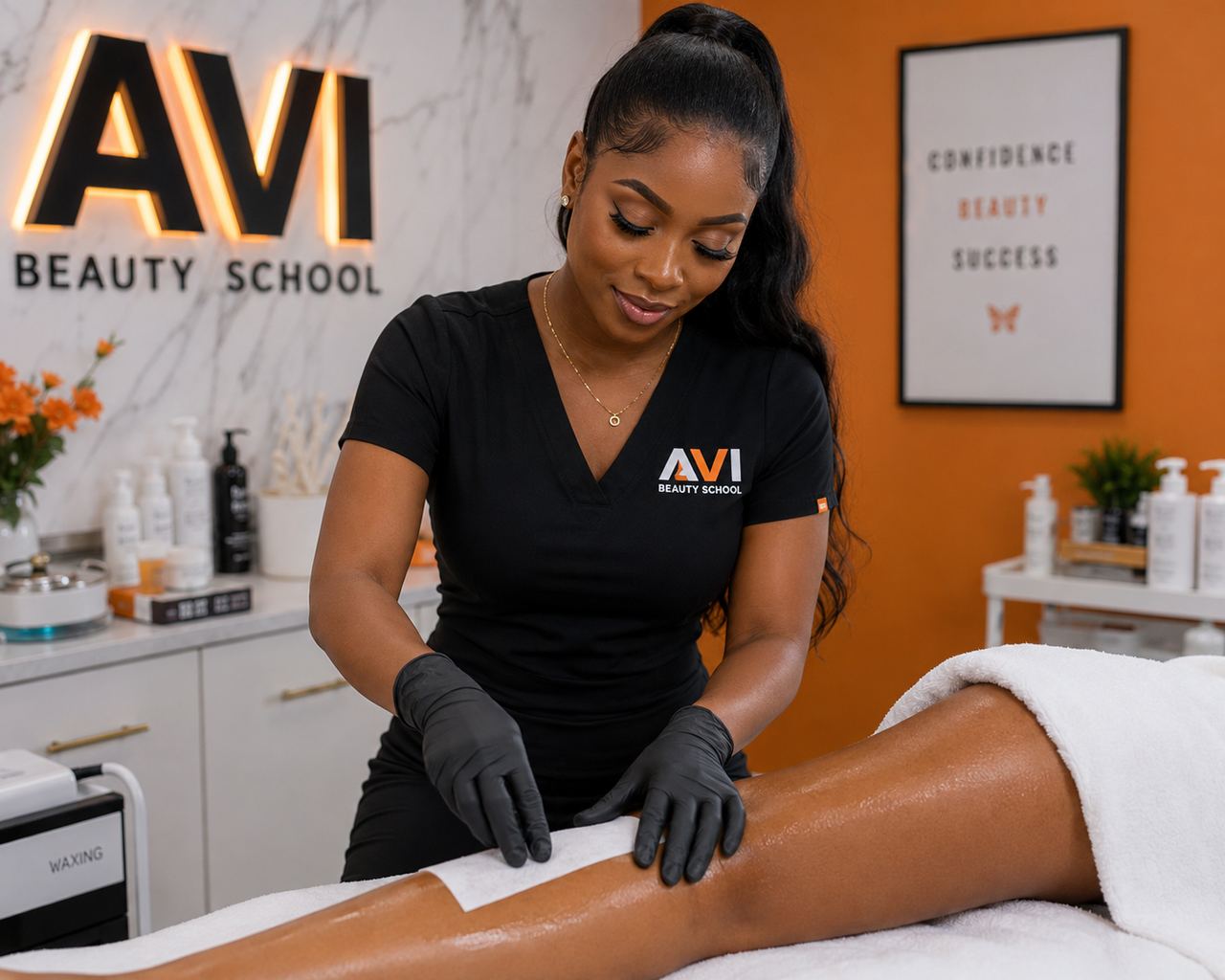
- Hair Removal — Waxing and threading techniques for the face and body, with attention to technique, sanitation, and client comfort across different skin sensitivities.
- Chemical Exfoliation — Introduction to chemical peels, enzyme treatments, and exfoliation protocols — including contraindications and safety procedures for different skin tones.
- Inclusive Techniques for All Skin Tones — AVI’s curriculum specifically addresses how treatments perform differently across the Fitzpatrick scale. In a market as diverse as Northern Virginia and the DC metro, this is a professional necessity.
- Sanitation, Safety & Virginia State Board Prep — Infection control, OSHA standards, Virginia DPOR regulations, and practical preparation for both the written and practical components of the State Board exam.
Why the Northern Virginia Market Demands Inclusive Training
The DC metro area is one of the most ethnically and culturally diverse regions in the United States. Clients walking into Northern Virginia spas and salons represent dozens of nationalities and every skin tone on the Fitzpatrick spectrum. Estheticians trained on a narrow range of skin types are limited in who they can confidently serve — and limited in their earning potential.
AVI’s inclusive curriculum isn’t a marketing tagline. It’s practical preparation for the actual market you’ll work in.
According to the U.S. Bureau of Labor Statistics, the national median annual wage for skincare specialists is approximately $39,210, with earnings in high-demand metro markets like the DC area trending above that national figure. Career paths for licensed estheticians include day spas, medical aesthetics clinics, hotel wellness centers, resort spas, and self-employment.
A Military Spouse Finding Career Stability in Northern VirginiaMarcus’s wife had been a military spouse for eight years — relocating three times in a decade and struggling to build a portable career. After their family settled at Fort Belvoir, she enrolled in AVI’s esthetics program using the GI Bill®. The Vienna campus was a 30-minute drive from base. Within nine months of graduating, she had her Virginia esthetician license, a client book of her own, and was working four days a week at a spa in Alexandria. When the family eventually relocates again, her license and skills move with her.