Esthetician School: Your Path to Skincare Success
Esthetician school gives you the hands-on training, industry knowledge, and state-board preparation you need to launch a rewarding career in skincare — and at AVI Career Training in Vienna, VA, you can earn your license in as few as 600 program hours. Whether you dream of working in a luxury spa, a medical office, or running your own skincare studio, the right esthetics program opens every one of those doors. Read on to learn exactly what esthetician school involves, what you can expect at AVI Career Training, and how to take your first step today.
Key Takeaways
- AVI Career Training offers a Basic Esthetics program at 600 hours and a Master Esthetics program at 750 hours, giving you flexible pathways depending on your career goals.
- The school is COE-accredited (Council on Occupational Education), meaning your credential carries real weight with employers.
- Federal financial aid (Title IV) is available for qualifying programs, including Esthetics, so cost does not have to be a barrier.
- Graduates are prepared to sit for Virginia state board exams and step directly into professional roles.
- AVI Career Training is conveniently located at 112 Lawyers Rd NW Suite 3, Vienna, VA 22180, and can be reached at (571) 520-4417.
- The school also offers Cosmetology, Massage Therapy, Nail Technology, Laser Technician, Medical Assistant, and ESL programs — perfect if you want to broaden your skill set later.
What Is Esthetician School, Really?
Esthetician school is a structured, state-regulated training program that blends classroom theory with extensive hands-on practice. You study the science of skin — anatomy, physiology, chemistry, and dermatology fundamentals — alongside practical techniques like facials, chemical exfoliation, waxing, and advanced skin analysis. At the end of your program, you are eligible to take your state licensing examination, which is the final credential most employers require before you can practice professionally.
Unlike a casual workshop or online tutorial series, a licensed esthetics program at an accredited school follows a defined curriculum approved by the state board of cosmetology. That structure is what transforms passionate skincare enthusiasts into true professionals.
Basic Esthetics vs. Master Esthetics: Choosing Your Track at AVI
One of the first decisions you will make is which esthetics pathway fits your goals. AVI Career Training offers two distinct options:
Basic Esthetics — 600 Hours
The Basic Esthetics program is the foundational route to your esthetician license. In 600 program hours, you cover the core competencies required for Virginia licensure: skin analysis, facial treatments, hair removal, product knowledge, sanitation and safety protocols, and client consultation skills. This track is ideal if you want to enter the workforce quickly — as a spa esthetician, beauty retail specialist, or skincare consultant — while keeping your options open to specialize later.
Master Esthetics — 750 Hours
The Master Esthetics program builds on the foundational curriculum with an additional 150 hours of advanced training. Topics at this level often include more sophisticated treatment modalities, deeper clinical skincare techniques, and expanded knowledge relevant to medical or spa environments. If you already know you want to work alongside dermatologists, in a medical spa, or in a high-end treatment environment, the Master Esthetics track positions you with a competitive edge right from graduation.
Not sure which program is right for you? Connect with an AVI Career Training advisor today to talk through your goals and find your perfect fit.
What You Will Learn in an Esthetics Program
Regardless of which track you choose, your coursework at AVI Career Training weaves together theory and technique throughout every stage of training. Here is a look at the core subject areas you can expect to cover:
Skin Science and Anatomy
Understanding the skin at a cellular level is what separates a skilled esthetician from someone who simply applies products. You will study the layers of the skin, how different skin types behave, common skin conditions and disorders, and the effects of lifestyle and environment on skin health. This scientific foundation informs every treatment decision you make in your career.
Facial Treatments and Massage
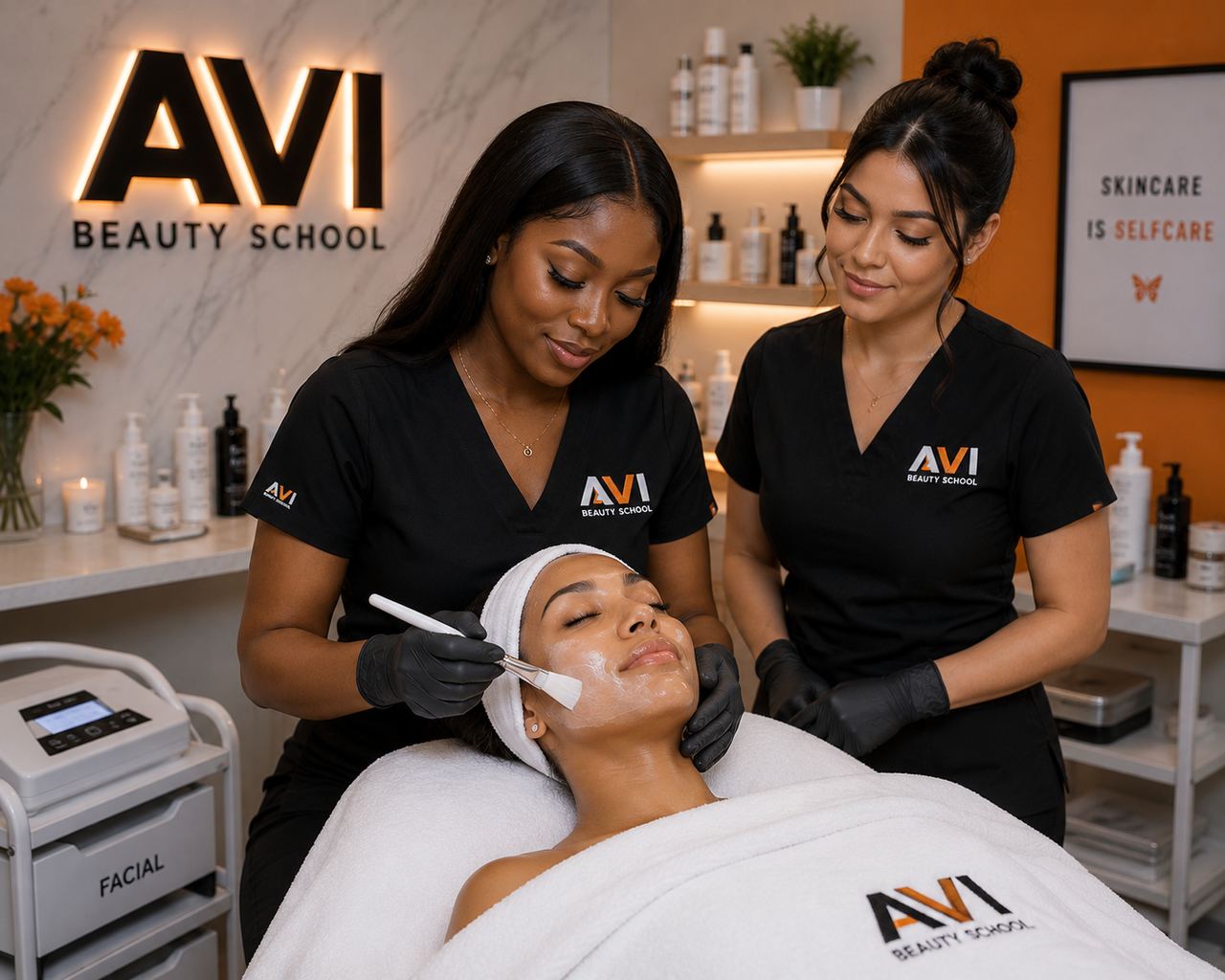
Hands-on practice in facial techniques is at the heart of esthetics training. You will learn cleansing protocols, extraction procedures, massage movements, mask application, and how to customize each treatment to meet a client’s unique needs. By the time you graduate, performing a professional facial will feel completely natural.
Hair Removal
Waxing — both soft and hard wax techniques — is a core service in virtually every spa and salon menu. Your program covers safe, effective hair removal for the face and body, proper skin preparation, and aftercare guidance to keep clients comfortable and satisfied.
Sanitation, Safety, and State Board Preparation
Virginia state board exams test both practical skills and written knowledge, and esthetics programs dedicate significant time to infection control standards, chemical safety, tool disinfection, and professional ethics. This is not busywork — it is the framework that protects your clients and your license throughout your entire career.
Business and Client Communication Skills
Today’s successful esthetician is also a savvy business communicator. Your training will include client consultation techniques, retail product recommendations, appointment management, and the fundamentals of building a loyal clientele — whether you work for someone else or eventually open your own space.
Why Choose AVI Career Training for Esthetician School?
Vienna, VA is home to one of the region’s most well-regarded beauty and wellness career schools, and AVI Career Training has built that reputation on a few important pillars.
COE Accreditation
AVI Career Training holds accreditation from the Council on Occupational Education (COE), one of the most respected accrediting bodies for career and technical education in the United States. COE accreditation signals to employers — and to yourself — that your education meets rigorous academic and professional standards.
Federal Financial Aid Availability
Paying for school is a real concern, and AVI addresses it directly. Title IV federal financial aid is available for qualifying programs, including Esthetics. That means eligible students may access federal grants and loans to cover their education — reducing the financial barrier between you and your new career. Contact AVI’s admissions team at (571) 520-4417 to learn about your specific eligibility.
A Campus Built for Career Training
Located at 112 Lawyers Rd NW Suite 3 in Vienna, VA, AVI’s campus is designed around practical skill development. You train in a hands-on environment that reflects real professional settings, building the confidence and muscle memory that employers notice immediately.
A Full Menu of Beauty and Wellness Programs
AVI also offers Cosmetology (1,000 hours), Massage Therapy (625 hours, Title IV eligible), Nail Technology (150 hours), Laser Technician (120 hours), Medical Assistant (600 hours), and ESL (1,200 hours). If your career path ever leads you toward expanding your skills, you already know where to go.
What Can You Do With an Esthetics License?
The short answer: quite a lot. Licensed estheticians work in day spas, resort spas, medi-spas, dermatology offices, plastic surgery practices, salons, cruise ships, wellness centers, and film and television production. Some build thriving self-employed businesses with a loyal private clientele. Others move into skincare product education and sales roles with major brands. The variety of settings is one of the most appealing aspects of a career in esthetics — you can evolve your path as your interests and ambitions grow.
The Bureau of Labor Statistics consistently notes solid employment demand for skincare specialists, and the growing consumer focus on wellness and self-care has only strengthened the profession’s outlook. Starting your journey now means you position yourself ahead of the curve.
Frequently Asked Questions About Esthetician School
How long does it take to complete the esthetics program at AVI Career Training?
AVI Career Training’s Basic Esthetics program is 600 program hours, and the Master Esthetics program is 750 program hours. The actual calendar time to complete your hours depends on your schedule — full-time students typically finish faster than part-time students. An AVI admissions advisor can walk you through expected timelines based on your availability.
Does AVI Career Training offer financial aid for esthetics students?
Yes. Title IV federal financial aid is available for qualifying programs at AVI Career Training, which includes the esthetics programs. Eligibility is determined based on your individual financial situation and other federal criteria. The best way to find out what you qualify for is to speak directly with AVI’s admissions team at (571) 520-4417 or start your application online.
What is the difference between Basic Esthetics and Master Esthetics?
The Basic Esthetics program (600 hours) covers the core skills and knowledge required for Virginia esthetician licensure. The Master Esthetics program (750 hours) includes everything in the basic curriculum plus additional advanced training in higher-level treatment techniques and clinical skincare applications. The Master track is especially beneficial for students who want to work in medical or high-end spa environments from day one.
Will I be prepared to take the Virginia state board exam after graduating?
Yes. AVI Career Training’s esthetics curriculum is designed to align with Virginia’s state board examination requirements, covering both the practical and written components of the exam. State board preparation is woven throughout your program, not just tacked on at the end, so you build confidence incrementally as you train.
How do I apply to the esthetics program at AVI Career Training?
Applying is straightforward. You can visit AVI Career Training in person at 112 Lawyers Rd NW Suite 3, Vienna, VA 22180, call the school at (571) 520-4417, or go directly to the online application. Start your application at AVI Career Training today and an admissions advisor will guide you through every next step, from program selection to financial aid options to your start date.
Your Next Step Starts Here
A career in skincare is within reach, and esthetician school is the structured, proven pathway to get you there. AVI Career Training offers COE-accredited Basic and Master Esthetics programs, federal financial aid options, and a supportive campus environment designed to turn your passion for skincare into a professional credential you will carry for life. Whether you are starting fresh or pivoting from another field, there has never been a better time to invest in yourself and your future clients.
Do not wait to take the first step toward a career that is as rewarding as it is in demand. Apply to AVI Career Training’s Esthetics program now and let’s get your skincare career started.