Cosmetology School vs. 4-Year Degree: Which Pays Off Faster?
Cosmetology school gets you licensed, working, and earning in 12–14 months — while a 4-year degree takes four years and can leave you carrying $29,000–$37,000 in student loan debt before your career even starts.
That’s the core math. But the full picture is more nuanced, and you deserve an honest breakdown before you commit your time, money, and energy to either path.
This article compares cosmetology school vs. a 4-year degree across five factors that actually matter: total cost, time to earning, salary potential, career flexibility, and long-term ROI. Whether you’re a recent high school graduate, a career-changer, or someone who just wants to work with your hands and build something real — this comparison is for you.
Explore AVI’s Cosmetology Program →
—
Key Takeaways
- Virginia requires 1,500 hours of training to earn a cosmetology license — completable in as few as 12–14 months full-time.
- A 4-year university costs $37,000–$105,000+ in tuition and fees, compared to significantly lower cosmetology program costs.
- Average student loan debt for 4-year graduates runs $29,000–$37,000 — debt that follows you before your first paycheck.
- Cosmetologists in the DC metro / Northern Virginia market earn measurably above the national median thanks to the region’s high income levels and diverse clientele.
- AVI Career Training in Vienna, VA is COE-accredited and SCHEV-certified, meaning students may qualify for federal financial aid — including the GI Bill®.
—
The Real Cost of a 4-Year Degree vs. Cosmetology School
The sticker price of a 4-year university is only part of what you pay — and most prospective students underestimate the full cost.
What a 4-year degree actually costs:
According to the College Board and the National Center for Education Statistics (NCES), total tuition and fees at a 4-year institution range from approximately $37,000 at public in-state schools to over $105,000 at private universities — and that’s before room, board, books, and living expenses. The Federal Reserve reports that the average 4-year graduate carries $29,000–$37,000 in student loan debt by graduation day.
Here’s the part most financial aid calculators don’t show you: that debt accrues while you’re in school. You spend four years not earning — or earning very little — and you start your career already in the red.
What cosmetology school costs:
Cosmetology program tuition varies by school, but it is a fraction of university costs. Programs like AVI’s Cosmetology program in Vienna, Virginia are designed to be accessible, with federal financial aid available to eligible students. The total investment — including tuition, kit fees, and materials — is typically far lower than even one year at a 4-year university.
The hidden cost nobody talks about: time-to-earning.
A 4-year student spends 48 months before entering the workforce at full professional capacity. A cosmetology student in Virginia can complete their 1,500 required training hours, pass state board exams, and be licensed and working within 12–14 months. That gap — roughly 2.5 to 3 additional earning years — has real dollar value that never shows up in a tuition comparison chart.
—
How Long Does Cosmetology Training Actually Take in Virginia?
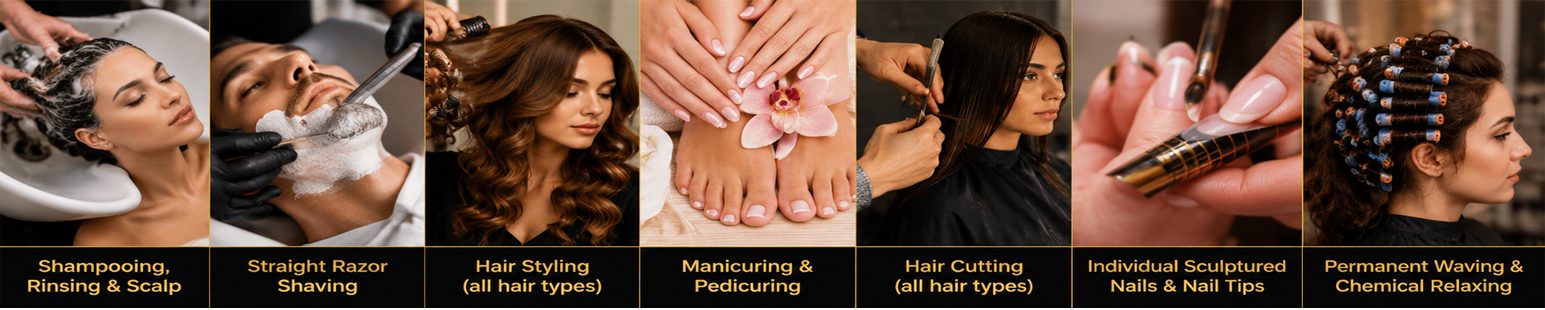
Virginia requires 1,500 clock hours to sit for the cosmetology licensure exam — and a well-structured full-time program gets you there in about 12–14 months.
Those 1,500 hours aren’t busywork. The Virginia Department of Professional and Occupational Regulation (VA DPOR) requires that training cover a specific curriculum including:
- Haircutting, coloring, and chemical services
- Skin care fundamentals and scalp treatments
- Nail care basics
- Salon business practices, sanitation, and Virginia state law
- Hands-on client services in a supervised clinic setting
At AVI Career Training’s campus in Vienna, Virginia — situated in the heart of the Tysons Corner area — students complete this curriculum in a structured environment with licensed professional instructors. The school operates on a schedule designed to move students efficiently from classroom instruction to real client work in the student salon.
How does this compare to a 4-year program?
A standard bachelor’s degree takes 8 semesters, or roughly 120 credit hours spread across 4 years. Many students take longer — the average time-to-degree has crept closer to 4.5–5 years at some institutions. Meanwhile, a cosmetology student completes their training, takes the Virginia State Board exam, and can be actively employed before a traditional college freshman has finished their second semester.
What Happens After You Complete Your Hours?
After finishing your 1,000 hours, you apply to take the Virginia State Board of Cosmetology exam — a written and practical skills test administered by the Virginia Department of Professional and Occupational Regulation. Pass that, and you hold a portable, state-issued professional license. You can work anywhere in Virginia — and in most other states through reciprocity agreements — from day one.
—
Mini-Story #1: The Career-Changer Who Couldn’t Wait Four More Years
Maya worked as an administrative coordinator in Fairfax County for six years. She was good at her job, but the work didn’t excite her. What she loved — what she’d always loved — was doing hair for family and friends on weekends.
At 28, she looked into going back to school for marketing. The program she found would take 3 years part-time and cost over $40,000. Then a coworker mentioned AVI Career Training in Vienna.
Maya enrolled in the Cosmetology program, completed her 1,000 hours, passed her Virginia State Board exam, and was working at a salon in the DMV area within 14 months of starting school. She had lower total debt than any of her friends who went the four-year route — and a license she owns for life.
—
What Can You Earn? Salary Realities for Cosmetologists vs. Degree Holders

The national median salary for cosmetologists is approximately $33,000–$36,000 per year according to the Bureau of Labor Statistics (BLS Occupational Outlook Handbook). That’s a real, honest number — and context matters.
Why the median doesn’t tell the full story:
The median captures everyone: entry-level stylists at chain salons, part-timers, and those in low-income markets. It does not capture:
- Booth renters and salon owners, who operate as small businesses and often clear well above the median after building a clientele
- Specialists in color, extensions, or bridal work who command premium pricing
- The DC metro wage premium — cosmetologists working in Northern Virginia, Washington DC, and the greater DMV area earn measurably above the national median. The region’s high household incomes and dense, diverse population support robust demand for skilled beauty professionals.
What about 4-year degree holders?
Here’s the comparison point most “college is safer” articles skip: not all degrees lead to high-paying jobs. The median starting salary for bachelor’s degree graduates across all majors sits in the $50,000–$55,000 range nationally — but that figure masks enormous variation. Graduates in communications, general studies, or liberal arts often start closer to $35,000–$40,000, carrying $30,000+ in student loan debt.
A cosmetologist in Northern Virginia who builds a loyal clientele and moves into booth rental can realistically match or exceed those early-career figures — without the debt drag.
The inclusive training advantage in a diverse market:
This is a genuine career differentiator that most beauty school articles completely ignore. The Northern Virginia and DMV area is one of the most ethnically and culturally diverse regions in the United States. Cosmetologists trained to work skillfully on all skin tones and all hair textures — natural hair, relaxed hair, fine hair, coarse hair, every variety — serve a dramatically wider client base than those trained on a narrow range.
AVI’s curriculum is built around this reality. Graduating with the skills to serve every client who walks through the door isn’t just an ethical value. In a market like Northern Virginia, it’s a direct business advantage.
—
Flexibility, Licensing, and Career Paths a Degree Can’t Offer
A cosmetology license is portable, permanent, and entrepreneurship-ready in a way that a college degree simply isn’t.
Your license goes where you go.
Once you hold a Virginia cosmetology license issued by VA DPOR, you have a state-recognized professional credential. Most states offer reciprocity — meaning you can transfer your license and work in other markets without starting over. Move to another city? Your career moves with you.
A college degree, by contrast, is a credential that signals education. A cosmetology license is a credential that legally authorizes you to work in a regulated profession. That’s a different category of value.
Entrepreneurship is built into the path.
The most common career trajectory for successful cosmetologists isn’t just “get a salon job.” It’s:
1. Work as an employee to build skills and clientele
2. Transition to booth rental — rent a chair, set your own schedule, keep more of your earnings
3. Eventually open your own salon or suite
This entrepreneurship ladder is accessible from the start of your career. You don’t need an MBA or a business degree. You need your license, your skills, and your client relationships.
Specialty licensing tracks expand your options further.
In Virginia, cosmetology is one of several beauty and wellness disciplines with their own licensing tracks under VA DPOR. Students who complete cosmetology training can also pursue:
- Basic Esthetics / Master Esthetics — skincare, facials, waxing, advanced treatments
- Nail Technology — manicures, pedicures, nail enhancements
- Cosmetic Laser Technology — laser hair removal and skin treatments (a growing, higher-earning specialty)
- Electrolysis — permanent hair removal
- Massage Therapy — a separate but complementary wellness career
AVI Career Training offers programs across all of these disciplines at its Vienna, VA campus. Each represents a licensed, regulated career path that does not require a 4-year degree.
—
Mini-Story #2: The Recent Graduate Who Skipped the Debt
Jordan graduated high school in Woodbridge, Virginia, in the spring. His parents pushed hard for a 4-year university. He was accepted to a state school — but when he ran the numbers, he was looking at $52,000 in total costs over four years, and a degree in business administration with no guaranteed job at the end.
His older sister was a licensed esthetician working at a medical spa in Tysons Corner. She suggested he look at AVI Career Training.
Jordan enrolled in the Cosmetology program at AVI’s Vienna campus, completed his 1,000 hours, and passed his Virginia State Board exam. Eighteen months after high school graduation, he had a license, a job at a salon in the DMV area, and zero student loan debt. His former classmates were halfway through sophomore year.
—
How to Choose — And What to Look for in a Cosmetology Program

The cosmetology school vs. 4-year degree decision comes down to three honest questions:
1. What do you actually want to do for work?
If your goal is a career in beauty, wellness, or personal care — and you want to get there as fast and affordably as possible — cosmetology school is the direct route. If your goal requires a specific degree (medicine, law, engineering), a 4-year path makes sense. But if you’re going to college because it feels like the default option, it’s worth pausing and asking whether that default serves your actual goals.
2. What’s your financial situation?
Four-year degrees can be worth the investment — but not automatically, and not for everyone. If you’re looking at significant loan debt for a degree with uncertain job placement, the math deserves scrutiny. Cosmetology school financial aid is real: COE-accredited schools like AVI qualify for federal Title IV aid, including Pell Grants. AVI also accepts the GI Bill® for eligible veterans and service members.
3. How do you learn best?
Some people thrive in lecture halls and term papers. Others learn by doing. Cosmetology school is hands-on from week one. You’re cutting hair, mixing color, working with real clients in a supervised salon environment. If that style of learning fits you better than sitting in a classroom for four years, that alignment matters for your success.
What to Look for in a Cosmetology Program
Not all beauty schools are equal. When evaluating programs — especially in the Northern Virginia and DMV area — look for:
- COE Accreditation: The Council on Occupational Education (COE) is a nationally recognized accrediting body for career and technical schools. COE accreditation means the school meets rigorous standards for curriculum, instructors, facilities, and student outcomes. It also means students can access federal financial aid.
- SCHEV Certification: In Virginia, the State Council of Higher Education for Virginia (SCHEV) certifies private postsecondary institutions. AVI Career Training holds both COE accreditation and SCHEV certification.
- Licensed Professional Instructors: Your instructors should be working professionals with real industry experience — not just educators who studied about beauty.
- Inclusive Curriculum: A program that only trains you on one hair type or skin tone limits your career from day one. Look for schools that explicitly train on all textures and skin tones.
- Financial Aid Availability: If a school can’t connect you with federal aid options, that’s a red flag. Ask specifically about Title IV eligibility, Pell Grants, and VA benefits.
AVI Career Training in Vienna, Virginia meets all of these criteria. Students at AVI’s campus — conveniently located in the Tysons Corner area — train in a fully equipped student salon under licensed instructors, with access to financial aid for those who qualify.
Start Your Application at AVI →
—
Frequently Asked Questions
Q: How long does it take to become a licensed cosmetologist in Virginia?
A: Virginia requires 1,000 clock hours of cosmetology training, as set by the Virginia Department of Professional and Occupational Regulation (VA DPOR). In a full-time program, most students complete this in 12–14 months. After finishing their hours, students sit for the Virginia State Board of Cosmetology exam to receive their license.
Q: Is a cosmetology license worth more than a college degree for a beauty career?
A: For a career in beauty and personal care, a cosmetology license is more directly valuable than a college degree. A license is a legal authorization to practice a regulated profession. A degree does not authorize you to cut hair, perform chemical services, or operate as a licensed cosmetologist — a state-issued license does. For beauty careers specifically, the license is the credential that matters.
Q: Can you make a good living as a cosmetologist without a 4-year degree?
A: Yes. Many cosmetologists — particularly those who build strong clientele, move into booth rental, or operate their own salons — earn competitive incomes without a college degree. In high-income markets like Northern Virginia and the DC metro area, skilled cosmetologists with a strong client base and inclusive training can earn well above national median figures. Earnings vary by experience, market, and business model.
Q: What is the difference between vocational school and community college for cosmetology?
A: Vocational schools like AVI Career Training focus exclusively on career training in a specific field, with hands-on, hours-based programs designed to prepare you for state licensure as efficiently as possible. Community colleges may offer cosmetology programs, but they operate on a semester-credit model that can take longer to complete. COE-accredited vocational schools often offer a more focused, industry-aligned training path for students whose primary goal is entering the workforce quickly.
Q: Does cosmetology school qualify for financial aid?
A: Yes — if the school is accredited by a recognized accrediting body. AVI Career Training is accredited by the Council on Occupational Education (COE), which makes the school eligible for federal Title IV financial aid, including Pell Grants. AVI also accepts the GI Bill® for eligible veterans and active-duty service members. Students should complete the FAFSA to determine their individual eligibility.
Q: How much does cosmetology school cost compared to a 4-year university?
A: A 4-year university costs between $37,000 and $105,000+ in tuition and fees alone, and the average graduate carries $29,000–$37,000 in student loan debt. Cosmetology programs are a fraction of that cost, and students can often access financial aid to reduce out-of-pocket expenses further. Contact AVI Career Training directly at (703) 943-9841 for current tuition details.
Q: Where is AVI Career Training located, and what programs do they offer?
A: AVI Career Training is located in Vienna, Virginia, in the Tysons Corner area of Northern Virginia. The school offers cosmetology, esthetics, nail technology, cosmetic laser technology, electrolysis, and massage therapy programs. All programs are designed to meet Virginia state licensing requirements. Visit avicareertraining.com or call (703) 943-9841 to learn more.