Cosmetology as a Healthcare Career in the DMV
Cosmetology is a licensed, regulated healthcare-adjacent career that directly impacts client health — and in the DMV area, it’s one of the most in-demand wellness professions you can enter without a four-year degree.
That’s not marketing language. Virginia mandates 1,500 hours of supervised training before you can touch a client professionally. The state requires you to pass both a written theory exam and a hands-on practical exam. Licensed cosmetologists in Northern Virginia work alongside dermatologists, serve clients in medical spas, and are trained to recognize scalp and skin conditions that may warrant a referral to a physician.
This guide breaks down exactly what the cosmetology career path looks like in Virginia — what it pays, what it requires, and how to get started at AVI Career Training in Vienna, VA.
—
- Virginia requires 1,500 clock hours of cosmetology training — plus written and practical state board exams — before you can practice professionally.
- Licensed cosmetologists work in medical spas, dermatology clinics, film and TV production, education, and salon ownership — not just behind a styling chair.
- The Washington-Arlington-Alexandria metro area consistently pays above the national median for cosmetology services due to regional cost of living and an affluent client base.
- The U.S. wellness industry is valued at over $1.8 trillion (Global Wellness Institute), making beauty and wellness one of the largest career sectors in the country.
- AVI Career Training’s Cosmetology program in Vienna, VA is COE-accredited and SCHEV-certified, making graduates eligible for federal financial aid and the GI Bill®.
—
Is Cosmetology Really a Healthcare Career?
Cosmetology sits at the documented intersection of personal wellness, preventive health, and licensed professional practice — and that answer matters for how you frame your career.
Most people think of healthcare as nurses, physicians, or physical therapists. But the definition of healthcare has been expanding for decades. The Global Wellness Institute values the global wellness economy at over $1.8 trillion, and it explicitly includes beauty and personal care within that framework. When you get a license to cut, color, and chemically treat hair — or to assess scalp and skin conditions — you’re doing work that has real health consequences.
The Health Responsibilities Licensed Cosmetologists Carry
Consider what a licensed cosmetologist actually does during a service:
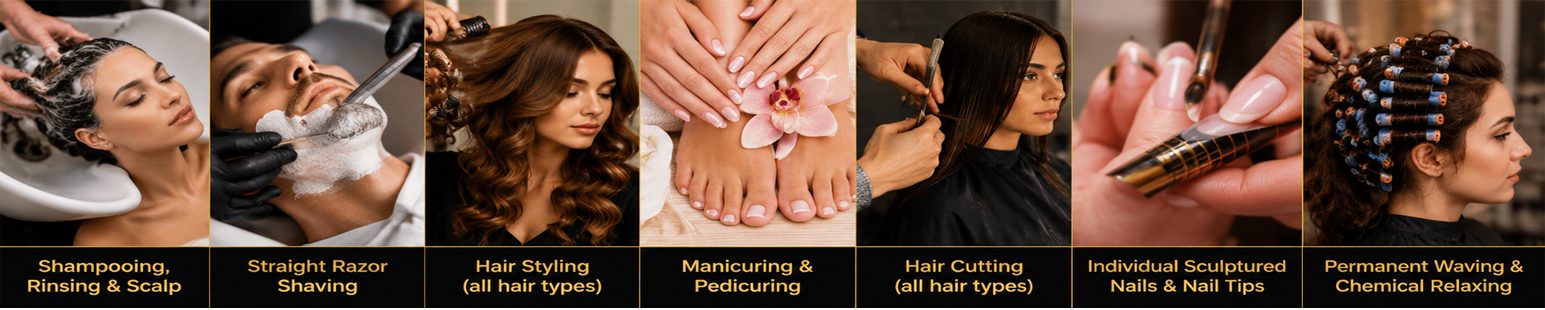
- Assesses scalp health — identifying dryness, flaking, inflammation, or lesions that may indicate dermatological conditions
- Evaluates skin and hair integrity before applying chemical treatments to avoid burns, breakage, or allergic reactions
- Sanitizes and disinfects tools and workstations according to state board standards — a regulated infection control practice
- Recognizes contraindications — situations where a chemical service should be declined and a client referred to a physician
- Maintains client records and tracks sensitivities and treatment history over time
None of that is informal. All of it is regulated by the Virginia Department of Professional and Occupational Regulation (DPOR) and the Virginia Board of Barbering and Cosmetology.
Cosmetology vs. Healthcare Careers: The Real Comparison
When people search “cosmetology vs healthcare careers,” they’re usually asking: Is cosmetology serious enough to be a real career? The answer is yes — with important distinctions.
Cosmetology doesn’t involve medical diagnosis or prescription authority. But neither does physical therapy assistant work, dental hygiene, or medical aesthetics — and all of those are considered allied health professions without debate. The licensed cosmetologist’s role in observing, referring, and serving client wellness fits squarely within the wellness-and-allied-health spectrum.
The mental health dimension matters too. Research consistently links personal grooming services to improved self-esteem, reduced anxiety, and social wellbeing — especially for older adults, cancer patients, and individuals with disabilities. Many cosmetologists actively serve these populations in hospital and hospice settings. That’s healthcare work.
—
What Virginia Requires to Practice Cosmetology
Virginia treats cosmetology as a licensed profession — meaning you cannot legally work in a salon, spa, or clinic without meeting the state’s credentialing requirements.
Here’s exactly what Virginia mandates before you can sit for your license.
The 1,500-Hour Training Requirement
The Virginia Board of Barbering and Cosmetology requires 1,500 clock hours of cosmetology training at a state-approved school. This isn’t a suggestion — it’s a legal prerequisite. Those hours must cover theory and hands-on clinical practice across core disciplines including:
- Hair cutting, coloring, and chemical services
- Scalp and skin analysis
- Nail care (basic)
- Sanitation, infection control, and safety protocols
- Salon management and professional standards
This training structure is why a COE-accredited school like AVI Career Training in Vienna, Virginia matters. Accreditation ensures the curriculum meets both state board and federal quality standards — which also determines whether you’re eligible for financial aid.
The State Board Exams
After completing your 1,500 hours, you must pass two separate exams administered through PSI Exams on behalf of the Virginia Board:
- Written (Theory) Exam — tests your knowledge of safety, sanitation, chemistry, skin and hair science, and Virginia regulations
- Practical (Clinical) Exam — tests your hands-on skills on a live model in a timed, scored format
Both exams must be passed before Virginia will issue your license. Schools that prepare students well for both components — not just the technical skills — give graduates a real advantage on exam day.
License Renewal and Continuing Education
Your Virginia cosmetology license must be renewed every two years. This is a professional maintenance requirement, not a formality. The renewal framework reinforces that cosmetology is an evolving, regulated discipline — not a static skillset.
The minimum age to apply for a Virginia cosmetology license is 16 years old, making it one of the most accessible credentialed careers for young people and adult career changers alike.
by Virginia State Board
(Written + Practical)
Requirement
Apply in Virginia
—
Career Paths for Licensed Cosmetologists in the DMV
A cosmetology license in Northern Virginia opens far more doors than most people expect — and the DMV’s economic profile makes many of those doors especially lucrative.

Traditional Salon and Spa Work
This is where most graduates start — and for good reason. The Northern Virginia and DC market is saturated with high-end salons, luxury day spas, and boutique studios that pay well and build strong books of business quickly. The Tysons Corner corridor alone is home to dozens of premium salon brands competing for skilled talent.
Medical Spas and Dermatology Clinic Support
This is the fastest-growing segment of wellness careers in the DMV. Medical spas combine physician oversight with licensed beauty professionals to offer services like laser hair removal support, chemical peel prep, and post-procedure skin care. Cosmetologists with strong skin and scalp training are valuable members of these teams.
Working in a med-spa environment also positions you for advancement into Cosmetic Laser Technician or Basic Esthetics credentialing — programs AVI also offers.
Film, Television, and Government Media Work
Washington, DC is a media market unlike almost any other. Federal agencies, news networks, political campaigns, documentary productions, and C-SPAN all require professional hair and makeup talent. Licensed cosmetologists with an eye for camera-ready styling find consistent freelance and contract work in this niche — often at premium rates.
Education and Instruction
Once you have experience and hours under your belt, teaching is a natural next step. Virginia cosmetology schools are required to employ licensed instructors. If you enjoy mentoring and have a passion for the craft, an instructor path offers stability, respect, and a community-building role.
Entrepreneurship and Salon Ownership
Many cosmetologists in the DMV work as booth renters — essentially running their own small businesses inside an established salon space. Others eventually open full studios. The DMV’s density of affluent neighborhoods (McLean, Great Falls, Arlington, Bethesda) creates strong demand for boutique, personalized salon experiences.
> Mini-Story: Latoya entered AVI’s Cosmetology program after eight years as a medical office administrator in Fairfax County. She understood healthcare systems, client communication, and compliance — and she wanted a career where those skills met something creative. Within six months of graduating and passing her Virginia State Board exams, she was working in a medical spa in Tysons Corner, managing pre-treatment consultations and building a client roster that included several patients referred directly from the on-site physician. Her administrative background made her an asset. Her cosmetology license made her legal.
—
What Cosmetologists Earn in Northern Virginia
Cosmetology salary in Northern Virginia trends above the national median — and your earning ceiling depends heavily on how you structure your career.
Note: All figures below should be verified against current BLS data at time of publication.
National and Regional Baseline
According to the U.S. Bureau of Labor Statistics Occupational Outlook Handbook, the national median annual wage for hairdressers, hairstylists, and cosmetologists is published at BLS.gov — writers should pull the current figure at time of drafting.
What’s consistent across reporting periods: the Washington-Arlington-Alexandria MSA wages for cosmetologists track above the national median. The region’s cost of living, the density of high-income households, and the competitive market for premium salon services all push wages upward. Verify current metro-specific data using BLS Metro Area wage tables.
Earning Variables That Matter
Your income as a cosmetologist isn’t fixed — it’s shaped by your business model:
- Commission-based employees earn a percentage of services performed, plus tips. This is common for new graduates building a client base.
- Booth renters pay the salon a flat weekly or monthly fee and keep all service income. Higher risk, higher ceiling — and many experienced cosmetologists in Northern Virginia earn significantly above median through this model.
- Salon owners set their own rates and build equity in their businesses. This requires business acumen alongside technical skill, but the income potential is uncapped.
- Specialization premiums apply for cosmetologists trained in extensions, color correction, keratin treatments, or natural hair — all high-demand services in the DMV’s diverse client market.
Tips Are Real Income
In the Northern Virginia and DC market, gratuity is a standard and significant income layer for client-facing beauty professionals. A full-time cosmetologist with a loyal book of clients in an affluent area often receives tips that meaningfully increase their annual take-home above the stated wage rate.
> Mini-Story: Marcus separated from the U.S. Army after six years at Fort Belvoir and used the GI Bill® to enroll in AVI Career Training’s Cosmetology program in Vienna, Virginia. He had zero prior beauty industry experience — but he had discipline, client-service instincts from his military role, and a genuine interest in the craft. He passed both Virginia State Board exams on his first attempt and started as a commission stylist at a salon in Reston. Within 18 months, he transitioned to booth rental and began building a clientele that reflected the DMV’s diversity — including clients from the Ethiopian, Korean, and Latino communities in the Fairfax area. He now earns well above what he made in uniform, with full schedule control.
—
How to Start Your Cosmetology Career in Northern Virginia
The path from where you are now to a Virginia cosmetology license is straightforward — it starts with choosing the right school.
Why School Accreditation Is Not Optional
Not all beauty schools are equal — and the difference isn’t just curriculum quality. COE accreditation (Council on Occupational Education) and SCHEV certification (State Council of Higher Education for Virginia) determine whether your school is recognized by:
- The U.S. Department of Education for federal financial aid (FAFSA, Pell Grants)
- The VA for GI Bill® benefits
- Employers who use accreditation as a credibility signal
- The Virginia State Board, which only accepts training hours from approved institutions
If you train at an unaccredited school, your hours may not count. Your financial aid may not apply. And your credential may carry less weight with employers. This is why accreditation is a non-negotiable factor when choosing where to train.
What to Look for in a Cosmetology Program
Beyond accreditation, evaluate programs based on:
- Curriculum alignment with Virginia State Board requirements — does the program explicitly prepare you for both the written and practical exams?
- Inclusive training standards — are you being trained to work on all hair textures and skin tones? In the DMV’s diverse market, this is a career asset, not a bonus.
- Hands-on clinic hours — how much of your 1,500 hours is actual client work vs. observation?
- Instructor credentials — are instructors actively licensed professionals with real industry experience?
- Financial aid support — does the school have a financial aid office to help you navigate FAFSA, scholarships, and military benefits?
AVI Career Training’s Cosmetology Program
AVI Career Training in Vienna, Virginia — serving the Tysons Corner area and the broader Northern Virginia/DMV market — offers a full Cosmetology program structured around Virginia’s 1,000-hour requirement.
AVI is COE-accredited (Council on Occupational Education) and SCHEV-certified, meaning students are eligible for federal financial aid and the GI Bill® is accepted. The program is taught by licensed industry professionals, and AVI’s curriculum is explicitly built around inclusive beauty training — preparing graduates to serve every skin tone and hair texture in one of the most diverse metro areas in the country.
AVI offers programs in Cosmetology, Basic Esthetics, Master Esthetics, Nail Technician, Massage Therapy, Cosmetic Laser Technician, Electrolysis, and an ESL Program — making it one of the most comprehensive beauty and wellness schools in Northern Virginia.
For tuition information, financial aid options, or to ask about scheduling, call (703) 943-9841 or visit the campus at 1595 Spring Hill Rd #720, Vienna, VA 22182.
—
Frequently Asked Questions
Q: Is cosmetology considered a healthcare career?
A: Cosmetology is a licensed, regulated profession that operates within the wellness and allied health space. While cosmetologists do not diagnose or prescribe, they are trained to assess scalp and skin health, follow infection control protocols, recognize contraindications, and refer clients to medical professionals when appropriate. The U.S. wellness industry — which includes cosmetology — is valued at over $1.8 trillion, and many cosmetologists work in medical spas, hospital settings, and dermatology-adjacent environments. Most licensing bodies and workforce development organizations categorize cosmetology within the broader healthcare and wellness sector.
—
Q: How long does it take to become a licensed cosmetologist in Virginia?
A: Virginia requires 1,500 clock hours of training at a state-approved school, followed by written and practical state board exams administered through PSI Exams. The total time from enrollment to licensure depends on your program schedule — full-time students can complete training faster than part-time students. After passing both exams, the Virginia Board of Barbering and Cosmetology issues your license.
—
Q: What can you do with a cosmetology license besides work in a salon?
A: A Virginia cosmetology license qualifies you to work in medical spas, dermatology clinic support roles, film and television production, theatrical makeup, luxury hotel spas, cruise lines, and hospital or hospice grooming programs. You can also teach at an accredited cosmetology school, work as a platform artist for beauty brands, or launch your own booth rental or salon ownership business.
—
Q: How much do cosmetologists make in Northern Virginia?
A: Cosmetology salaries in the Washington-Arlington-Alexandria metro area trend above the national median due to regional cost of living and the area’s high-income client base. Exact figures vary based on employment model (commission, booth rental, or ownership), specialization, and experience. Verify the most current wage data at BLS.gov using the Washington MSA occupational wage tables. Tips represent a significant additional income layer for client-facing cosmetologists in the DMV market.
—
Q: Does Virginia require a cosmetology license to work in a salon?
A: Yes. Virginia law requires a current, active cosmetology license issued by the Virginia Board of Barbering and Cosmetology before you can legally perform cosmetology services in a salon or spa. Working without a license is a violation of state law and can result in fines for both the individual and the employer. Your license must be renewed every two years.
—
Q: Does AVI Career Training accept the GI Bill® for cosmetology?
A: Yes. AVI Career Training is a COE-accredited, SCHEV-certified institution, and the GI Bill® is accepted for eligible programs including Cosmetology. Veterans and active-duty military spouses interested in using VA education benefits should contact AVI’s admissions team at (703) 943-9841 or apply online to discuss benefit eligibility and program scheduling.
—
Q: Is financial aid available for cosmetology school in Virginia?
A: Yes. Because AVI Career Training holds COE accreditation and SCHEV certification, students may be eligible for federal financial aid through FAFSA, including Pell Grants. AVI’s admissions team can walk you through the financial aid process and help identify scholarship opportunities. GI Bill® benefits are also accepted.
—
Q: What is the minimum age to enroll in cosmetology school in Virginia?
A: Virginia allows applicants as young as 16 years old to apply for a cosmetology license, making it one of the most accessible licensed career pathways for high school students and young adults exploring their options early.
—
Ready to Start Your Cosmetology Career in Northern Virginia?
AVI Career Training in Vienna, VA offers a COE-accredited, SCHEV-certified Cosmetology program built around Virginia’s 1,000-hour licensing requirement. Federal financial aid and GI Bill® benefits are accepted. Call (703) 943-9841 or apply online to take the first step.