Cosmetology as a Healthcare Career in the DMV
Cosmetology is a legitimate healthcare-adjacent career — one where licensed professionals observe early signs of scalp disorders, skin cancer, alopecia, and other health conditions before a doctor ever does. If you’re weighing your options in the DMV and wondering whether cosmetology belongs in the same conversation as nursing or allied health, the answer is yes — and the evidence is substantial.
The beauty chair is often the first place a health concern gets noticed. Cosmetologists spend more consistent, hands-on time with clients’ scalp, skin, and hair than most primary care providers do. That’s not a marketing claim. It’s a public health reality that researchers, the CDC, and state health departments have all documented.
If you’re in Northern Virginia, the DC metro area, or anywhere in the DMV, AVI Career Training prepares you for exactly this kind of career — one that is health-informed, inclusive, and built for a diverse, high-demand market. Apply now to take the first step.
—
Key Takeaways
- Virginia requires 1,500 clock hours of cosmetology training before you can sit for the state board exam.
- The U.S. Bureau of Labor Statistics reports a median annual wage of approximately $33,400 nationally for cosmetologists — DMV wages trend higher due to regional cost of living and market demand.
- Licensed cosmetologists are trained in sanitation and infection control protocols that directly mirror public health standards.
- Public health researchers and the CDC have documented cosmetologists as frontline health-awareness professionals in underserved communities.
- AVI Career Training in Vienna, VA is COE Accredited and SCHEV Certified, with financial aid and GI Bill® acceptance available.
—
Why Cosmetology Belongs in the Healthcare Conversation
Cosmetology belongs in the healthcare conversation because licensed cosmetologists are trained, first-contact professionals who observe skin and scalp conditions that often go unnoticed until they become serious. This isn’t a stretch — it’s a role the public health community has been documenting for years.
Think about how often the average person sees their doctor versus how often they visit a salon or barbershop. For millions of Americans, the beauty professional they see every four to six weeks is far more likely to notice something unusual on their scalp, neck, or skin than a physician who sees them once a year. That’s not a gap in the healthcare system — it’s an opportunity. And trained cosmetologists fill it every single day.
Cosmetologists as Public Health Touchpoints
Research published in public health literature has framed beauty professionals as critical “community health advocates” — particularly in communities with limited access to traditional healthcare. The framework known as “Beauty as a Public Health Tool” positions salons and barbershops as trusted gathering spaces where health messaging and early observation can reach people who might never otherwise engage with formal health systems.
The CDC and various state health departments have actively partnered with beauty professionals to distribute health education and conduct outreach campaigns — particularly around heart disease, diabetes, HIV awareness, and domestic violence prevention. Virginia’s own health initiatives have included beauty professionals as community partners.
Cosmetologists are specifically trained to recognize:
Infection Control as a Public Health Skill
Virginia’s cosmetology licensing requirements mandate rigorous infection control and sanitation training. This isn’t incidental — it directly parallels the sanitation standards used in clinical and medical environments. Every licensed cosmetologist in Virginia learns to prevent cross-contamination, properly sterilize implements, and maintain a hygienic client service environment. These are not soft skills. They are public health competencies.
—
What a Licensed Cosmetologist Actually Does — Beyond the Chair
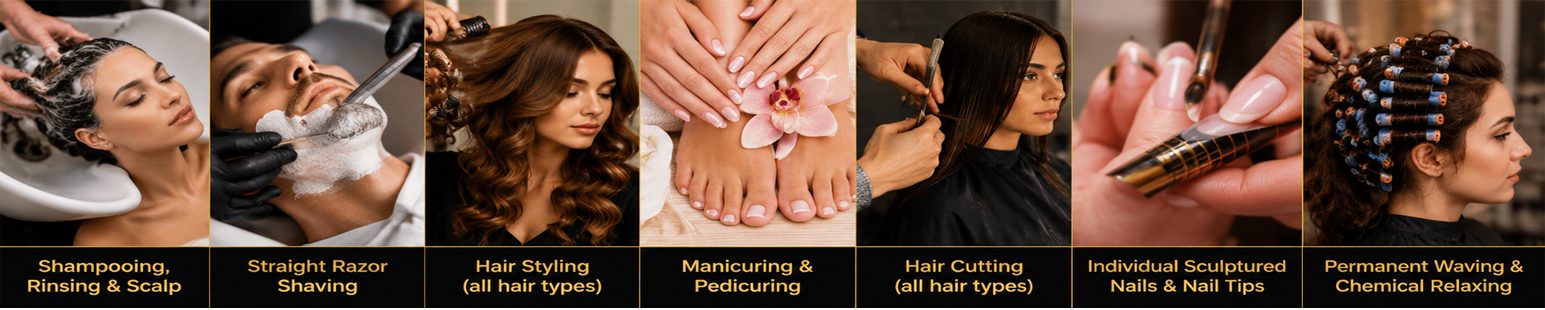
A licensed cosmetologist does far more than cut and color hair — the full professional scope includes scalp analysis, chemical services, client health consultations, and sanitation compliance that together form a health-adjacent skill set.
Most people picture a cosmetologist as someone who styles hair. That image undersells the profession dramatically. A fully licensed cosmetologist is trained across a wide range of technical and interpersonal competencies that put them squarely in health-adjacent professional territory.
Core Professional Competencies
Scalp Analysis and Trichology Basics
Trichology is the scientific study of hair and scalp health. While a full trichologist requires additional post-licensure training, cosmetology programs cover foundational trichology — understanding hair growth cycles, scalp conditions, and the factors (hormonal, nutritional, chemical) that affect hair health. This knowledge informs every service a cosmetologist performs.
Chemical Services
Relaxers, perms, color, and keratin treatments involve chemistry that interacts directly with the client’s hair and scalp biology. A cosmetologist must understand contraindications — situations where a chemical service could cause harm — and conduct thorough client consultations before every chemical application. This is clinical thinking applied in a beauty context.
Client Consultation and Health History
Before performing services, cosmetologists gather client health histories. Medications, allergies, recent illnesses, hormonal changes, and scalp conditions all affect how a service should be approached. This intake process is structurally similar to what allied health professionals do — gathering information to inform a personalized plan.
Sanitation, Sterilization, and Infection Control
Virginia licensure requires demonstrated competency in sanitation protocols. Cosmetologists know the difference between sanitizing, disinfecting, and sterilizing — and when each is appropriate. They maintain compliant workstations and handle implements in ways that protect both client and professional health.
Styling, Texture Services, and Protective Styling
Beyond health-adjacent skills, cosmetologists are trained in a full range of technical services — precision cuts, thermal styling, braiding, locs, extensions, and protective styles — that require an understanding of hair structure and client needs across all hair types and textures.
—
Meet Jasmine. She came to AVI Career Training after years working as a medical receptionist. She was already comfortable in healthcare-adjacent environments but wanted a career that felt creative and hands-on. During her Cosmetology program, she was surprised by how much overlap she found with her previous work — client intake processes, sanitation standards, referral awareness for skin and scalp conditions. She graduated, passed the Virginia State Board exam, and now works at a medical spa in Tysons Corner, where her background in both healthcare administration and cosmetology makes her uniquely valuable to the clinical team.
—
Career Pathways and Earning Potential in Northern Virginia and the DC Metro

A cosmetology career in Northern Virginia offers above-median earning potential and access to one of the most economically robust beauty markets in the country. The DMV is not an average market. With its dense population of government employees, military personnel, tech workers, and international residents, the Fairfax County/Tysons/DC corridor supports high-end service pricing, strong tip income, and consistent demand for diverse hair and beauty services.
According to the U.S. Bureau of Labor Statistics, the median annual wage for hairdressers, hairstylists, and cosmetologists is approximately $33,400 nationally. DMV-area wages trend meaningfully higher due to the region’s cost of living, purchasing power, and concentration of premium salons and spas. Readers should verify current figures at BLS.gov, as wage data is updated annually.
Where Cosmetologists Work in the DMV
The beauty wellness career landscape in the DMV area includes far more than traditional salon work. Licensed cosmetologists in Northern Virginia pursue careers across:
Medical & Clinical Settings
Medical spas, oncology esthetics clinics, burn rehabilitation centers, and dermatology offices all employ licensed cosmetologists for specialized client care.
Salon Ownership
Northern Virginia’s entrepreneurial ecosystem and affluent client base make salon ownership a realistic and rewarding long-term pathway for licensed cosmetologists.
Film, TV & Editorial
DC’s growing film and production industry — plus proximity to major media outlets — creates demand for licensed cosmetologists in editorial, commercial, and broadcast contexts.
Military & Government
The DMV’s large military community — including installations in Northern Virginia — creates consistent demand for skilled beauty professionals, especially those fluent in diverse hair textures.
Oncology Esthetics: A Growing Healthcare-Adjacent Niche
One of the fastest-growing intersections of cosmetology and healthcare is oncology esthetics — providing specialized beauty and wellness services to cancer patients undergoing treatment. Chemotherapy and radiation cause significant changes to hair, skin, and nails. A cosmetologist with additional oncology esthetics training can work directly with cancer care teams to provide services that support patient dignity, mental health, and quality of life. This is healthcare-adjacent cosmetology at its most direct.
The Diversity Advantage in the DMV Market
Northern Virginia is one of the most ethnically diverse regions in the United States. The Fairfax County area is home to significant communities from across Latin America, South Asia, East Africa, East Asia, and the Middle East — each with distinct hair textures, scalp care needs, and beauty traditions. Cosmetologists trained to work across all hair types and skin tones have a genuine competitive advantage in this market. This is exactly what AVI Career Training’s curriculum is built to deliver.
—
Virginia Licensing Requirements and What Cosmetology School Looks Like
To become a licensed cosmetologist in Virginia, you must complete 1,000 clock hours of accredited cosmetology training and pass a two-part state board exam. Here’s what that path actually looks like — and why it matters that you choose the right school.
The Virginia Licensing Framework
Cosmetology licensing in Virginia is governed by the Virginia Board for Barbers and Cosmetology under the Virginia Department of Professional and Occupational Regulation (DPOR). You can review current licensing requirements directly at the DPOR website.
The key requirements are:
What Those 1,500 Hours Cover
The 1,500-hour requirement is not arbitrary. It reflects the genuine breadth of knowledge a practicing cosmetologist needs — from hair science and chemical safety to business operations and client communication. Programs accredited by the Council on Occupational Education (COE) meet rigorous educational standards that ensure those hours deliver real, career-ready training — not just seat time.
Accreditation: Why It Matters
Not all cosmetology programs are equal. COE Accreditation signals that a school has met independently verified standards for curriculum quality, instructor qualifications, student services, and outcomes. SCHEV Certification (from the State Council of Higher Education for Virginia) is the state-level approval required for schools operating in Virginia.
Both credentials matter when you’re applying for federal financial aid, VA education benefits, or transferring credit. Choosing an accredited, certified school is a foundational decision — one that protects your investment and your future licensure.
—
Meet Marcus. He spent six years as an Army medic, deployed twice, and came back to Northern Virginia looking for a civilian career that kept him working with people. A friend mentioned that AVI accepts the GI Bill®. He was skeptical at first — beauty school wasn’t on his radar. But when he learned about the infection control curriculum, the client health consultation process, and the growing field of oncology esthetics, something clicked. His medical training and his new cosmetology license made him a natural fit for a medical spa in Falls Church that specifically sought out professionals with clinical backgrounds. He enrolled, completed his 1,500 hours, passed the Virginia State Board exam, and never looked back.
—
How AVI Career Training Prepares You for a Healthcare-Adjacent Cosmetology Career
AVI Career Training’s Cosmetology program in Vienna, Virginia is specifically designed to produce health-informed, inclusive beauty professionals ready for the full range of DMV career opportunities. This is not a generic beauty school curriculum — it’s a program built for a diverse, high-expectation market.
What Makes AVI Different
Inclusive Curriculum by Design
AVI’s curriculum is built around the full spectrum of human hair textures and skin tones. In the DMV’s multicultural market, this isn’t optional — it’s essential. Graduates leave AVI confident working with clients of every background, whether they’re in a Tysons salon, a Capitol Hill spa, or a community-based beauty business in Prince George’s County.
Health-Informed Training
AVI’s program covers scalp analysis, trichology fundamentals, chemical contraindications, and client health consultation — giving graduates the awareness to identify when something they observe may require a medical referral. This is the foundation of the licensed cosmetologist healthcare role.
Sanitation and Safety Standards
Students practice and demonstrate infection control protocols throughout their training — not just as a licensing checkbox, but as a professional standard they carry into every career setting.
Experienced, Licensed Instructors
Every AVI instructor is a licensed industry professional — not just an educator. You learn from people who have worked in salons, spas, and clinical settings and bring that real-world context into the classroom and clinic floor.
Accreditation, Financial Aid, and the GI Bill®
AVI Career Training is COE Accredited and SCHEV Certified — the dual credentialing that positions you for federal financial aid eligibility and Virginia state approval. AVI accepts the GI Bill® (including the Post-9/11 GI Bill), making this career path accessible to veterans and military-connected students across the DMV.
Financial aid is available for qualified students. Whether you’re coming from a different career, returning to school after a break, or transitioning from military service, AVI’s admissions team can walk you through your options.
Vienna, VA: The Right Location for a DMV Career Launch
AVI Career Training is located at 1595 Spring Hill Rd #720, Vienna, VA 22182 — in the heart of Fairfax County, minutes from Tysons Corner, and accessible to students from across the DC metro area. The school’s location puts graduates within reach of Northern Virginia’s premium salon and spa market, medical spa employers, and DC’s editorial and production industry.
Ready to Start?
If you’re weighing cosmetology as a healthcare-adjacent career in Northern Virginia, AVI Career Training is the next logical step. COE Accredited. SCHEV Certified. GI Bill® accepted. Financial aid available.
—
Frequently Asked Questions
Q: Is cosmetology considered a healthcare career?
A: Cosmetology is widely recognized as a healthcare-adjacent career. Licensed cosmetologists are trained to observe scalp disorders, skin conditions, signs of alopecia, and physical indicators of health concerns — and are often among the first professionals to notice them. Public health researchers and the CDC have formally documented the role of beauty professionals as community health touchpoints.
Q: What is the connection between cosmetology and public health?
A: The connection between cosmetology and public health is well-documented. Salons and barbershops serve as trusted community spaces — particularly in underserved communities with limited healthcare access. State and federal health agencies have partnered with cosmetologists on outreach campaigns covering heart disease, HIV awareness, diabetes, and domestic violence prevention. Cosmetology licensing also mandates sanitation and infection control training that mirrors clinical health standards.
Q: Can a cosmetologist work in a medical or clinical setting?
A: Yes. Licensed cosmetologists work in medical spas, oncology esthetics clinics, burn rehabilitation centers, and dermatology offices. With additional post-licensure training in areas like oncology esthetics, cosmetologists can work directly alongside clinical healthcare teams to provide services for cancer patients and medically complex clients.
Q: How long does it take to become a licensed cosmetologist in Virginia?
A: Virginia requires 1,000 clock hours of cosmetology training at an approved school, followed by passing a two-part state board exam (written and practical). The timeline to complete 1,500 hours varies by program schedule — full-time students typically complete their hours faster than part-time students. Contact AVI Career Training at (703) 943-9841 for current program timelines.
Q: What do cosmetologists do beyond hair and beauty services?
A: Beyond styling services, licensed cosmetologists conduct scalp analysis, client health consultations, chemical service assessments, and infection control compliance — a skill set that extends well into health-adjacent professional practice.