CNA Careers in Virginia: Why 2026 Is the Year to Start
CNA careers in Virginia are growing fast — and 2026 is shaping up to be one of the strongest years on record for anyone ready to enter hands-on healthcare or wellness work in the Northern Virginia and DC metro area.
Virginia’s aging population, expanding long-term care facilities, and persistent staffing shortages across Fairfax County, Arlington, and Alexandria have made nurse aides one of the most in-demand workers in the state. If you’ve been researching whether this path is worth your time, the short answer is: the demand is real, the entry barrier is low, and the careers in this space — including healthcare-adjacent options like Massage Therapy and medical esthetics — launch faster than almost any other field.
This guide covers everything you need to know about CNA careers in Virginia for 2025–2026: what the job pays, what the state requires, and how the broader landscape of fast-credential, people-focused careers fits into your goals — including programs offered right here in Vienna, Virginia at AVI Career Training.
—
- Virginia requires a minimum of 120 hours of state-approved CNA training, including at least 40 clinical hours
- The national median wage for nursing assistants is $38,130/year (BLS, 2023); the Northern Virginia/DC metro market typically runs 10–20% above that
- BLS projects 4–5% growth in nursing assistant jobs nationally through 2032 — driven largely by the aging Baby Boomer population
- Healthcare-adjacent careers like Massage Therapy and medical esthetics share CNA’s core appeal: fast to credential, hands-on, and high-demand in Northern Virginia
- AVI Career Training in Vienna, VA offers COE-accredited wellness career programs that can be completed in as few as 8 weeks for some tracks
—
Why Nurse Aide Is One of Virginia’s Fastest-Growing Jobs Right Now
Virginia’s demand for Certified Nurse Aides isn’t a trend — it’s a structural shift in the healthcare labor market that’s been building for over a decade.
The U.S. Bureau of Labor Statistics (BLS) projects nursing assistant employment to grow 4–5% through 2032 — faster than many traditional white-collar roles. At the national level, that translates to tens of thousands of new job openings every year. In Virginia, the numbers are sharper and more immediate.
The Aging Population Is the Core Driver
The oldest Baby Boomers turned 80 in 2026. That generation — 76 million strong — is now squarely in the age range where long-term care, assisted living, and home health services become essential. Fairfax County alone is home to one of the largest 65+ populations in the Mid-Atlantic region, and the demand for hands-on caregivers in that corridor is not slowing down.
Nursing homes, memory care facilities, rehabilitation centers, and home health agencies across Northern Virginia are all competing for the same pool of credentialed aides. That competition benefits job-seekers: it means faster hiring, signing bonuses at some facilities, and steady wage pressure upward.
The DC Metro Effect
Northern Virginia and the greater DMV area have a compounding advantage: a high cost of living that pushes wages above national averages, combined with a dense concentration of healthcare systems — Inova Health System, Virginia Hospital Center, Sentara Northern Virginia Medical Center, and dozens of smaller specialty and long-term care facilities. For CNAs, that means more options, more competition among employers, and better pay than you’d see in most other parts of the state.
—
What a CNA Actually Does — and Why It Matters
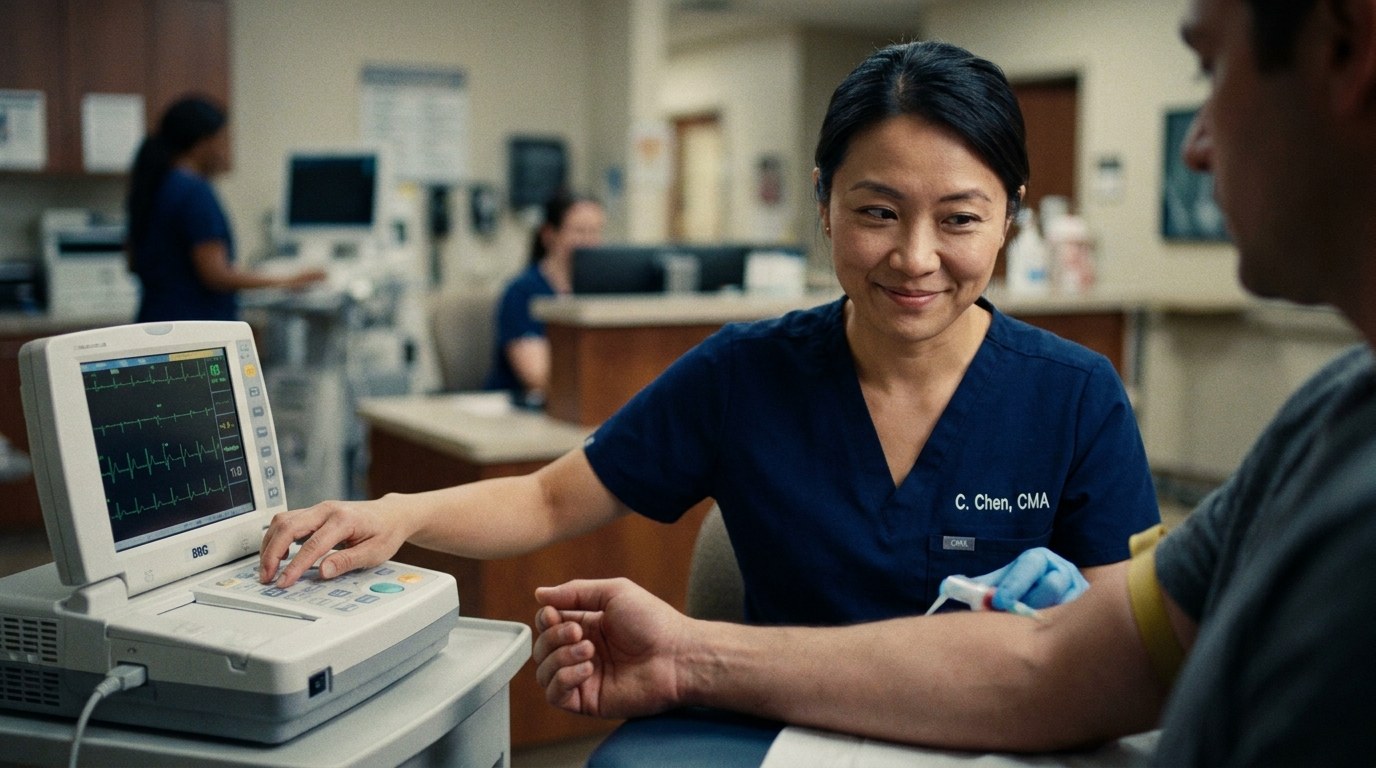
A Certified Nurse Aide is the direct-care backbone of any long-term care or inpatient healthcare setting. CNAs work with patients day-to-day in ways that nurses and doctors simply don’t have time to — and that hands-on human connection is exactly what draws many people to the role.
Core Responsibilities
On any given shift, a CNA might:
The work is physical and emotionally demanding — and deeply meaningful. CNAs often describe their role as the part of healthcare that feels most human. For people who are drawn to care work but not ready (or interested) in a four-year nursing degree, it’s one of the most direct paths into that world.
CNAs work in nursing homes and skilled nursing facilities (the most common setting), hospitals, rehabilitation centers, assisted living communities, and private home health agencies. The variety of settings means flexibility — and the ability to find a schedule and environment that fits your life.
—
Virginia CNA Certification Requirements: What You Need to Know
Becoming a Certified Nurse Aide in Virginia is a state-regulated, structured process — and that’s actually a good thing. The credential carries real professional legitimacy and is recognized across most states, which gives you job portability if you ever relocate.
The Basic Requirements
To become a CNA in Virginia, you must:
1. Complete a state-approved training program — Virginia requires a minimum of 120 hours of training, including at least 40 clinical hours in a real care setting (not just a classroom)
2. Pass the NNAAP exam — the National Nurse Aide Assessment Program exam includes both a written (or oral) component and a hands-on skills demonstration
3. Be listed on the Virginia Nurse Aide Registry — maintained by the Virginia Department of Professional and Occupational Regulation (DPOR), this registry confirms your active status to employers
How Long Does It Take?
Most Virginia CNA training programs run between four and eight weeks for full-time students. Part-time schedules are available through some providers and can extend the timeline to two to three months. From program completion to NNAAP exam scheduling, many candidates are fully certified and job-ready within 60–90 days of starting.
That speed-to-employment is one of CNA’s biggest advantages over longer academic pathways. You can be working — and earning — within a few months of making the decision to start.
Is the Credential Portable?
Yes. Virginia’s CNA certification, once listed on the state registry, can often be transferred to other states through a reciprocity process — meaning if you eventually move out of the DMV area, your credential travels with you. This is a meaningful long-term benefit that’s easy to overlook when you’re just getting started.
—
CNA Salary and Job Outlook in Northern Virginia (2025–2026)
The pay for CNAs in Northern Virginia is meaningfully higher than national benchmarks — and the job market is one of the most active in the state.
What That Looks Like in Real Numbers
Taking the national median of $38,130 and applying a 15% Northern Virginia premium puts the estimated range for an entry-level CNA in Fairfax County, Arlington, or Alexandria at roughly $43,000–$46,000 per year — and experienced CNAs with specialized skills (dementia care, for example) or those working in higher-acuity hospital settings often earn more.
Hourly wages in this region typically range from $18 to $24 for entry-level positions, with some hospital systems and home health agencies offering sign-on bonuses in a competitive hiring environment.
Time to Employment
One data point that matters as much as the salary: entry-level CNAs in Northern Virginia can typically find employment within weeks of receiving certification. The shortage is real enough that many facilities will hire a newly certified CNA before they’ve completed their first full month of job searching. That’s not true of every field — and it’s one reason CNA careers in Virginia 2026 show up in so many “fastest-growing careers” discussions.
—
Consider someone like Maya — a 34-year-old Northern Virginia resident who spent her twenties in retail management. She was good at her job, but the work left her feeling disconnected from people in any meaningful way. When her mother needed short-term skilled nursing care after a surgery, Maya watched the CNAs on the floor and thought: That’s what I want to do.
She enrolled in a state-approved CNA training program in Fairfax County, completed her 120 hours over five weeks, passed the NNAAP exam on her first attempt, and was hired by a rehabilitation center in Alexandria two weeks later — at $21.50 per hour with a full benefits package. From “I want to do this” to first paycheck: under three months.
—
Healthcare-Adjacent Careers to Explore Alongside CNA Training
Here’s something worth knowing: if what draws you to CNA work is the combination of fast credentials, hands-on learning, meaningful client interaction, and a strong local job market — you’re describing an entire category of careers, not just one.
CNA is one path. But there are healthcare-adjacent wellness careers that share every one of those characteristics, offer more earning upside, allow for self-employment, and are available right here in the Northern Virginia area through COE-accredited career training programs.
Massage Therapy
Licensed massage therapists in Virginia work in spas, chiropractic offices, physical therapy clinics, medical offices, and private practices. The credential is fast — AVI Career Training’s Massage Therapy program in Vienna, VA is designed for career-changers who want structured, hands-on training without a multi-year commitment. Massage therapists with a strong client base in the Northern Virginia market can earn well above entry-level CNA wages — especially those who build a private practice in the Tysons Corner corridor, where disposable income is high and demand for wellness services is consistent.
Medical Esthetics and Basic Esthetics
Esthetics is one of the fastest-growing segments in the beauty and wellness industry — and in Northern Virginia, the medical esthetics lane (think: chemical peels, microneedling prep, advanced skincare in physician-supervised settings) is particularly strong. AVI’s Basic Esthetics program trains students for the Virginia State Board licensing exam with an inclusive, skin-tone-aware curriculum. For those who want to work adjacent to healthcare without working in a clinical patient-care environment, esthetics offers that exact middle ground.
Cosmetic Laser Technology
Cosmetic laser technicians perform laser hair removal, skin rejuvenation, and other light-based treatments in medical spas and dermatology offices. AVI’s Cosmetic Laser Technician program is one of the few programs of its kind in Northern Virginia — and it feeds directly into one of the highest-growth segments of the aesthetics market. This is a role that blends technical precision with client care: the same appeal as CNA work, but in a wellness-forward clinical setting.
Darius, 27, came to AVI’s admissions team after spending months researching CNA programs in Northern Virginia. He was drawn to the speed, the hands-on nature, and the clear job market — but something about patient care in a nursing environment wasn’t clicking for him. During an admissions conversation, he learned that AVI’s Basic Esthetics program hit every one of his criteria: a clear licensing pathway, hands-on training from day one, and a job market in the Tysons Corner and DC metro area that was actively hiring new estheticians.
Eighteen months after that conversation, Darius is working full-time at a medical spa in McLean, performing facials, chemical exfoliants, and pre-treatment prep for laser clients — earning more than the median entry-level CNA wage in Northern Virginia, with a schedule he sets himself two days a week.
—
Frequently Asked Questions: CNA Careers in Virginia 2026
Q: How long does it take to become a CNA in Virginia?
A: Most students complete a state-approved CNA training program in four to eight weeks of full-time study. Virginia requires a minimum of 120 hours of training — including at least 40 clinical hours. After training, you must pass the NNAAP exam (written and skills components) before being listed on the Virginia Nurse Aide Registry. Total time from enrollment to employment: typically 60 to 90 days.
Q: What is the average CNA salary in Virginia in 2026?
A: The national median annual wage for nursing assistants is $38,130 (BLS, 2023 data). In the Northern Virginia and DC metro market, CNAs typically earn 10–20% above that benchmark due to the higher cost of living and competitive labor market — putting realistic entry-level earnings in the $43,000–$46,000 per year range, or $18–$24 per hour.
Q: Is CNA a good career to start in Northern Virginia?
A: Yes — the Northern Virginia and DC metro area has one of the strongest CNA job markets in the Mid-Atlantic. Facilities in Fairfax County, Arlington, and Alexandria are actively hiring, and entry-level candidates can often find employment within weeks of certification. Wages in this market run above the national median, and the volume of healthcare employers gives you options in terms of setting, schedule, and specialty.
Q: What are the Virginia state requirements to become a certified nurse aide?
A: Virginia requires completion of a state-approved training program (minimum 120 hours, including 40 clinical hours), passing the NNAAP examination (written and hands-on skills sections), and placement on the Virginia Nurse Aide Registry, which is administered by the Virginia Department of Professional and Occupational Regulation (DPOR). A background check is also required.
Q: What is the job outlook for CNAs in Virginia over the next five years?
A: Strong. The BLS projects 4–5% growth nationally for nursing assistants through 2032, and Virginia’s healthcare labor market — particularly in Northern Virginia — is under persistent staffing pressure due to the aging Baby Boomer population. Demand is concentrated in long-term care, home health, and rehabilitation settings, and is unlikely to soften significantly in the next five years.
Q: What healthcare-adjacent careers can I train for in Northern Virginia without a four-year degree?
A: Several fast-credential careers share CNA’s core appeal — hands-on work, meaningful client relationships, and a strong local job market. These include Licensed Massage Therapist, esthetician (Basic or Master Esthetics track), Cosmetic Laser Technician, Nail Technician, and Electrolysis Practitioner. AVI Career Training in Vienna, Virginia offers COE-accredited programs in all of these areas, with financial aid available for qualifying programs and GI Bill® accepted.
Q: Can I become a massage therapist or esthetician instead of a CNA if I want to work in healthcare-adjacent settings?
A: Absolutely — and for many people, it’s a better fit. Licensed massage therapists work in chiropractic offices, physical therapy practices, and medical wellness clinics. Estheticians increasingly work in medical spa and dermatology settings. Both paths are faster to credential than a nursing degree, offer self-employment flexibility, and are in strong demand in the Northern Virginia market. AVI Career Training offers programs in both areas from its Vienna, VA campus.
—
Your Next Step: Hands-On, Fast-Credential Careers in Northern Virginia
CNA careers in Virginia 2026 are a genuinely smart option for the right person — the demand is real, the entry path is clear, and the Northern Virginia job market is one of the most active in the country for healthcare workers at every level.
And if what draws you to CNA work is the hands-on nature, the fast credentials, the meaningful human connection, and the strong local job market — those same elements are exactly what defines careers in massage therapy, esthetics, cosmetic laser technology, and nail technology in the Northern Virginia area.
AVI Career Training in Vienna, Virginia trains students for all of these paths — with COE-accredited programs, licensed industry instructors, an inclusive curriculum built around every skin tone and hair type, and a campus located right in the heart of the Tysons Corner and Northern Virginia wellness corridor. GI Bill® is accepted, and financial aid is available for qualifying programs.
If you’re ready to explore what a hands-on, healthcare-adjacent career could look like for you, we’d love to talk.