
Beauty school is a formal, accredited education system that teaches technical skills, safety protocols, chemical knowledge, and business acumen under licensed instructors. Self-taught learning, by contrast, relies on informal practice, online tutorials, and personal experimentation. The beauty school vs self-taught explained debate matters because your choice directly affects your ability to get licensed, find employment, and build a lasting career. The U.S. Bureau of Labor Statistics projects 84,200 annual job openings for beauty professionals through 2034. That level of demand rewards those who enter the field fully prepared.
What essential skills does beauty school actually teach?
Beauty school delivers a complete system, moving students from zero foundation to professional mastery through structured curriculum and real-time feedback. Self-study, by contrast, stalls at skill plateaus without guided correction. That gap shows up fast when a student faces a real client for the first time.
Core technical and safety training
Accredited cosmetology programs cover hair structure, scalp biology, chemical interactions, and sanitation standards. Students learn why bleach lifts color at different rates on different hair types, not just how to apply it. This foundational science knowledge is what separates a professional from someone who learned from YouTube. Curriculum sequencing in beauty schools ensures students understand these chemical principles before they ever touch a client.
Hands-on practice and supervised client work
Hands-on cosmetology training transforms passive observation into active skill development through practice, real-time feedback, and supervised client interactions. Students at Avi, for example, work with real clients in a supervised salon environment before graduation. That experience builds the muscle memory and professional confidence that tutorials cannot replicate.
Business and professional skills
Beauty school also teaches client consultation, appointment management, service pricing, and professional communication. Formal training emphasizes analyzing hair density, growth patterns, and face shapes in the first ten minutes of a client visit. These consultation skills directly reduce client dissatisfaction and repeat complaints.
Key skills covered in accredited beauty programs:
- Sanitation and infection control standards
- Chemical safety and product knowledge
- Ergonomics and injury prevention
- Client consultation and communication
- Business operations, pricing, and career planning
- State board exam preparation
Pro Tip: Ask any beauty school you consider whether students practice on real clients before graduation. Schools that offer supervised salon floors give you a significant head start over those that rely only on mannequins.
What are the real advantages and limits of going self-taught?
Self-taught learning offers genuine benefits for the right person. The flexibility to study at your own pace, the low upfront cost, and the ability to focus on one specific skill make it attractive for hobbyists and casual learners. Platforms like YouTube and Instagram provide access to techniques that were once locked inside professional classrooms.

The limits, however, are significant for anyone aiming at a professional career. Social media tutorials hide the hours of off-camera correction needed, creating a confirmation bias that reinforces bad habits. A self-taught learner may believe their technique is correct simply because the final result looks acceptable in a photo.
Where self-taught learners consistently fall short
- Ergonomics: Incorrect hand position and posture cause uneven work and chronic physical injury over time.
- Client consultation: Self-taught practitioners rarely develop the structured consultation process that prevents client dissatisfaction.
- Career infrastructure: Schools teach managing service quotes, professional client interactions, and team collaboration. Self-taught learners typically lack all three.
- Licensing: Most states require completion of an approved training program and a state board exam. Self-taught learners cannot legally offer paid services without meeting these requirements.
Self-study is adequate to start and build interest, but it lacks the system, mentorship, and practical experience needed to become a working professional. The transition from hobbyist to licensed professional requires formal education in nearly every U.S. state.
How do the two paths compare for career readiness?
Career readiness is where the gap between formal training and self-taught learning becomes impossible to ignore. Licensing requirements in most U.S. states mandate completion of an approved program and passing a state board exam. A self-taught learner, no matter how skilled, cannot legally work as a paid cosmetologist or esthetician without meeting those requirements.
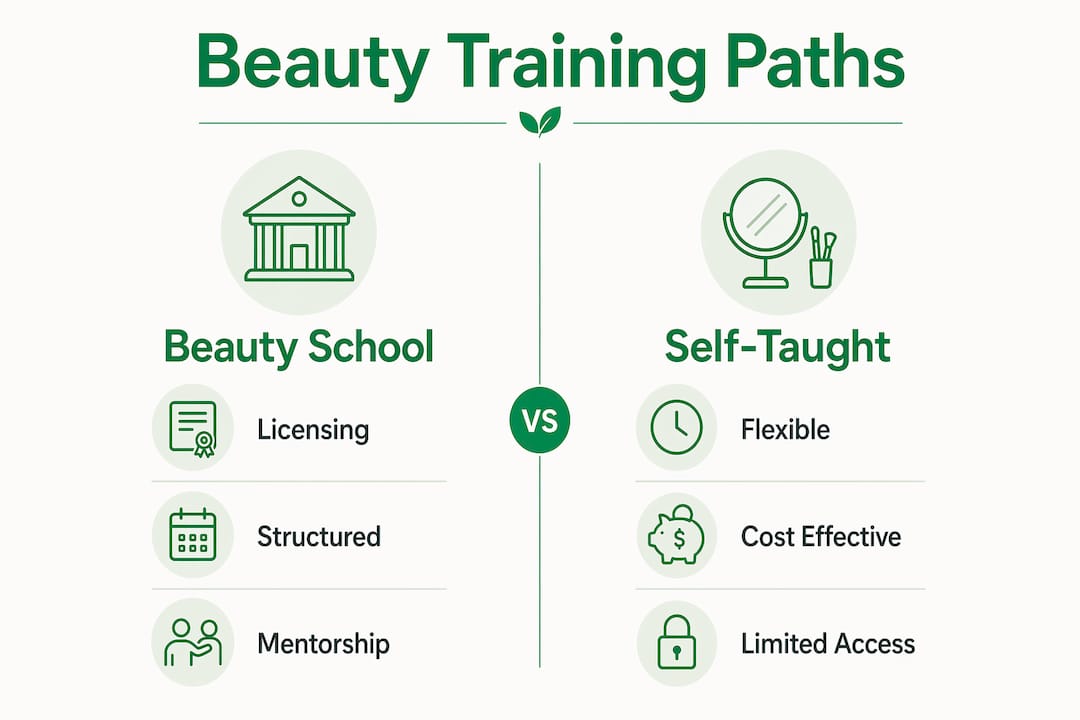
Employers also respond differently to each path. Salons and spas hiring for client-facing roles consistently favor candidates with accredited credentials. Beauty school graduates arrive with documented hours, state licensure, and demonstrated client experience. Self-taught candidates must overcome skepticism about their technical foundation and professional reliability.
Avi’s graduates benefit from partnerships with leading spas and salons in Northern Virginia, giving them direct access to externship placements and career development opportunities that self-taught learners must build entirely on their own.
| Career readiness factor | Beauty school graduate | Self-taught learner |
|---|---|---|
| State licensure eligibility | Yes, upon passing board exam | No, without formal program completion |
| Documented training hours | Yes, tracked and verified | No formal record |
| Client consultation skills | Taught and practiced | Often absent or inconsistent |
| Business and pricing knowledge | Covered in curriculum | Typically self-discovered |
| Employer credibility | High, accredited credential | Lower, requires extra proof |
| Networking and mentorship | Built into program | Must be self-initiated |
Pro Tip: Before enrolling anywhere, verify that the school’s program hours meet your state’s licensing requirements. Virginia, for example, requires 1,000 hours for cosmetology licensure. Choosing an accredited school like Avi means those hours count toward your state board application automatically.
Beauty school is increasingly recognized as a deliberate, career-focused investment in an automation-resistant field. That recognition matters when you are negotiating your first salon position or building a client base.
What do costs and time investments actually look like?
Cost is the most common reason people consider the self-taught route. The upfront savings are real. Cosmetology tuition averages around $26,000, while esthetics programs average $15,500. Both figures are significantly lower than a four-year university degree, which ranges from $39,000 to $153,000.
The time investment is also shorter than most people expect. Most cosmetology programs complete in about 11 months of full-time study. That means you can be licensed and earning within a year of starting.
The hidden costs of going self-taught
Self-taught learners save on tuition but absorb costs that are harder to see upfront:
- Legal exposure: Working without a license in most states carries fines and potential legal action.
- Injury costs: Improper ergonomics lead to repetitive strain injuries that require medical treatment and time off.
- Rework and reputation damage: Technique errors on paying clients create refund requests and negative reviews that are difficult to recover from.
- Lost income: Without licensure, you cannot legally charge for services, meaning the “free” learning period extends your time before earning.
Financial aid options change the cost equation for formal programs significantly. Avi offers financial aid options that make accredited training accessible to students who cannot pay tuition upfront. Scholarships, federal aid, and payment plans reduce the real out-of-pocket cost well below the sticker price.
The return on investment for a licensed cosmetologist or esthetician compounds over a career. A self-taught hobbyist who never obtains licensure earns nothing from their skills professionally. A licensed graduate earns from day one of employment.
Key Takeaways
Beauty school provides the licensing eligibility, technical foundation, and career infrastructure that self-taught learning cannot replicate for anyone pursuing a professional beauty career.
| Point | Details |
|---|---|
| Licensing requires formal training | Most U.S. states mandate an approved program and state board exam before you can work professionally. |
| Self-taught suits hobbyists, not careers | Self-study builds interest but lacks the system and mentorship needed for professional practice. |
| Beauty school costs less than a degree | Cosmetology programs average $26,000, far below a four-year university at $39,000 to $153,000. |
| Career readiness gap is significant | Graduates arrive with documented hours, licensure, and client experience that self-taught learners must prove separately. |
| Hidden costs make self-taught riskier | Legal exposure, injury, and lost income offset the tuition savings of skipping formal training. |
The uncomfortable truth about “learning as you go”
I have spoken with hundreds of people who started self-teaching beauty skills with genuine talent and real enthusiasm. Almost every one of them hit the same wall: the moment they tried to turn that talent into income, the licensing requirement stopped them cold. The skills were real. The credential was not.
What surprises most people is that beauty school is not about learning to do the work. It is about learning to do the work safely, consistently, and professionally on strangers who are paying you and trusting your judgment. That is a completely different skill set from practicing on friends.
The self-taught path makes sense if your goal is personal enjoyment or occasional help for people you know. If your goal is a career, the math does not work in your favor. The time you spend avoiding school is time you are not earning a licensed professional’s income.
I also want to push back on the idea that beauty school is a passive experience. The best programs, including what Avi offers in Northern Virginia, blend theory with hands-on practice, business mentorship, and an evolving curriculum that reflects what salons actually need right now. That is not a classroom. That is a career launch.
The hybrid approach, where someone self-teaches to build initial interest and then enrolls in a formal program, is genuinely smart. It means you arrive at school with curiosity and some context. But the formal program is still the non-negotiable step for anyone who wants to work professionally.
— krishna
Avi’s accredited programs put your career first
Choosing formal training is the clearest path to a licensed, sustainable beauty career. Avi Career Training in Fairfax County, VA, offers accredited cosmetology and esthetics programs built around real client practice, industry-expert faculty, and direct connections to Northern Virginia’s top spas and salons.
Students at Avi receive personalized mentorship from enrollment through graduation, with financial aid options that make the investment accessible. The cosmetology program at Avi covers every skill, standard, and business concept you need to pass your state board exam and walk into your first professional role with confidence. If you are ready to move from interest to career, Avi is built for exactly that step.
FAQ
Does beauty school guarantee a license?
Beauty school completion makes you eligible to sit for your state board exam. Passing the exam grants your license, and accredited programs like Avi’s are specifically designed to prepare you for it.
Can self-taught beauty artists work professionally?
Not legally in most U.S. states without completing an approved training program and passing a state board exam. Self-taught skills do not substitute for licensure requirements.
How long does cosmetology school take?
Most full-time cosmetology programs complete in about 11 months, making it one of the fastest routes to a licensed professional career in any field.
Is beauty school worth the cost?
Cosmetology tuition averages $26,000, which is significantly less than a four-year degree. Combined with strong job market demand and the ability to earn a licensed income within a year, the return on investment is clear for career-focused students.
What is the biggest skill gap for self-taught beauty learners?
Client consultation is the most commonly missing skill. Formal training teaches structured analysis of hair density, growth patterns, and face shape in the first minutes of a client visit, which directly reduces dissatisfaction and rework.