

Summary:
If you’ve been researching PMU training, you’ve probably noticed that prices are all over the place — $3,000 here, $10,000 there, a weekend course for $4,499. It’s hard to compare when every program is packaged differently and nobody seems to publish a straightforward number.
But cost is only part of the question. In Virginia, the school you choose also determines whether you can legally work as a permanent makeup artist when you’re done. That’s a detail a lot of programs conveniently leave out of their marketing.
Here’s an honest breakdown of what PMU training costs in 2026, what you’re actually getting at different price points, and how financial aid can change the math entirely.
How Much Does PMU Training Cost in 2026?
Nationally, permanent makeup training programs range from $2,000 to $8,000 depending on the school, the format, and what’s included. A 3-day intensive might run $4,499. A 100-hour fundamentals program could be $6,000. An 8-week program with an apprenticeship component can reach $10,000.
Beyond tuition, there are other costs to factor in. A professional starter kit — machine, pigments, needles, disposables — runs $500 to $2,000 and may or may not be included in your program fee. The Virginia Permanent Cosmetic Tattooer exam fee is $86, and the license itself costs $95 to $105. Advanced workshops and masterclasses, which most working artists pursue at some point, can cost $1,000 to $5,000 each.
So when you’re comparing programs, the real question isn’t just what the tuition is — it’s what the total cost looks like, and what you walk away with at the end.
PMU Certification Cost vs. Licensure Program Cost: What's the Difference in Virginia?
This is where a lot of aspiring PMU artists in Virginia get tripped up — and it’s worth being direct about it.
In Virginia, you cannot legally perform permanent makeup services without a Permanent Cosmetic Tattooer (PCT) license issued by the Virginia Department of Professional and Occupational Regulation, known as DPOR. To qualify for that license, you need to complete 200 hours of training at a DPOR-licensed school and pass the Virginia PCT Theory Examination through PSI, the state’s designated testing provider.
Here’s the problem: many private academies offer “certification” courses that are not affiliated with a DPOR-licensed school. These programs — regardless of how they’re marketed, how well-reviewed they are, or how much they cost — do not satisfy Virginia’s legal training requirement. You can spend $4,000 to $5,000 on a private certification course and still not be eligible to sit for the state exam.
The distinction matters most when you’re comparing programs in Fairfax County. If a program doesn’t explicitly confirm that it’s DPOR-licensed and that its graduates are eligible to apply for the Virginia PCT license, ask before you enroll. The answer should be immediate and clear.
A DPOR-licensed licensure program will typically cost more than a short-format private certification course — but the cost comparison is meaningless if one path leads to a state license and the other doesn’t. For anyone planning to practice professionally in Virginia, the licensure path isn’t optional.
Our Permanent Cosmetic Tattooing program at AVI Career Training is DPOR-licensed. That means when you complete the program, you’re eligible to apply for the Virginia PCT license and legally build your career in this state.
Can You Use Financial Aid to Pay for Permanent Makeup School?
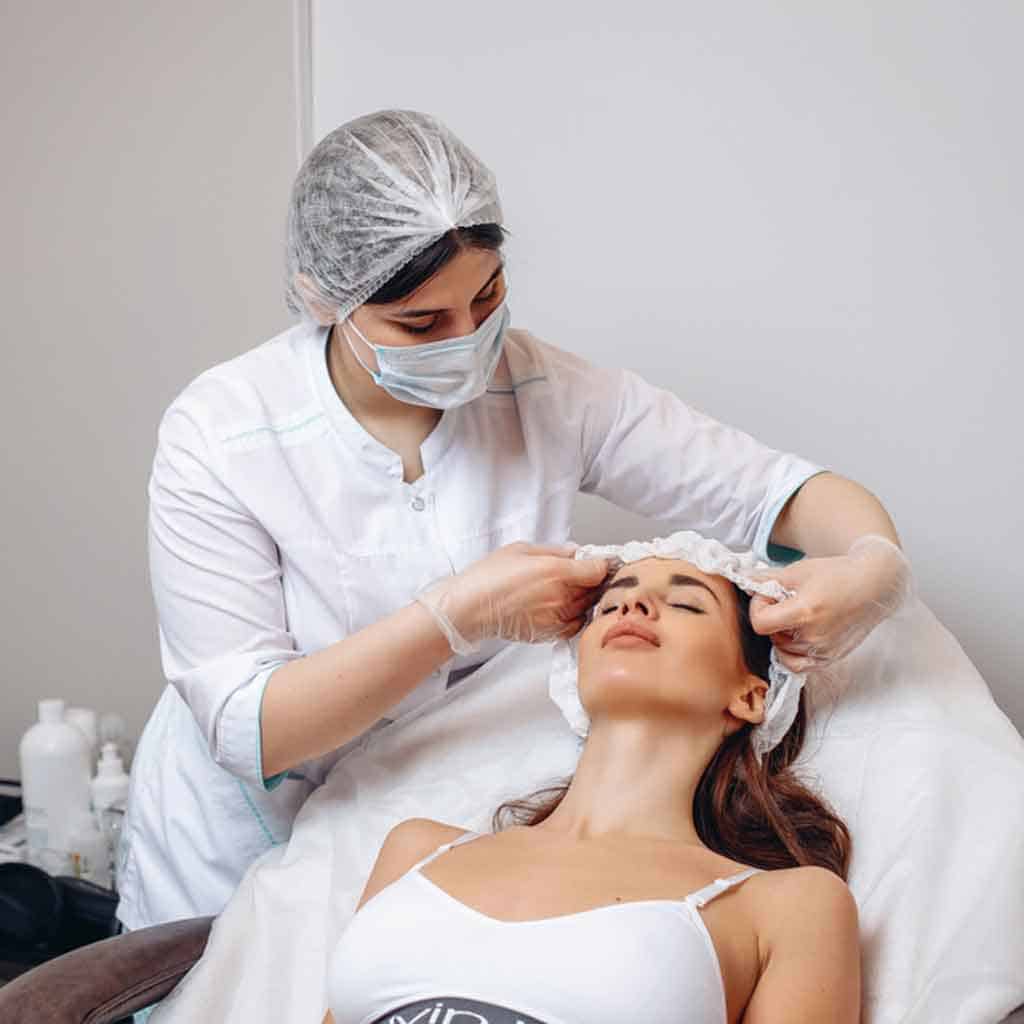
Most people assume the answer is no — and for most PMU programs, they’d be right. Private academies and short-format certification courses are almost never eligible for federal financial aid. If you’ve been budgeting for PMU training as a full out-of-pocket expense, that assumption is understandable.
But it’s not universal. At an accredited institution with Title IV federal financial aid approval, qualified students can access Pell Grants of up to $7,395 and subsidized or unsubsidized student loans. For some students, that covers the majority of their training cost. For others, it eliminates the upfront payment entirely.
AVI Career Training holds COE accreditation — the Council on Occupational Education — and is certified by SCHEV, the State Council of Higher Education for Virginia. These credentials are what make a school eligible to offer federal financial aid. We’re also approved by the U.S. Department of Veterans Affairs, which means GI Bill and Vocational Rehabilitation and Employment (VR&E) benefits can be applied toward your program.
In Fairfax County, where the military and veteran community is significant given proximity to the Pentagon, Fort Belvoir, and other installations, this is a financial pathway that many of our students actually use. If you’re not sure where to start with financial aid, our staff personally walks every student through the FAFSA process at no cost. There’s no application fee, and there’s no charge for that guidance.
Permanent Makeup Artist Salary: Is the Training Worth It?
Cost only makes sense in context. The average permanent makeup artist in the DC metro area earns $65,195 per year, according to Salary.com. Nationally, experienced artists in high-demand markets earn between $55,000 and $120,000 annually. The global PMU industry is currently valued at approximately $163 million and growing at a 7.9% compound annual growth rate through 2032.
Those numbers reflect a career with real earning potential — not a side hustle. And in a market like Fairfax County, where household incomes are among the highest in the country and clients routinely pay $500 to $800 or more per PMU session, a trained and licensed artist has a strong foundation to build on.
How Much Can a PMU Artist Realistically Earn in Northern Virginia?
The math on PMU income is worth working through, because it changes how you think about training cost.
PMU artists typically charge $300 to $600 per treatment, with experienced artists in premium markets charging $450 to $850 per session. At the lower end of that range, completing six treatments in a week generates around $1,800. At the higher end, ten sessions could bring in close to $8,500 in a single week. Artists who build a full schedule — two to three clients per day, four days per week — can realistically exceed $100,000 annually.
Fairfax County is one of the most favorable markets in the country for those numbers. The county’s high-income, professionally dense population means there’s strong, consistent demand for premium beauty services. Vienna, Tysons Corner, McLean, Reston — these are communities where clients are accustomed to paying for quality and return for touch-ups without hesitation.
There’s also a diversity dimension worth noting. Fairfax County is one of the most ethnically diverse counties in the United States, with large South Asian, East Asian, Middle Eastern, and Latin American communities. PMU artists trained to work across all Fitzpatrick Skin Types I through VI — the full spectrum of skin tones — have a meaningful advantage in this market. Our training covers all six Fitzpatrick types, which isn’t universal across programs.
When you run the numbers, a PMU training program that costs $6,000 to $10,000 can realistically pay for itself within the first few months of practice. After that, every session is income.
What Does a Quality PMU Training Program Actually Include?
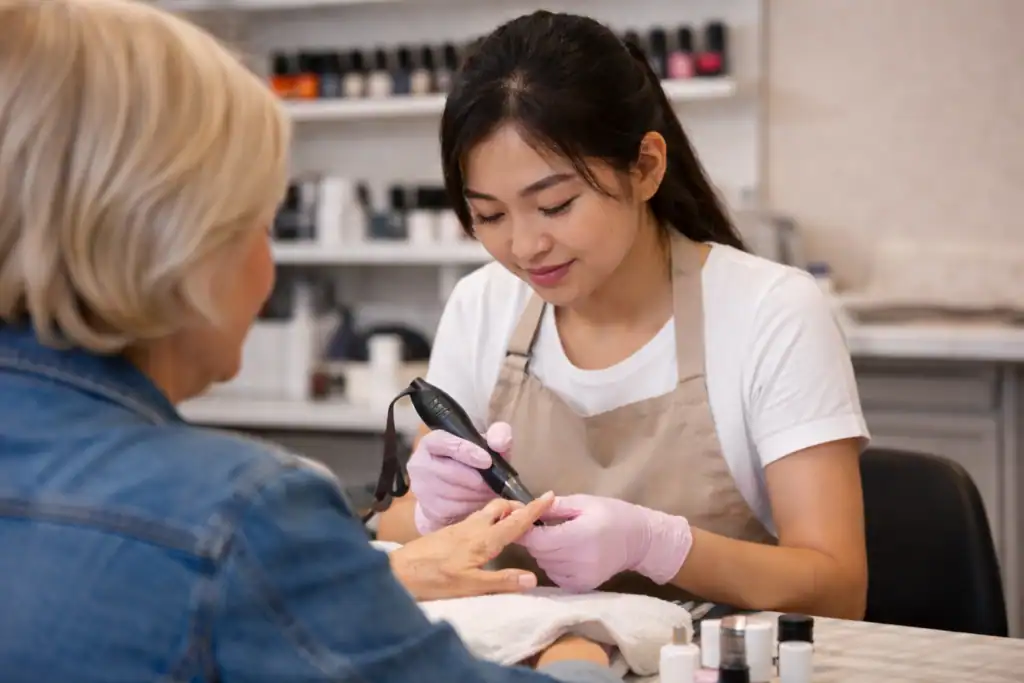
Not all programs are built the same, and the price tag alone doesn’t tell you much about what you’re getting. A quality PMU training program should cover more than technique. Color theory, skin anatomy, contraindications, bloodborne pathogen protocols, and client consultation are all foundational — and they’re what separate artists who build lasting careers from those who struggle with consistency and safety issues.
Hands-on training matters, but the specifics matter more. Practice on synthetic pads is a starting point. Practice on live models — real clients, real skin, real results — is what actually prepares you to work professionally. Ask any program you’re considering how many live model hours are included and what supervision looks like during those sessions.
A professional starter kit is another factor. Quality kits — machine, pigments, needles, disposables — are valued at $500 to $1,200 or more. Some programs include this in tuition. Others charge separately or expect you to source your own equipment. Know what’s included before you compare prices.
Our Permanent Cosmetic Tattooing program at AVI Career Training balances comprehensive theoretical instruction with intensive practical application. The curriculum is designed for both aspiring artists and working professionals who want to add PMU to their existing service menu. Classes start the first Monday of every month, so you’re not waiting six months for the next cohort to open. If you’re working a current job and need flexibility, rolling enrollment makes that easier to manage.
We’ve been training beauty professionals for over 30 years, and our 96% graduation rate reflects what happens when students get the support they actually need — not just a seat in a classroom. Our instructors bring real experience and individualized attention to every student, from enrollment through graduation and into the job search.
Our campus is located at 1595 Spring Hill Rd, Suite 720, Vienna, VA 22182 — in the heart of Fairfax County, accessible via the Springhill Silver Line Metro station. Whether you’re coming from Reston, McLean, Herndon, or across the county, the commute is straightforward.
Choosing the Right PMU Program in Fairfax County: What to Know Before You Enroll
The honest answer to “how much does PMU training cost?” is: it depends on the program, and the program matters more than most people realize — especially in Virginia, where the legal requirement to practice is tied directly to where you train.
A DPOR-licensed program at an accredited school costs more than a weekend certification course. But it leads to a state license, opens the door to federal financial aid, and prepares you to build a real career — not just complete a course.
If you’re in Fairfax County or anywhere in Northern Virginia and you’re serious about permanent makeup as a profession, we’d encourage you to reach out to AVI Career Training. There’s no application fee, our staff will walk you through your financial aid options personally, and we can tell you exactly what the program looks like, what it costs, and what you’ll be able to do when you finish.