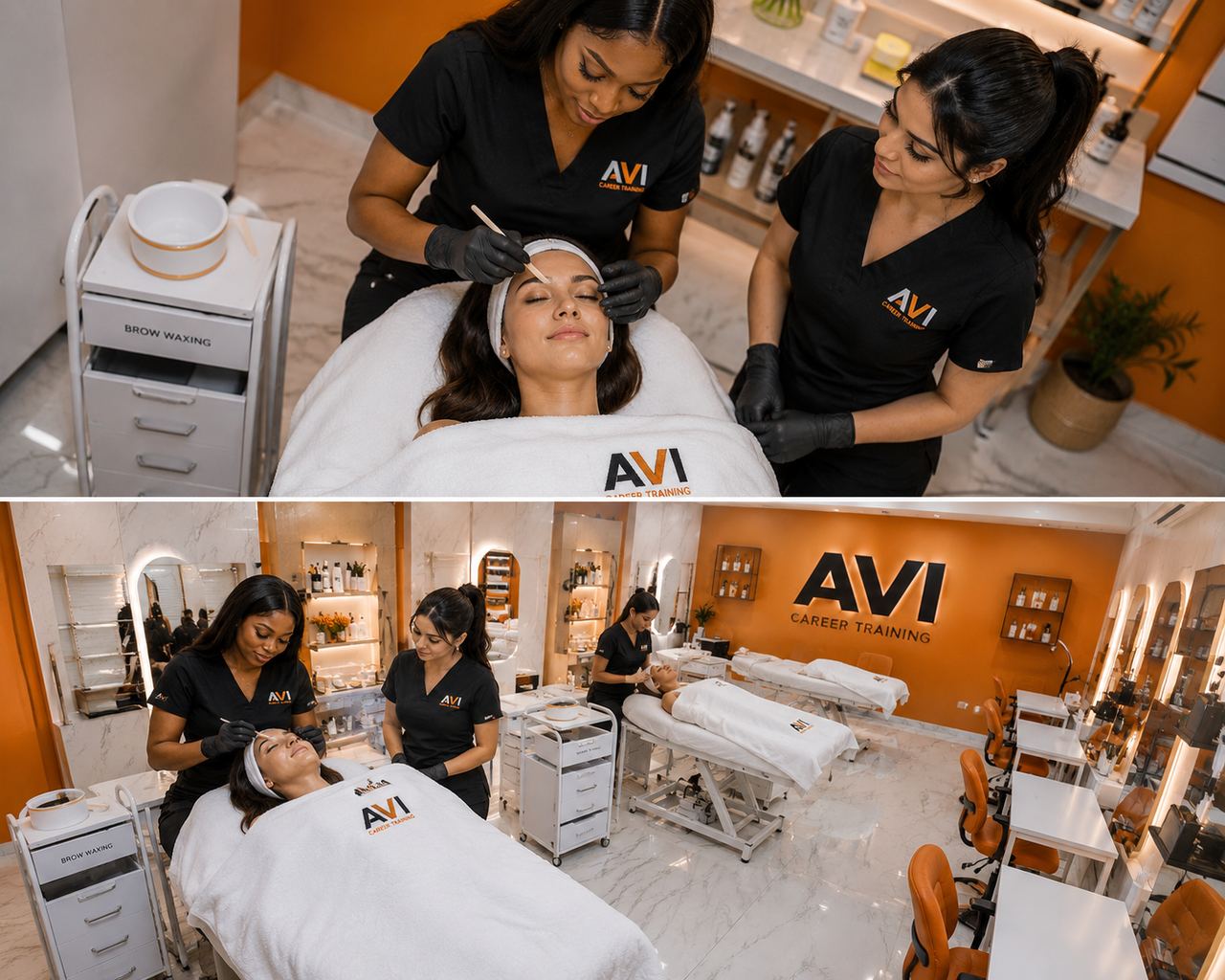
Medical Assistant vs. Medical Esthetician: Which Career Is Right for You?
If you’re comparing a medical assistant vs esthetics career, the esthetics route offers a faster licensing pathway, stronger earning potential, and a clearer path into clinical settings like medical spas and dermatology offices — especially in Northern Virginia. Both careers involve clinical environments and patient interaction, but the training paths, licensing requirements, and daily job duties are very different.
Here’s a side-by-side look at both careers so you can make an informed decision.
—
> ### Key Takeaways
> – Virginia requires 600 clock hours of training to become a licensed esthetician — there is no state license required for medical assistants in Virginia
> – AVI Career Training’s Esthetics program prepares students to sit for the Virginia State Board exam and enter clinical settings like med spas and dermatology offices
> – Licensed estheticians in clinical settings in Northern Virginia can earn $50,000–$70,000+ per year, depending on specialization
> – Medical assistants in Virginia earn approximately $38,000–$52,000 annually (BLS, May 2023)
> – AVI is COE Accredited, SCHEV Certified, and accepts the GI Bill® — making quality esthetics training accessible and affordable
—
What Does a Medical Assistant Actually Do?
Medical assistants (MAs) are multi-role support professionals who work in physician offices, clinics, urgent care centers, and hospitals. Their responsibilities fall into two broad categories: clinical and administrative.
On the clinical side, MAs take vital signs, draw blood, administer injections, prepare patients for exams, and assist physicians during procedures. On the administrative side, they schedule appointments, manage patient records, handle billing, and process insurance paperwork.
It’s genuinely meaningful work — and the demand for MAs is growing. The U.S. Bureau of Labor Statistics projects strong job growth for the occupation over the next decade. But there’s a trade-off worth knowing about.
There is no state licensure for medical assistants in Virginia. That means no state board exam, no formal credential required to practice, and — depending on your employer — inconsistent recognition of your training. Voluntary certifications like the Certified Medical Assistant (CMA) through the American Association of Medical Assistants (AAMA) or the Registered Medical Assistant (RMA) through the American Medical Technologists (AMT) can strengthen your resume. But they aren’t required to get hired.
For many people comparing the medical assistant vs esthetics career paths, this is the first surprising discovery: esthetics actually has a stricter formal licensing structure in Virginia than medical assisting does.
—
What Is a Medical Esthetician — and Why It’s Not What Most People Expect
When most people hear “esthetician,” they picture facials at a day spa. That picture is incomplete.
A licensed esthetician working in a medical or clinical setting — often called a medical esthetician or clinical esthetician — performs treatments that would not look out of place in a dermatologist’s office. These include:
Many of these services are performed in medical spas, dermatology practices, plastic surgery offices, and cosmetic laser clinics — all under physician oversight. The work is hands-on, results-driven, and deeply connected to patient wellness.
This is why the medical assistant vs esthetics career comparison resonates so strongly with people who want clinical work without the full clinical medicine track. You’re working with real patients. You’re producing visible, meaningful results. And you’re part of a healthcare-adjacent team in a way that goes far beyond “putting on lotions.”
If this kind of work sounds like a fit, apply to AVI Career Training’s Esthetics program and take your first step toward working in a medical spa or dermatology setting.
—
Meet Dara: A CNA Who Found Her Path in Esthetics
Dara spent three years working as a certified nursing assistant at a long-term care facility in Fairfax County. She loved the patient interaction and the feeling of making a tangible difference in someone’s day. But the physical demands, the overnight shifts, and the emotional weight of the work were taking a toll.
She started researching medical assistant programs, thinking it would offer a lighter clinical path. But when she compared the training time, the lack of Virginia licensure, and the salary ceiling, something felt off. A friend mentioned AVI Career Training in Vienna.
Dara enrolled in AVI’s Esthetics program. She completed her 600 clock hours, passed the Virginia State Board exam, and landed a position at a med spa in Tysons Corner within two months of graduation. Today, she performs chemical peels and laser treatments, earns more than she did as a CNA, and works a schedule she can actually build a life around.
Her story is not unusual. Career changers from healthcare backgrounds — CNAs, medical receptionists, even EMTs — find that clinical esthetics training gives them a new entry point into patient-centered work without starting over from scratch.
—
Comparing Training Time, Cost, and Licensing in Virginia
Let’s put the two paths side by side. Numbers matter when you’re making a career investment.
Medical Assistant Training in Virginia
| Factor | Details |
|—|—|
| Training length | 9–12 months (certificate); 2 years (associate degree) |
| State license required | No — Virginia does not require licensure for MAs |
| Optional certifications | CMA (AAMA), RMA (AMT) — voluntary |
| Typical program setting | Community college, vocational school |
| Average Virginia salary | $38,000–$52,000/year (BLS, May 2023) |
Esthetics Training in Virginia
| Factor | Details |
|—|—|
| Training length | 600 clock hours required by Virginia DPOR |
| State license required | Yes — must pass Virginia State Board written and practical exams |
| Program setting | State-approved cosmetology/esthetics school |
| AVI program | COE Accredited, SCHEV Certified, financial aid available |
| Average clinical salary | $50,000–$70,000+/year in Northern Virginia metro |
Virginia’s Department of Professional and Occupational Regulation (DPOR) sets the 600-hour requirement for esthetics licensure. That structure means something: when you graduate and pass your board exam, you hold a state-issued license that employers recognize and require.
AVI’s Esthetics program is designed to meet that 600-hour requirement with hands-on, clinical-grade training — not just theory. You’ll practice on real clients in a supervised setting, learning techniques that translate directly to medical spa and clinical work.
The timeline for AVI’s program varies based on your schedule. Full-time and part-time options are available, so you can fit training around your current job or family situation. Call (703) 943-9841 to get current schedule details and tuition information.
For students considering adding clinical laser skills on top of their esthetics license, AVI also offers a Cosmetic Laser Technician program — a specialization that significantly increases your earning potential in Northern Virginia’s competitive med spa market.
—
Where Do Medical Estheticians Work — and What Do They Earn in Northern Virginia?
The Northern Virginia and DC metro job market is one of the strongest in the country for medical esthetics careers. The region has a high concentration of medical spas, cosmetic dermatology practices, and plastic surgery centers — particularly in:
These aren’t neighborhood day spas. They are medical-grade facilities serving clients who expect clinical results. Estheticians working in these environments are expected to hold state licensure, understand skin science at a professional level, and perform treatments with precision and consistency.
What Can You Earn?
Salary data for licensed estheticians in clinical settings in Northern Virginia reflects the region’s high cost of living and demand for skilled professionals:
Estheticians who add laser certification, electrolysis training, or specialize in treatments like chemical peels for hyperpigmentation and melanin-rich skin — a specialty area where trained professionals are well established — often command higher rates and more stable, full-time positions.
AVI specifically trains students to work on every skin tone and every client, which is both an ethical commitment and a practical career advantage. In a region as diverse as Northern Virginia and DC, that inclusive training approach makes graduates more competitive in hiring and more effective in practice.
—
Meet Marcus: From the Military to a Med Spa Career
Marcus separated from the Army after eight years of service and wasn’t sure what came next. He’d done combat medic training and genuinely enjoyed the clinical side of that work. He looked at medical assistant programs, but felt the work was too administrative-heavy and the salary ceiling too low.
A colleague mentioned that AVI Career Training accepted the GI Bill®. Marcus hadn’t considered esthetics before, but after researching the medical esthetics career pathway in Virginia, he enrolled in AVI’s Esthetics and Cosmetic Laser Technician programs.
The clinical structure of AVI’s training felt familiar — hands-on, technique-based, focused on client outcomes. He passed his Virginia State Board exam and used his laser certification to secure a position at a cosmetic clinic in Arlington. His GI Bill® benefits covered his tuition. His medic background made him a natural in a clinical-facing role.
Veterans, first responders, and healthcare workers who transition into clinical esthetics often find the learning curve shorter than expected — and the career satisfaction higher. If you’re eligible for GI Bill® benefits, reach out to AVI’s admissions team to learn how your benefits can be applied.
—
How to Get Started with Clinical Esthetics Training in Northern Virginia
If you’ve been researching the medical assistant vs esthetics career comparison, the decision really comes down to what you want your daily work to look like.
Choose medical assisting if you want:
Choose esthetics / medical esthetics if you want:
AVI Career Training in Vienna, Virginia is one of the few COE Accredited, SCHEV Certified schools in Northern Virginia that prepares students for exactly this path. The programs are hands-on, the instructors are licensed working professionals, and the curriculum is built to prepare you for the Virginia State Board exam and real-world clinical employment from day one.
What AVI offers:
You don’t need a college degree, a healthcare background, or years of experience to get started. You need the right school, the right training, and the commitment to see it through.
Ready to learn more? Apply to AVI Career Training today or call (703) 943-9841 to speak with an admissions advisor about program schedules, tuition, and financial aid options.
The Northern Virginia med spa market is hiring. AVI can help you get there.
—
For Virginia esthetics licensing requirements, visit the Virginia Department of Professional and Occupational Regulation (DPOR). For national salary data by occupation, visit BLS.gov.