Medical Assistant vs. Esthetician: Which Career Is Right for You?
The right choice between a medical assistant and esthetician career depends on how you want to spend your workday, how long you are willing to train, and what kind of career flexibility you want long-term. Both roles let you work with people every day, earn competitive salaries, and enter the workforce without a four-year degree — but the training path, licensing structure, and day-to-day reality of each career are very different.
—
> Key Takeaways
> – Virginia estheticians must complete 600 clock hours of training — comparable to many medical assistant programs
> – Medical estheticians at Northern Virginia med spas often earn $45,000–$65,000+, competitive with entry-level MAs in the region
> – Virginia’s esthetics licensing path through the DPOR is clearly structured, with written and practical exams
> – AVI Career Training’s Esthetics program takes approximately 7–9 months to complete
> – Estheticians can work in medical spas, dermatology offices, laser clinics, and private practice — without a nursing prerequisite
—
What Does a Medical Assistant Actually Do Day-to-Day?
Medical assistants support physicians and clinical staff in outpatient settings — think doctors’ offices, urgent care clinics, and specialty practices. The job blends administrative tasks with basic clinical duties.
On a typical day, a medical assistant might:
It is a stable, meaningful role. If you genuinely want to work in a traditional medical environment and are comfortable with administrative workloads, clinical admin tasks, and rotating through back-office duties, the medical assistant path can be a solid fit.
What medical assistants typically do not do: build ongoing client relationships over time, perform aesthetic or skin-focused treatments, or move fluidly between clinical and luxury spa environments. The scope is largely determined by the supervising physician, and creative or hands-on skincare work is rarely part of the picture.
Virginia does not require a state license for medical assistants. While national certifications (like the CMA through AAMA) are valued by employers, there is no mandatory state licensing exam in Virginia. That may sound like a benefit — but it also means less professional structure and fewer employer-recognized credentials compared to licensed estheticians, who complete a regulated training program and pass state board exams.
—
What Does an Esthetician Do — and Where Can They Work?
Here is where many people are surprised: esthetics is far more clinical than most people assume.
A licensed esthetician performs skin analysis, chemical exfoliations, microdermabrasion, facials, hair removal, and advanced skincare treatments. Many estheticians in Northern Virginia work in medical spas, dermatology offices, and cosmetic laser clinics — settings that feel much closer to healthcare than a traditional day spa.
In these environments, estheticians often work alongside physicians, nurse practitioners, and laser technicians. They consult with clients on skincare regimens, prep clients for laser treatments, and perform pre- and post-procedure skin care. It is a hands-on, relationship-driven career where the client experience is entirely in your hands.
Estheticians can work in:
That range of employment settings is one of esthetics’ biggest advantages. You can start in a day spa, transition to a med spa, and eventually build a private clientele — all under the same Virginia esthetician license.
If you’re drawn to the clinical feel of a medical career but want to focus on skin, aesthetics, and client wellness, esthetics gives you that environment without requiring a nursing degree, pre-med coursework, or years of additional training.
—
Training Length, Cost, and Licensing — A Side-by-Side Comparison
This is the section most career researchers want to see before making a decision. Let’s break it down clearly.
Esthetician vs. Medical Assistant : Key Training Comparison
| Factor | Medical Assistant | Esthetician (Virginia) |
|—|—|—|
| Training Hours Required | Varies by program (typically 600–900 hours) | 600 clock hours (Virginia DPOR requirement) |
| Typical Program Length | 9–12 months (certificate) | Approximately 7–9 months at AVI |
| State License Required? | No (Virginia does not license MAs) | Yes — Virginia Board of Cosmetology |
| Licensing Exam | Optional national certification (CMA, RMA) | Written + practical exam through DPOR |
| Entry-Level Employment | Doctors’ offices, urgent care, clinics | Spas, med spas, dermatology, laser clinics |
| Career Flexibility | Limited to clinical admin environments | Broad — spa, medical, independent, travel |
Why the Licensing Difference Matters
Virginia’s esthetician license, administered through the Virginia Department of Professional and Occupational Regulation (DPOR), is a formally recognized professional credential. Employers — especially medical spas and dermatology practices — know exactly what it means and what a licensed esthetician can legally do.
Medical assisting, by contrast, has no equivalent licensing structure in Virginia. National certifications are voluntary and employer-dependent. That creates more variability in how your credential is received across job settings.
For career-changers who want a clear, structured path to a professional credential, esthetics often wins on clarity alone.
—
Salary and Career Growth in Virginia — What the Data Says
Let’s talk numbers — because salary is usually the deciding factor.
Medical Assistant Salary in Virginia
According to the U.S. Bureau of Labor Statistics, the median annual wage for medical assistants nationally is approximately $42,000 (2023 data). In the Northern Virginia and Washington, D.C. metro area, that figure tends to run slightly higher — typically in the $44,000–$52,000 range for entry-level positions.
Growth potential for medical assistants is generally tied to gaining certifications, years of experience, and specializing in a particular clinical setting. Movement into higher-earning roles usually requires additional education (nursing, healthcare administration, etc.).
Esthetician Salary in Virginia — Including Medical Spa Employment
The BLS reports a national median of approximately $37,000 for estheticians — but that number is misleading for the Northern Virginia market, and here’s why.
Estheticians working in medical spas and clinical settings in the DC metro area consistently earn more than spa-based estheticians. When you factor in:
…experienced estheticians in Northern Virginia frequently earn $45,000–$65,000 or more annually. Top performers at established medical spas in the region can earn above that range.
Cosmetic laser technicians — a natural step-up credential for licensed estheticians — often command $50,000–$75,000+ in clinical settings. AVI Career Training offers a Cosmetic Laser Technology program that positions esthetics graduates to enter this higher-earning tier. This is one of the clearest paths for estheticians who want a salary that competes directly with — and often exceeds — entry-level medical assisting income.
The Career Ceiling Comparison
Medical assistants who want to grow their income substantially often need to return to school — nursing programs, health information management, or medical billing credentials. That’s additional time and tuition.
Estheticians can grow income by adding skills within their license scope: laser certifications, advanced chemical peels, lash extensions, or body treatments. The investment is targeted and often much shorter than returning for a full degree program.
—
Meet Two People Who Faced This Exact Decision
Mariana’s Story: From Medical Office Burnout to Med Spa
Mariana spent three years working front desk and intake at a primary care office in Fairfax. She liked interacting with patients but felt disconnected from any real hands-on work — she spent most of her day on scheduling software and insurance calls.
She started researching medical assistant training thinking it would get her closer to clinical work. But when she read what MAs actually do, she realized the administrative side wouldn’t go away.
A friend mentioned that the med spa down the road was looking for licensed estheticians. Mariana looked it up, found AVI Career Training, and enrolled in the Esthetics program. Seven months later, she passed her Virginia Board exam. She now works at a medical spa in Tysons Corner performing facials, chemical peels, and pre-laser skin prep — with a schedule she controls and commission that consistently pushes her income above what she earned at the medical office.
David’s Story: Leaving the Military, Choosing a Clear Path
David separated from the Army after eight years of service and started exploring healthcare careers. Medical assisting came up repeatedly — it was short, accessible, and “medical adjacent.” But when he dug into the Virginia licensing picture, he noticed something: MAs aren’t licensed by the state. He wanted a credential with weight.
David discovered that AVI Career Training accepts the GI Bill®, which covered a significant portion of his Esthetics program tuition. He enrolled, completed 600 hours of training, passed both the written and practical Virginia Board exams, and began working at a dermatology-affiliated spa in McLean. His career now sits at the intersection of clinical skincare and client service — exactly where he wanted to land.
These examples represent the types of career transitions AVI students make. Individual outcomes vary.
—
If You Want a Clinical Skincare Career, Here’s the Virginia Path
If you’re drawn to medical assisting because of the clinical environment — the structure, the credibility, the sense that you’re doing something with real health stakes — esthetics at a medical spa offers all of that, plus a creative and client-facing dimension that most MA roles simply don’t include.
Here is what the Virginia path looks like through AVI Career Training:
Step 1: Enroll in AVI’s Esthetics Program
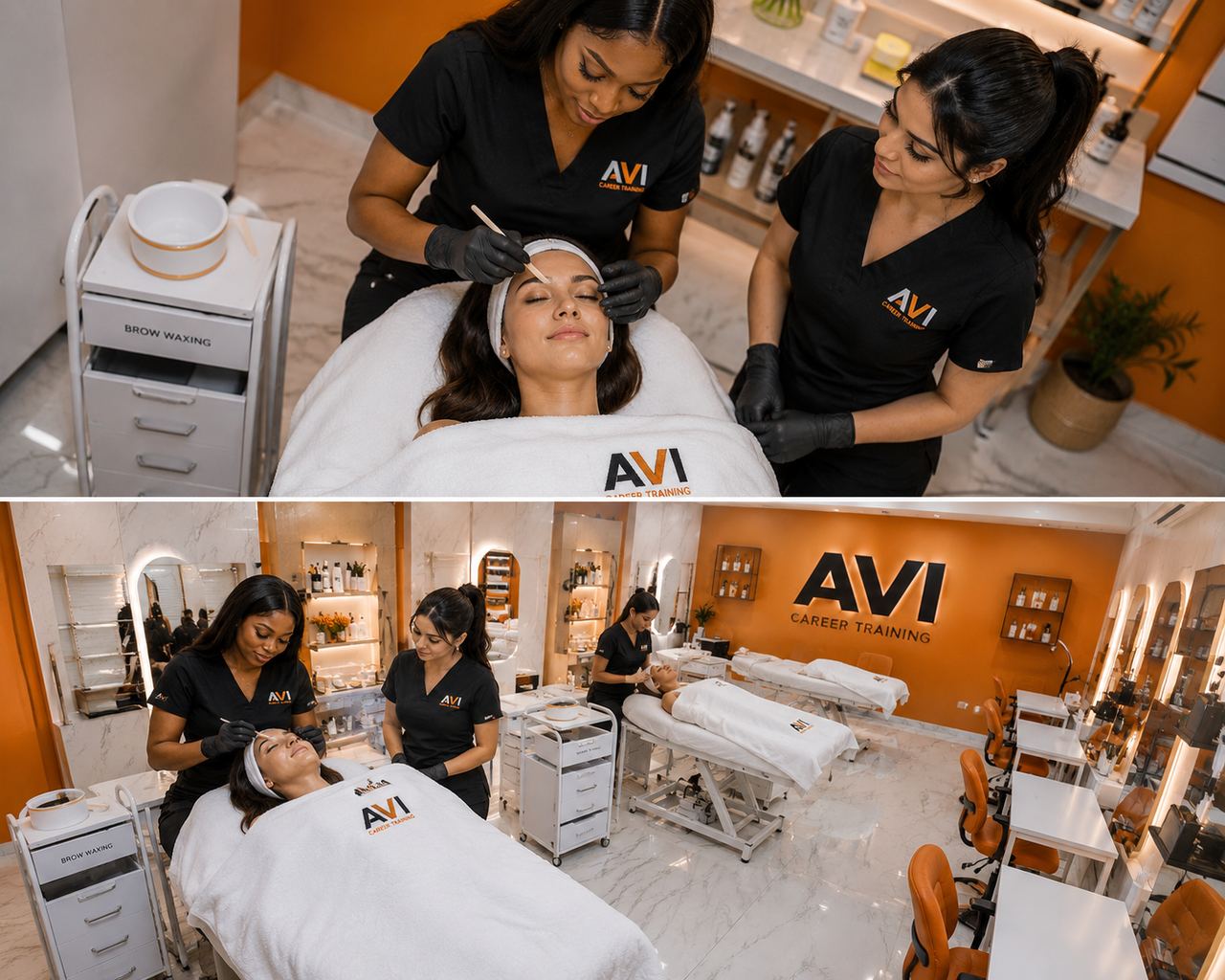
AVI’s Basic Esthetics program covers 600 clock hours of hands-on training in skin analysis, facials, hair removal, chemical exfoliation, sanitation, client consultation, and business skills. The program takes approximately 7–9 months.
Step 2: Sit for the Virginia Board of Cosmetology Exam
After completing your hours, you’ll take the written and practical exam administered through Virginia’s DPOR. Passing means you hold a state-recognized esthetician license — a credential that medical spa employers across Northern Virginia actively seek.
Step 3: Consider Adding Cosmetic Laser Technology
AVI also offers a Cosmetic Laser Technology program that pairs directly with the Esthetics credential. Laser-certified estheticians are well established at Northern Virginia’s growing network of medical spas and cosmetic clinics — and the earning potential reflects that demand.
Step 4: Enter the Northern Virginia Med Spa Market
The DC metro area is one of the strongest markets in the country for aesthetic services. Medical spas, dermatology practices, and plastic surgery offices in Tysons Corner, McLean, Arlington, and Alexandria actively recruit licensed estheticians. AVI’s location in Vienna puts you at the center of this market.
You do not need a nursing degree. You do not need a four-year college credential. You need 600 hours, a Virginia license, and the practical skills to deliver results — all of which AVI’s program is built to give you.
Financial aid is available for those who qualify, and AVI proudly accepts the GI Bill® for veterans and eligible dependents. If you’re ready to explore whether esthetics is the right career pivot for you, apply now or call AVI directly at (703) 943-9841 to speak with an admissions advisor.
—
Frequently Asked Questions
Is medical assisting or esthetics a better career?
It depends on what you want your workday to look like. Medical assisting is well-suited for people who want to work in traditional clinical settings and are comfortable with a heavy administrative component. Esthetics is a stronger fit for people who want hands-on work, client relationships, creative freedom, and access to both medical and luxury spa environments — often at comparable or better pay in the Northern Virginia market.
How long does medical assistant training take in Virginia?
Most medical assistant certificate programs run 9–12 months, with some community college programs extending to 18 months when taken part-time. AVI’s Esthetics program takes approximately 7–9 months to complete 600 hours of training — making it a comparable or faster path to entering the workforce.
Can an esthetician work in a medical spa in Virginia?
Yes — and medical spas are one of the fastest-growing employers of licensed estheticians in Northern Virginia. Many med spas actively prefer estheticians over general spa workers because of their training in clinical skin conditions, chemical exfoliation, and pre- and post-procedure care. AVI graduates regularly move into med spa roles upon licensure.
What is a medical esthetician, and how do I become one?
A medical esthetician is a licensed esthetician who works primarily in clinical settings — medical spas, dermatology offices, or plastic surgery practices. In Virginia, you become one by earning your esthetician license (600 hours of training + state board exam) and gaining experience or additional certification in clinical treatments like laser therapy or advanced chemical peels. AVI’s combined Esthetics and Cosmetic Laser Technology programs are designed to position graduates for exactly this career path.
Do medical assistants need a license in Virginia?
No. Virginia does not require medical assistants to hold a state license. Some employers prefer or require national certifications (such as the CMA through the AAMA), but these are voluntary. By contrast, Virginia estheticians must be licensed through the DPOR — a structured credential that carries clear, statewide professional recognition.
—
The decision between a medical assistant path and an esthetics career is not just about which job title sounds more “medical.” It is about where you want to work, how you want to grow, and which training investment gives you the most career flexibility. For many people searching this question in Northern Virginia, esthetics — especially with a med spa focus — turns out to be the stronger answer.
If that resonates with you, apply to AVI Career Training today and take the first step toward a licensed, career in clinical skincare.