Esthetics School in Northern Virginia | AVI Career Training
AVI Career Training in Vienna, Virginia is a COE-accredited esthetics school in Northern Virginia that prepares students to meet Virginia’s 600-hour licensing requirement — with hands-on clinic training, inclusive technique instruction, and financial aid options including the GI Bill®.
If you’re searching for a clear, direct path to becoming a licensed esthetician in the DC metro area, here’s everything you need to know: what estheticians actually do, what Virginia requires for licensure, what AVI’s program covers, and how to get started. Apply to AVI’s Esthetics Program today or call (703) 943-9841 to speak with admissions.
—
> ## Key Takeaways
> – Virginia requires 600 clock hours of esthetics training at an approved school to qualify for licensure
> – The Virginia State Board exam has two parts: a written theory test and a hands-on practical exam
> – Estheticians in Northern Virginia earn between $38,000 and $48,000 per year on average — above the national median, due to the area’s dense concentration of medical spas and luxury day spas
> – AVI Career Training is COE Accredited and SCHEV Certified, which means students can access federal financial aid, including Pell Grants and federal loans
> – AVI accepts the GI Bill® — a critical benefit for Northern Virginia’s large veteran population
> – AVI’s esthetics curriculum includes inclusive skin care techniques for all skin tones, a genuine differentiator in the diverse DC metro market
—
What Does an Esthetician Actually Do?
Estheticians are licensed skin care professionals. They analyze skin conditions, perform treatments, and help clients maintain healthy, glowing skin — in settings that range from day spas to dermatology offices to high-end medical practices.
Day-to-day, a working esthetician might perform:
Beyond traditional spa settings, the medical esthetics lane is one of the fastest-growing areas in the profession. Medical spas — which combine physician oversight with esthetics services like laser treatments, microneedling, and chemical peels — are expanding rapidly across the Northern Virginia and Tysons Corner corridor. Estheticians who build clinical skills and pursue advanced certifications in cosmetic laser technology are especially well-positioned in this market.
If you enjoy working directly with people, have an interest in skin science, and want a career that’s both creative and technical, esthetics is worth a serious look. Learn more about the full range of programs at AVI Career Training to see how esthetics fits alongside other beauty and wellness career paths.
—
Virginia Esthetician License Requirements
Before you can work as an esthetician in Virginia, you need a state license issued through the Virginia Department of Professional and Occupational Regulation (DPOR) and the Virginia Board of Cosmetology.
Here’s what Virginia currently requires:
600 Clock Hours of Approved Training
You must complete 600 clock hours of esthetics instruction at a school approved by the Virginia Board of Cosmetology. These hours must be completed at an accredited institution — not through self-study, apprenticeship, or online-only coursework.
This is where choosing the right school matters. Not every program is approved, and not every program is accredited in a way that qualifies you for federal financial aid. AVI Career Training meets both requirements: our esthetics program satisfies Virginia’s 600-hour standard, and our COE accreditation and SCHEV certification open the door to Pell Grants and federal loans.
> ⚠️ Important: Virginia licensing requirements are subject to change. Always verify current requirements directly at dpor.virginia.gov before enrolling.
The Two-Part Virginia State Board Exam
After completing your training hours, you’ll sit for the Virginia State Board exam — which has two distinct components:
1. Written (Theory) Exam — Tests your knowledge of skin anatomy, contraindications, sanitation, product chemistry, and Virginia state laws and regulations
2. Practical (Skills) Exam — A hands-on evaluation where you demonstrate actual esthetics techniques on a live model or mannequin, depending on the service
Both parts must be passed before your license is issued. AVI’s program is structured to prepare you for both — classroom theory instruction builds the knowledge base you need for the written portion, and supervised clinic floor hours develop the hands-on competency required for the practical.
After You Pass
Once you’ve passed both sections of the State Board exam, you apply to DPOR for your Virginia Esthetician license. After that, you’re legally qualified to work as a licensed esthetician anywhere in the state — and you can begin building a clientele or applying for positions immediately.
—
What to Expect in AVI’s Esthetics Program
AVI’s Esthetics program at our Vienna, VA campus is designed to take you from beginner to board-ready — covering the full scope of esthetics knowledge and technique required to pass the Virginia State Board exam and succeed in a professional setting.
Classroom Instruction
The classroom phase covers the science behind esthetics: skin anatomy and physiology, skin disorders and conditions, ingredient knowledge, sanitation and safety protocols, and Virginia state laws and regulations. This foundation is what separates a skilled esthetician from someone who only knows how to follow a protocol.
You’ll learn to read a client’s skin — understanding the difference between dehydration and dryness, between active acne and post-inflammatory hyperpigmentation, between a skin condition that responds to esthetics treatment and one that requires a physician referral.
Hands-On Clinic Floor Training
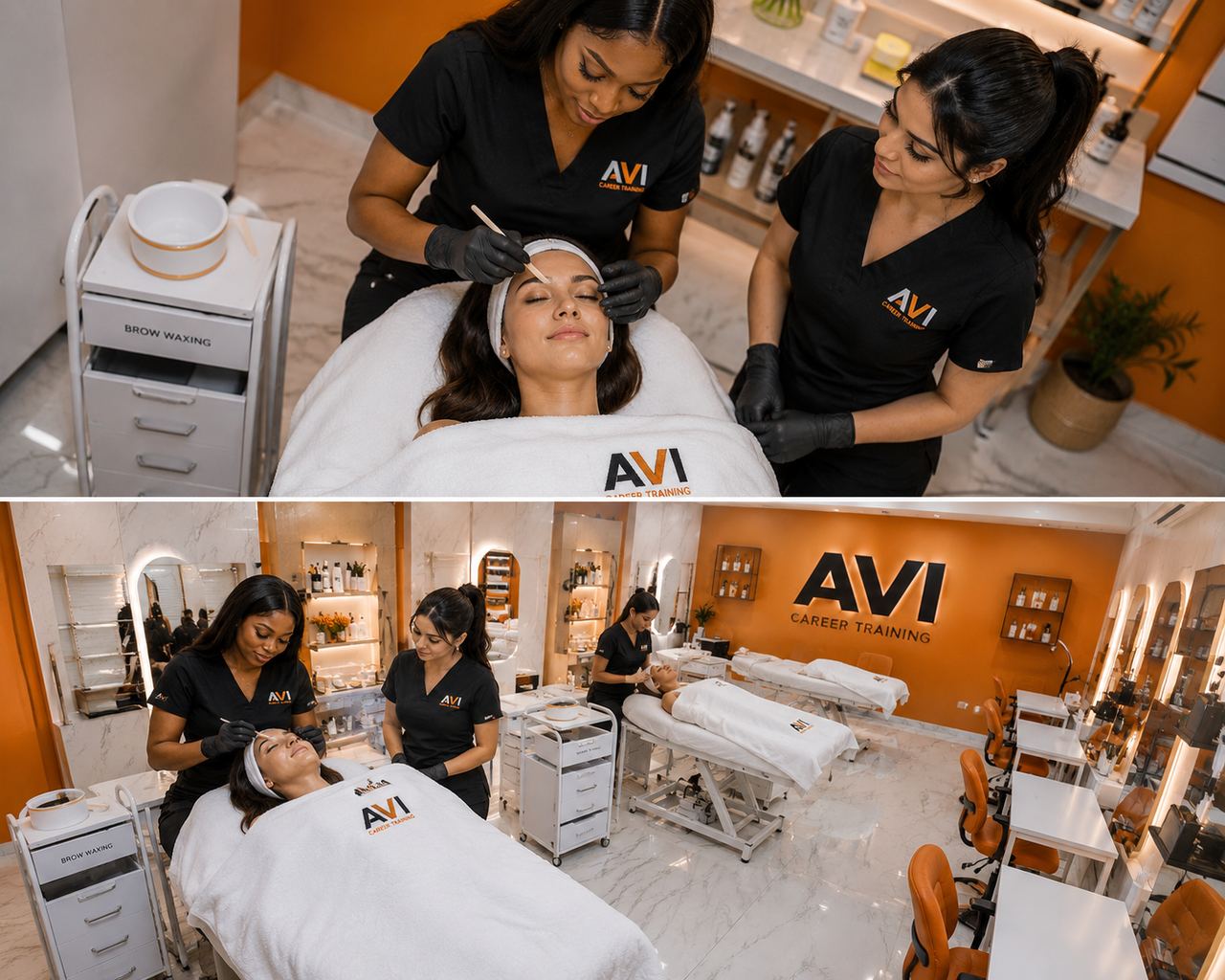
The clinic floor is where classroom knowledge becomes professional skill. Under the supervision of licensed instructors, AVI students perform real services on real clients — not just on mannequins or fellow students in a controlled classroom setting.
This real-world exposure is critical. By the time you sit for your practical State Board exam, you’ve already performed the skills dozens of times in a professional environment. That kind of repetition and confidence doesn’t come from textbook study alone.
Inclusive Skin Care Training — For Every Skin Tone
This is one of AVI’s most important differentiators, and it’s worth saying directly: not all esthetics programs train students to work effectively on every skin tone.
AVI’s curriculum specifically addresses techniques, products, and protocols for diverse skin — including melanin-rich skin that carries a higher risk of post-inflammatory hyperpigmentation from aggressive treatments, deeper skin tones that require modified peel and laser protocols, and a range of textures and sensitivities that demand a nuanced approach.
In Northern Virginia and the broader DC metro area, your clients will reflect the region’s extraordinary diversity. You need training that reflects that reality. AVI’s inclusive approach isn’t an add-on to the curriculum — it’s built into every unit.
Equipment and Techniques
AVI students learn to work with professional esthetics equipment used in spas and clinical settings, including:
When you graduate, you won’t need an equipment orientation period at your first job. You’ll already know how these tools work and when to use them.
—
Career Outcomes — Where Can an Esthetics License Take You?
A Virginia Esthetician license is a credential with real market value — especially in Northern Virginia.
Where Estheticians Work
Licensed estheticians work across a wide range of settings:
The Northern Virginia and Tysons Corner area is particularly strong for esthetics employment. The region’s concentration of high-income households, along with a dense and growing medical spa market, creates above-average demand for skilled estheticians. This market consistently supports earning potential above the Virginia state median.
Earning Potential in Northern Virginia
According to the U.S. Bureau of Labor Statistics, estheticians in Virginia earn a median annual wage in the range of $38,000 to $48,000 per year — and Northern Virginia professionals often land at the higher end of that range or above it, driven by the region’s cost-of-market and the premium service pricing at area med spas and luxury day spas.
Estheticians who build specialty skills — advanced chemical peels, medical esthetics, or cosmetic laser technology — typically earn more. Gratuities add meaningful income for client-facing roles in spa settings as well.
> 📊 Verify current salary data at BLS.gov Occupational Outlook for Skin Care Specialists
Growth Paths Beyond the License
Your esthetician license is a starting point, not a ceiling. AVI Career Training also offers programs in Cosmetic Laser Technology and Electrolysis — two advanced specialties that open doors to higher-paying clinical roles and medical spa positions.
Many estheticians begin in a day spa setting to build their clientele and technique confidence, then pursue advanced certifications within two to three years to move into medical esthetics, earn higher hourly rates, and take on more complex clinical responsibilities.
—
Meet Monique: A Career Changer Who Didn’t Want to Start Over
Monique had spent a decade working in retail management. She was good at her job, but she wasn’t building toward anything that felt like her own. When her sister — a licensed esthetician in Maryland — suggested she look into skin care training, Monique was skeptical. She assumed beauty school was for people who “knew” from age 16 that they wanted to do hair or nails.
What changed her mind was a conversation with AVI admissions. She learned that she could complete the 600-hour esthetics program in a matter of months — not years — and that COE accreditation meant she could apply for Pell Grant funding to help cover costs. She enrolled, completed her training on AVI’s clinic floor with real clients, and passed both parts of the Virginia State Board exam on her first attempt.
Six months after graduating, Monique was working full-time at a medical spa in Tysons, performing facials, chemical peels, and pre-laser prep treatments — earning more than she had in her last retail role and building the kind of repeat clientele that made every shift feel worthwhile.
—
How to Enroll in AVI’s Esthetics Program
Getting started at AVI is straightforward. Here’s what the process looks like:
Step 1: Submit Your Application
Start by applying online here. The application is quick and gets you connected with the AVI admissions team, who can answer your specific questions about program start dates, scheduling, and costs.
Step 2: Discuss Financial Aid Options
AVI is COE Accredited and SCHEV Certified — two credentials that matter enormously for financial aid eligibility. These accreditations allow AVI to participate in federal financial aid programs, which means qualified students may be eligible for:
Northern Virginia has one of the largest veteran populations in the country. If you’ve served, the GI Bill® can cover a significant portion of your training costs at AVI. Call (703) 943-9841 to speak directly with admissions about what your benefits will cover.
Step 3: Review Your Schedule and Start Date
AVI offers different scheduling options to work around your life — whether you’re transitioning from a full-time job, caring for family, or ready to dive in full-time. Ask about current options when you connect with admissions.
Step 4: Begin Training
Once enrolled, you’ll move through the structured curriculum — classroom theory, hands-on lab sessions, and supervised clinic floor hours — until you’ve completed your 600 hours and are ready to sit for the Virginia State Board exam.
—
Meet James: A Veteran Who Used His Benefits to Launch a New Career
James served eight years in the Army before separating and settling in Woodbridge with his family. He’d always been interested in skin care — his wife joked that he knew more about serums than she did — but he assumed a beauty school career path “wasn’t for him.”
After learning that AVI accepts the Post-9/11 GI Bill® and that the esthetics program qualified for those benefits, he scheduled a tour. The campus, the instructors, and the clear structure of the 600-hour program convinced him. He used his GI Bill® benefits to cover his training costs and graduated ready to sit for the Virginia State Board exam. Today he works at a dermatology-affiliated medical spa in Alexandria, where his technical precision and client communication skills — both sharpened during his training at AVI — set him apart.
—
Your Next Step Starts Here
Becoming a licensed esthetician in Virginia requires 600 hours of approved training, passing a two-part State Board exam, and choosing a school that prepares you thoroughly for both. AVI Career Training — located in Vienna, VA at the heart of the Northern Virginia market — is built specifically to get you there.
AVI offers:
Whether you’re changing careers, returning to the workforce, or starting out for the first time, esthetics training at AVI gives you a credential with real market value — in one of the strongest skin care markets in the country.
Apply to AVI’s Esthetics Program today or call (703) 943-9841 to speak with admissions. You can also learn more about AVI Career Training to explore all the programs available at our Vienna, VA campus.
Your career in skin care starts with 600 hours. Make them count.