From Doubt to Licensed: One Student’s CNA Journey in Northern Virginia
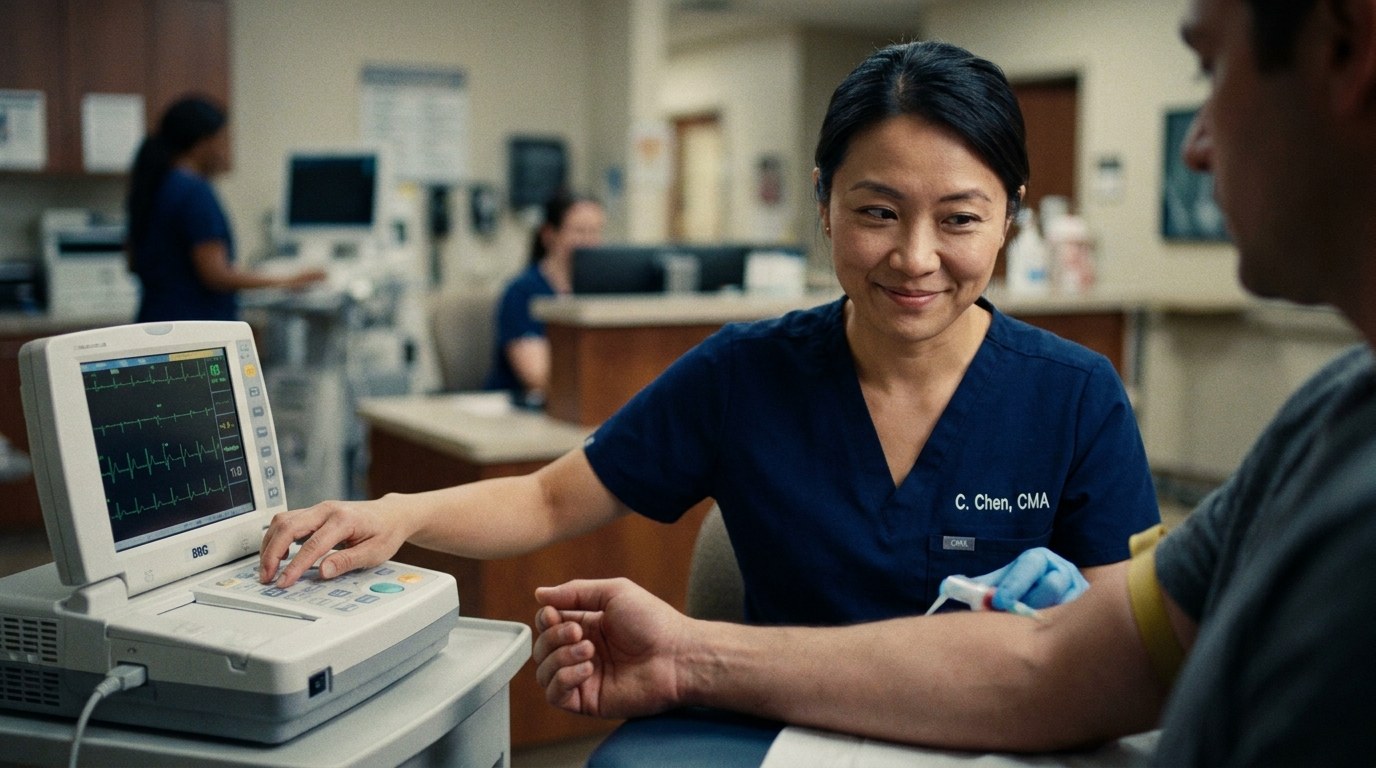
CNA training in Northern Virginia requires 150 clock hours to complete — and for many students in the DMV area, it’s the fastest, most accessible path into a healthcare career that pays from day one.
That’s the short answer. But for most people searching for CNA training in Northern Virginia, the real question isn’t just “how long does it take?” It’s closer to: “Is this actually something I can do — and will it be worth it?”
This article walks you through exactly what the journey looks like: the self-doubt at the start, the week-by-week reality of a 150-hour program, what the Virginia state board exam actually tests, what life looks like after you’re licensed, and how to know whether this path is right for you.
Ready to skip ahead? Apply to AVI Career Training now or call (703) 943-9841 to speak with an admissions advisor.
- Virginia requires 150 clock hours of state-approved Nurse Aide training before you can sit for the certification exam
- The Virginia Nurse Aide Competency Evaluation is administered by Pearson VUE and includes a written test and a hands-on clinical skills evaluation
- On a full-time schedule, students can be exam-eligible within weeks — not months or years
- CNAs in Northern Virginia work in hospitals, long-term care facilities, and home health agencies across Fairfax County, Arlington, and the DC metro area
- A CNA credential is also a recognized stepping stone toward LPN and RN pathways
- ⚠️ Federal financial aid (FAFSA) is NOT available for programs under 600 hours — see the enrollment section for payment options
—
Why She Almost Didn’t Enroll — And What Changed Her Mind
Most people who end up thriving as CNAs almost talked themselves out of it first. That’s not a cliché — it’s the most common thing career advisors in Northern Virginia hear.
Meet Danielle. She was 34, working a retail job in Fairfax County, and quietly burned out. She’d been caring for her mother through a health crisis for two years — handling medications, coordinating with nurses, learning more about patient care than she ever expected. When her mother recovered, Danielle had a thought she kept brushing aside: “Maybe I should do this for real.”
But the doubts piled up fast.
*”I don’t have a medical background.”
“I’m not young enough to start over.”
“I can’t afford to go to school for years.”
“What if I fail the exam?”*
What finally changed her mind wasn’t a brochure. It was finding out that Virginia’s Nurse Aide program is 150 hours — not two years, not four. That a full-time schedule could get her exam-eligible in a matter of weeks. That the credential was real, stackable, and immediately employable in Fairfax County, Arlington, and across the DC metro area.
She enrolled. She passed her boards. She was working in a hospital within 90 days of starting her training.
If any piece of Danielle’s story sounds familiar, keep reading. The path from doubt to licensed is more straightforward than most people assume — and understanding the structure of the training is usually the thing that tips the scale.
by Virginia
State Board Exam
Full-Time Timeline
CNAs in the Region
—
What CNA Training in Northern Virginia Actually Looks Like (Week by Week)
The state of Virginia requires 150 clock hours of approved Nurse Aide training — and that number tells you something important: this is a focused, practical credential, not a sprawling academic degree.
Here’s what those 150 hours break down into:
Phase 1: Classroom and Theory (Weeks 1–2)
The first portion of your training covers the knowledge foundation every Nurse Aide needs. You’ll study:
This phase typically runs 5–6 hours per day on a full-time schedule. By the end of week two, most students say the volume of material starts to click — especially once you see how it connects to real patient scenarios.
Phase 2: Hands-On Skills Lab (Weeks 2–3)
This is where training shifts from knowing to doing. In a supervised lab setting, you practice the clinical skills that will be tested on your state board exam:
The skills lab environment is intentionally repetitive. Instructors will have you run through the same skills multiple times because muscle memory under pressure is what the clinical evaluation tests.
Phase 3: Supervised Clinical Practicum (Weeks 3–4)
Virginia law requires that your training include a supervised clinical practicum in an actual care setting — typically a nursing home or long-term care facility. This is where the 150 hours become real.
You’ll work alongside licensed nurses, providing direct patient care under supervision. Most students describe this phase as the most nervewracking and the most rewarding part of training. It’s where Danielle — and countless students like her — realized they could actually do this.
Full-time schedule math: At approximately 30–35 hours per week, a student can complete all 150 hours in 4 to 5 weeks. Part-time options extend that timeline but keep the same structure.
—
The Virginia State Board Exam: What to Expect and How to Prepare
The Virginia Nurse Aide Competency Evaluation is the milestone that stands between you and your CNA certification in Northern Virginia — and knowing exactly what it tests removes most of the fear around it.
The exam is administered by Pearson VUE on behalf of the Virginia Board of Nursing. It has two distinct parts, and you must pass both to become certified.
Part 1: The Written (or Oral) Knowledge Test
The written exam covers everything from your classroom and lab phases: patient care principles, safety procedures, communication, residents’ rights, and basic anatomy. For students who struggle with standardized testing, Virginia offers an oral version of the test — an option worth knowing about if test anxiety is a concern.
The exam is computer-based at Pearson VUE testing centers. Most students sit for it within a few weeks of completing their 150-hour program.
Part 2: The Clinical Skills Evaluation
This is the hands-on portion. You’ll be evaluated by a trained observer as you perform 5 randomly selected clinical skills from the standard skills list. Common tested skills include:
Each skill is scored on a precise checklist. You must complete each step in the correct sequence. This is why the repetitive skills lab training matters so much.
Important Exam Rules to Know
- You must pass both parts within 24 months of completing your training program
- A criminal background check (fingerprinting) is required for Virginia CNA certification — start this process early
- If you don’t pass one part, you can retake that section without retaking both
- Virginia’s Nurse Aide Registry confirms your certification status to employers — most Fairfax County and DC metro employers verify this before hiring
Strong exam prep programs build state board readiness into every week of training — not just the final days before testing. Students who practice each clinical skill to the point of automaticity consistently outperform those who cram.
—
What Life Looks Like After Getting Licensed in Northern Virginia
Passing your boards isn’t the finish line — it’s the starting line. And the Northern Virginia job market for certified CNAs is one of the strongest in the country.
Where CNAs Work in the Fairfax/Arlington/DC Metro Area
Northern Virginia sits at the intersection of dense healthcare infrastructure and a rapidly aging population. Certified Nurse Aides in this region find employment across multiple settings:
What CNAs Earn in Virginia
According to the U.S. Bureau of Labor Statistics, nursing assistants in the Washington-Arlington-Alexandria metro area earn a median hourly wage that consistently outpaces the national average — driven by the high cost of living and healthcare worker demand in the DMV area.
Entry-level CNAs in Northern Virginia typically start in the range of $16–$20 per hour, with experienced CNAs and those working night or weekend shifts often earning more. Hospitals and acute care settings generally pay at the higher end of this range.
The CNA Credential as a Career Ladder
Here’s what many first-time CNA students don’t fully appreciate until they’re already working: your CNA certification is stackable.
It’s widely recognized as the fastest on-ramp into healthcare — and many nurses started exactly where you’re starting. The CNA credential gives you:
For career changers who want to move into healthcare without a multi-year commitment before their first paycheck, this is a meaningful advantage. You train for weeks, you certify, you work — and the door to further advancement stays open the entire time.
—
Is This Path Right for You? Here’s How to Know
CNA training in Northern Virginia works best for specific types of students — and being honest about whether you’re one of them will save you time and frustration.
You’re a strong candidate if:
Common objections — answered honestly:
“I’m not sure I’m smart enough.”
The Virginia Nurse Aide exam tests practical skills and applied knowledge — not abstract test-taking ability. Students who struggle with traditional academics often excel in hands-on clinical environments.
“I don’t have healthcare experience.”
Neither did most CNAs before they started. The 150-hour program assumes no prior experience.
“I’m worried about the background check.”
Virginia requires fingerprinting and a criminal background check. Certain convictions can affect eligibility. If this is a concern, consult directly with the program before enrolling — honesty early saves everyone time.
A Note on Tuition and Payment Options
Federal financial aid (FAFSA / Title IV) is NOT available for this program. Because the Nurse Aide program is under 600 hours, it does not meet the minimum threshold for federal student aid eligibility.
This does not mean cost is a barrier — it means you need to plan differently. Options include:
- Payment plans — ask about structured monthly payment arrangements
- Private financing — third-party education financing options may be available
- Employer tuition assistance — some hospitals and long-term care facilities in Fairfax County offer CNA training reimbursement for new hires
- Workforce development funding — Virginia’s workforce boards sometimes offer training grants for in-demand healthcare credentials; check with your local Workforce Innovation and Opportunity Act (WIOA) office
The total program cost is a fraction of a traditional degree — and for most students, a single month of CNA employment earnings begins to offset it immediately.
Ready to take the next step? Apply to AVI Career Training now or call (703) 943-9841 to speak with an admissions advisor about your options.
—
Frequently Asked Questions About CNA Training in Northern Virginia
Q: How long does CNA training take in Virginia?
A: Virginia requires 150 clock hours of state-approved Nurse Aide training. On a full-time schedule of 30–35 hours per week, students can complete all 150 hours in 4 to 5 weeks and become exam-eligible shortly after.
Q: How much does CNA training cost in Northern Virginia?
A: CNA program costs vary by provider, but they are generally far lower than multi-year degree programs. Federal financial aid (FAFSA) is NOT available for programs under 600 hours. Payment plans and private financing options are the primary paths most students use. Contact AVI Career Training at (703) 943-9841 for current tuition information.
Q: What do you need to become a CNA in Virginia?
A: You need to complete a Virginia-approved 150-hour Nurse Aide training program, pass both parts of the Virginia Nurse Aide Competency Evaluation (administered by Pearson VUE), and pass a criminal background check including fingerprinting. No prior healthcare experience is required to enroll.
Q: Is CNA training worth it in Virginia?
A: For most career changers, recent graduates, and people entering healthcare without a four-year degree, yes. CNAs in the Northern Virginia/DC metro area earn competitive hourly wages, face strong job demand across Fairfax County and beyond, and hold a credential that serves as a recognized stepping stone toward LPN and RN advancement.
Q: Can I get financial aid for CNA training in Northern Virginia?
A: Federal financial aid (FAFSA/Title IV) is NOT available for CNA programs because they are under 600 hours. However, WIOA workforce grants, employer tuition assistance, and payment plans may help offset costs. Speak with an AVI admissions advisor to explore your options.
Q: Who administers the Virginia CNA exam?
A: The Virginia Nurse Aide Competency Evaluation is administered by Pearson VUE on behalf of the Virginia Board of Nursing. The exam includes a written (or oral) knowledge test and a hands-on clinical skills evaluation. Both parts must be passed within 24 months of completing your training program.
Q: Where can I find CNA jobs after training in Fairfax County?
A: Certified Nurse Aides in Fairfax County and Northern Virginia find work at hospitals, skilled nursing facilities, assisted living communities, home health agencies, and rehabilitation centers across the Tysons Corner area, Arlington, and the broader DC metro area. Demand for CNAs in this region is consistently high.
Q: Do I need prior healthcare experience to enroll in CNA training?
A: No. The 150-hour Virginia Nurse Aide program is designed to take students from zero experience to certification-ready. Career changers, recent high school graduates, and informal caregivers with no formal medical training enroll and succeed regularly.
—
Your Next Step Starts Here
You’ve read the whole journey. You know what the 150 hours look like, what the state board tests, and what a Northern Virginia healthcare career can offer. The only question left is whether you’re ready to start.
Apply to AVI Career Training Now →
Or call us at (703) 943-9841 to speak with an admissions advisor.
—
About AVI Career Training
AVI Career Training is a COE-accredited, SCHEV-certified career school located in Vienna, Virginia — in the heart of the Northern Virginia/Tysons Corner area, serving students across Fairf