Cosmetology School vs. a 4-Year Degree: Which Pays Off?
Cosmetology school gets you licensed and earning in a fraction of the time — and at a fraction of the cost — of a traditional four-year degree. That’s not a sales pitch; it’s a math problem. When you stack real tuition numbers, realistic timelines, and actual earning trajectories side by side, the comparison tells a clear story for a specific type of person: someone who wants to build a real career with their hands, on their own schedule, without six figures of debt.
If you’re weighing these two paths right now — especially here in Northern Virginia — this article breaks it all down honestly. No fluff, no vague promises.
Key Takeaways
- Virginia requires 1,000 hours of cosmetology training before you can sit for the state board exam.
- A 4-year public university costs $37,000–$44,000 in tuition alone — before room, board, or fees.
- Cosmetology programs can be completed in significantly less than one year, getting you earning years ahead of a college graduate.
- The U.S. median wage for cosmetologists is ~$33,000–$35,000 (BLS), but booth renters, specialists, and salon owners regularly earn well beyond that.
- AVI Career Training in Vienna, Virginia is COE-accredited, SCHEV-certified, and accepts financial aid and the GI Bill®.
—
What Each Path Actually Looks Like
What Each Path Actually Looks Like
These two paths have almost nothing in common — and that’s the point.
The 4-year degree path means four years of full-time enrollment, thousands of hours of coursework in a broad curriculum, and a diploma at the end. For most fields, that diploma is the minimum entry ticket. You’re not practicing your craft on Day 1 of your first job — you’re still proving yourself. And you’ve spent four years and tens of thousands of dollars before your first paycheck arrives.
The cosmetology school path is built around a specific, measurable skill set and a concrete regulatory milestone: the Virginia State Board exam. From the first week of school, you’re in a hands-on environment — cutting, coloring, styling, and treating real clients under licensed instructor supervision. Your credential isn’t a general diploma; it’s a Virginia cosmetology license that qualifies you to work anywhere in the state.
Here’s a side-by-side comparison:
| Factor | Cosmetology School | 4-Year Degree |
|---|---|---|
| Time to credential | Tied to 1,000-hour requirement (Virginia) | Minimum 4 years |
| Type of credential | Virginia state license | Bachelor’s degree |
| Training format | Hands-on, client-facing from day one | Classroom-heavy, practical experience varies |
| Tuition cost range | Substantially lower; financial aid available | $37,000–$100,000+ in tuition alone |
| Entry-to-career speed | Among the fastest in skilled trades | 4+ years minimum |
The paths aren’t competing on the same terms. One is built for breadth; the other is built for speed, skill, and immediate career entry.
—
The Real Cost of a 4-Year Degree vs. Cosmetology School
The headline number for college tuition doesn’t tell the whole story — and the full story is significantly more expensive.
According to College Board data, the average in-state tuition at a public four-year university runs approximately $37,000–$44,000 over four years — and that’s tuition only. Add room and board, fees, textbooks, and transportation, and the total cost of attendance frequently exceeds $100,000. Private universities push that figure even higher, with tuition alone ranging from $55,000 to $100,000+ for a four-year program.
Cosmetology programs represent a dramatically smaller investment. While AVI Career Training’s tuition is best discussed directly with our admissions team, the category-wide cost is a fraction of a university degree. More importantly, financial aid is available at AVI — including federal Title IV aid through FAFSA — and AVI accepts the GI Bill® for eligible veterans and service members.
But there’s a cost that most comparisons miss entirely: opportunity cost.
Every year spent in a four-year program is a year you’re not earning income, not building a client base, and not accumulating professional experience. For someone entering cosmetology, that gap is enormous. Four years of industry experience — building clientele, developing technical speed, earning referrals — is genuinely valuable in a field where your reputation and your hands are your business.
A career-changer in their late 20s going back to a four-year program doesn’t just spend tuition money; they spend four years of career momentum. That’s rarely accounted for in the comparison.
—
How Fast Can You Start Earning? (Timeline Comparison)
Speed-to-income is one of the most concrete advantages cosmetology training offers — and in Virginia, it’s tied directly to a specific number.
Virginia requires 1,000 hours of cosmetology training to sit for the state board exam, as administered by the Virginia Department of Professional and Occupational Regulation (DPOR). Once you complete your program and pass both the written and practical components of the Virginia State Board exam, you hold a Virginia cosmetology license. You can begin working immediately — in a salon, a spa, a hotel, a cruise line, or on your own.
AVI Career Training’s Cosmetology program is built around this 1,000-hour benchmark. You’re not completing a general liberal arts curriculum before you get to your field. Every hour in the program counts directly toward the credential you need.
Compare that to a four-year degree:
For cosmetology, the math is simpler and faster. Complete your 1,000 hours, pass your boards, and you’re licensed. The Northern Virginia and DC metro market — one of the most affluent and densely populated regions in the country — offers serious demand for skilled cosmetologists. Getting into that market three or four years sooner isn’t a small advantage.
> Mini-Story: Meet Camille
> Camille was 29, working an office job in Tysons Corner that paid the bills but left her exhausted and unfulfilled. She’d always loved doing hair — for herself, for friends, for anyone who’d sit in her kitchen. When she looked at going back to school, she briefly considered a degree in business or marketing. Then she ran the numbers. A 4-year degree would cost her four more years of time, tens of thousands of dollars, and a degree that didn’t directly relate to what she actually wanted to do. She enrolled in AVI’s Cosmetology program instead. Within a year, she’d completed her 1,000 hours, passed her Virginia State Board exam, and was working at a salon in McLean building a loyal clientele — before her college-track peers had finished their sophomore year.
Ready to find out how quickly you could be licensed? Apply to AVI Career Training today and speak with an admissions advisor about your timeline.
—
What Cosmetologists Actually Earn — and How High the Ceiling Goes
The “low-paying trade” stereotype about cosmetology doesn’t hold up when you look at the full earnings picture.
According to the U.S. Bureau of Labor Statistics (BLS), the median annual wage for hairdressers, hairstylists, and cosmetologists is approximately $33,000–$35,000. That’s the median — meaning half of all cosmetologists earn more than that figure. And here’s what that median number systematically misses: self-employed cosmetologists.
BLS median wage data is based largely on salaried employees. Booth renters, independent stylists, and salon owners frequently earn significantly more — and their income doesn’t show up accurately in the median. A cosmetologist who rents a booth and builds a strong client base in a high-income market like Northern Virginia or the DC metro area operates more like a small business owner than an hourly employee.

Here’s a more honest look at the earning trajectory:
Entry-Level (0–2 Years Licensed)
New cosmetologists working as salon employees — building clientele, developing speed, learning the floor — typically earn in the lower-to-mid range of the wage spectrum. This is the learning phase, and it’s temporary.
Experienced Practitioners (3–7 Years)
With a solid client base, a cosmetologist’s earning power grows substantially. Repeat clients, referrals, and the ability to command higher service prices all compound. In the Northern Virginia and DC market, where disposable income is high and appearance-conscious clientele is plentiful, experienced cosmetologists with loyal books are in genuine demand.
Specialists and Salon Owners (5+ Years)
Cosmetologists who develop specializations — balayage and color correction, extensions, keratin treatments, bridal styling — can command premium pricing for those services. Booth renters set their own rates and keep a much larger share of their revenue. Salon owners who grow a team and a brand move into an entirely different income category. The ceiling in this field isn’t set by a corporate salary band; it’s set by your clientele, your skill level, and your business acumen.
This earnings trajectory compares favorably to many four-year-degree fields — especially when you factor in that the cosmetologist started earning three to four years earlier.
> Mini-Story: Meet Darius
> Darius served eight years in the military and wasn’t sure what came next. He’d always had an eye for style and technique, and a mentor suggested he look at cosmetology seriously. He used his GI Bill® benefit at AVI Career Training, which meant his program cost him almost nothing out of pocket. He completed his 1,000 hours, passed his Virginia State Board exam, and started working at a high-end salon in Arlington. Within three years, he’d developed a specialty in men’s cuts and fades that built him a clientele that booked weeks out. At that point, he was earning more than many of his military peers who went back to a traditional four-year university.
If you’re a veteran or service member, AVI accepts the GI Bill® — contact our admissions team at (703) 943-9841 or start your application here.
—
Virginia Cosmetology Licensing: What You Actually Need to Know
Understanding Virginia’s licensing requirements is essential to making an informed decision — and most national comparison articles skip this entirely.
In Virginia, anyone who wants to practice cosmetology professionally must hold a Virginia cosmetology license issued through the Virginia Department of Professional and Occupational Regulation (DPOR). To be eligible for the license, you must:
1. Complete 1,000 hours of training at a state-approved cosmetology school
2. Pass the written exam administered by the Virginia State Board of Cosmetology
3. Pass the practical exam administered by the Virginia State Board of Cosmetology
That’s the full path. No four-year degree required. No general education credits. No thesis. Complete your 1,000 hours at an approved program, pass both board exams, and you’re licensed to practice professionally in the Commonwealth of Virginia.
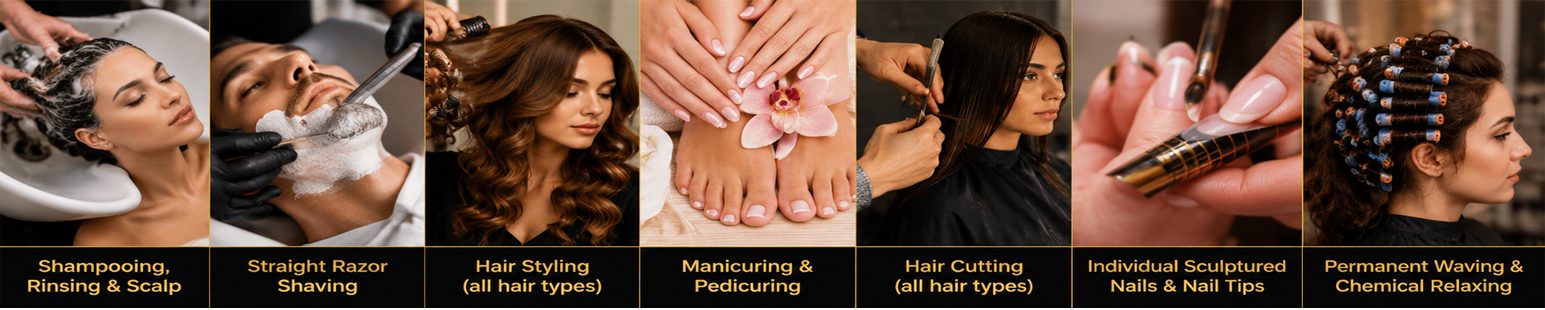
AVI Career Training’s Cosmetology program is structured to prepare you for both components of the state board exam. Our curriculum covers the full scope of cosmetology services — hair cutting, coloring, chemical services, skin care, nail care, and salon business fundamentals — so you walk into your board exam prepared, not guessing.
AVI is accredited by the Council on Occupational Education (COE) and certified by the State Council of Higher Education for Virginia (SCHEV). These aren’t just credentials on a wall — they’re what make federal financial aid available to our students and what signal to employers that your training met rigorous educational standards.
For the official Virginia licensing requirements, you can verify current standards directly on the Virginia DPOR Cosmetology Board website.
—
When Cosmetology School Is the Smarter Investment
Cosmetology school isn’t for everyone — and it doesn’t need to be. But for a specific type of person, it’s a dramatically better return on investment than a four-year degree.
Cosmetology school tends to be the smarter path when:
AVI Career Training, located at 1595 Spring Hill Rd #720 in Vienna, Virginia, sits in the heart of this market. Our students train in a facility that mirrors a real salon environment, work on real clients from diverse backgrounds, and graduate knowing they can serve every hair type and skin tone — which matters enormously in the culturally rich Northern Virginia and DC metro region.
That last point is worth saying plainly: AVI’s curriculum is built to train cosmetologists who can work beautifully on every skin tone and every hair texture. That’s not a selling point — it’s a professional standard. Stylists who can serve a diverse clientele confidently are more valuable in this market, full stop.

—
Frequently Asked Questions
Q: Is cosmetology school worth it financially?
A: For the right person, yes — and the numbers support it. Cosmetology programs cost a fraction of a four-year degree, take far less time to complete, and get you earning years earlier. In a high-income market like Northern Virginia, experienced cosmetologists with strong clientele earn well above the national median.
—
Q: How long does it take to become a licensed cosmetologist in Virginia?
A: Virginia requires 1,000 hours of cosmetology training at a state-approved school. After completing your hours, you must pass the written and practical exams administered by the Virginia State Board of Cosmetology through the Virginia Department of Professional and Occupational Regulation (DPOR). The total timeline depends on your program’s schedule, but cosmetology licensing is achievable in significantly less time than a four-year degree.
—
Q: Can you make a good living as a cosmetologist?
A: Yes — especially beyond entry level. The BLS median is ~$33,000–$35,000, but that figure undercounts self-employed earnings. Booth renters, specialists in color or extensions, and salon owners in strong markets like Northern Virginia and the DC metro area regularly earn considerably more. Your income potential scales with your clientele, your skills, and your business decisions.
—
Q: What’s the difference between a cosmetology program and a degree program?
A: A cosmetology program is a focused, hands-on training program built around a specific state licensing requirement — in Virginia, that’s 1,000 hours. A degree program is a broad academic curriculum that typically takes four years and results in a bachelor’s degree. Cosmetology training is faster, more affordable, and directly tied to a professional license. A four-year degree is broader and better suited to fields that require it.
—
Q: Do cosmetologists need a college degree?
A: No. In Virginia, cosmetologists need a state license — not a college degree. That license requires completing 1,000 hours of training at a state-approved school and passing the Virginia State Board written and practical exams. A college degree is not part of that requirement at any stage.